
A Directorless Catastrophe
Harder Truths About Who Is Actually In Charge

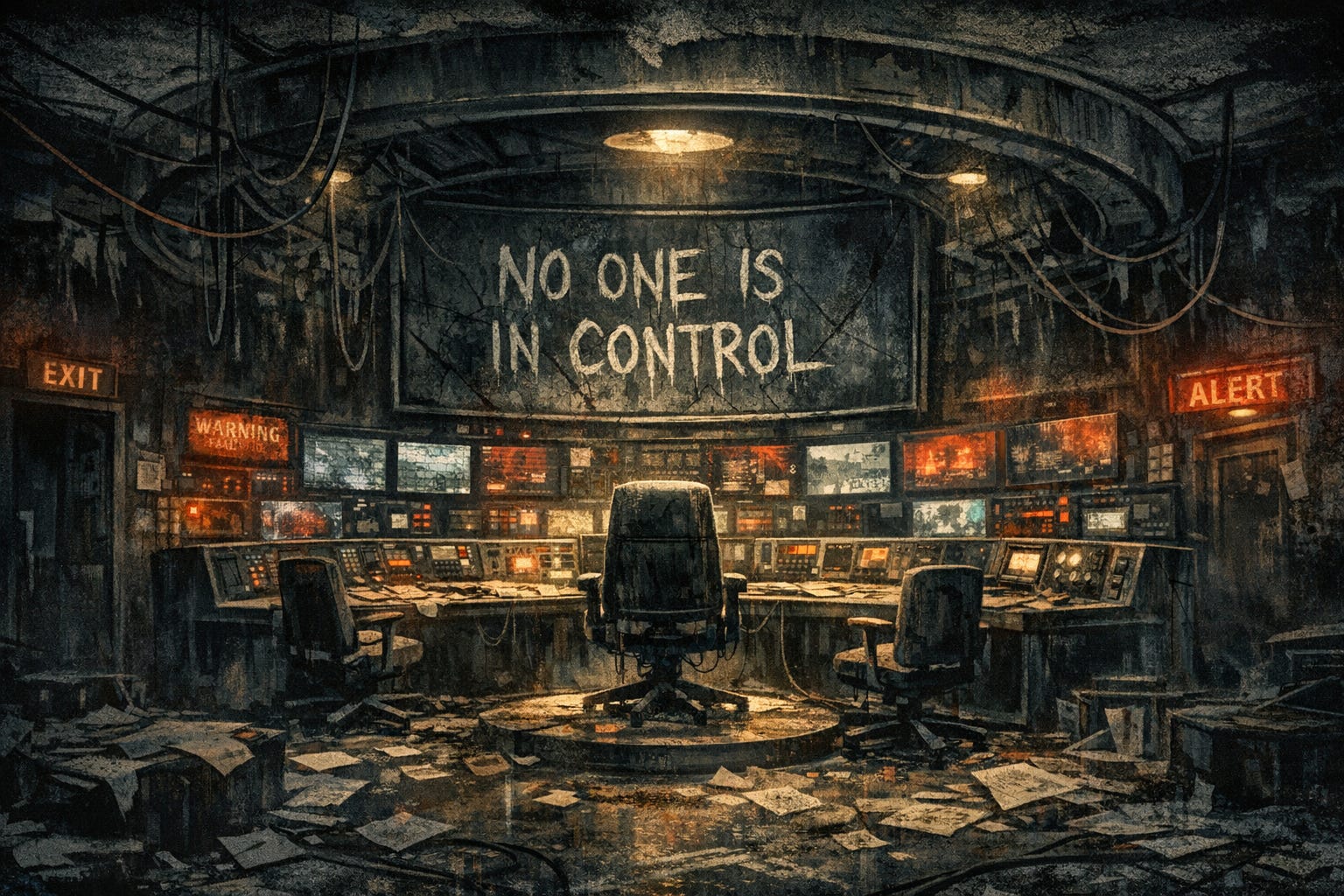
The Question Everyone Is Asking
Something has gone badly wrong. Most people can feel it. The institutions we learned to trust because we could — governments, courts, media, and international bodies — seem unable or unwilling to address what is plainly happening. They are no longer up to the task we set for them, which was to safeguard and care for the whole of society. Wealth now concentrates upward with mechanical regularity. Wars are prosecuted in our name for reasons that fracture under scrutiny. The planet burns while summits produce communiqués. And the gap between what is said and what is done grows wider every year.
So people reach for an explanation. And the explanation that feels most adequate to the scale of the harm being done is that there must be someone doing this deliberately. The deep state. The Zionist lobby. The Illuminati. Davos. Palantir. The Great Reset. The names change. The fantasy stays the same — a hidden hand, a secret room, a plan to which we’re not privy.
Governments know this feeling too. They are in the same boat. Confronted with forces they can’t name, can’t control, and can’t explain to their citizens, they reach for the same instinct — not conspiracy but its institutional twin: greater control, more surveillance, increased authority, tighter borders, and stronger executives. The citizen reaches for a villain. The stake reaches for a lever. Both are responses to the same vertigo — the dawning, unacceptable sense that nobody is actually steering. Both mistake the symptom for the disease. And both, in their different ways, make matters worse.
I have spent the better part of five decades working with governments, intelligence agencies, corporations, and heads of state across the Asia-Pacific, the Middle East, and the Global South. I have sat in enough rooms with enough powerful people to say this with some confidence: the conspiracy theories are wrong about the mechanism, but they are not wrong that something is broken. The instinct driving them — that the official explanation is insufficient, that the damage is too systematic to be accidental — is sound. The diagnosis is not.
The truth is harder. And it requires us to look at something more disturbing than a cabal.
What Is Real, and What It Actually Means
Before we go deeper, the named forces deserve their due—because some of them are genuinely powerful, and dismissing them entirely is its own kind of blindness.
The pro-Israel lobby in the United States, centred on AIPAC, is not a myth. In the 2024 electoral cycle, it spent over $100 million on congressional races, successfully removing progressive members of Congress who had criticised Israeli conduct in Gaza. It has funded candidates on both sides of the aisle, operates through affiliated super PACs to obscure the money trail, and has demonstrably shifted American foreign policy away from the preferences of the American public. This is a documented, legal, and legitimate crisis for democratic representation. What it is not is evidence of a global Jewish conspiracy — a vicious, centuries-old fantasy that has served as a precursor to genocide and which collapses the moment it meets actual evidence. The lobby is powerful and real. The mythology built around it is dangerous and false.
Palantir is real. A data-infrastructure company whose contracts span the CIA, NSA, ICE, the NHS, and dozens of intelligence services worldwide, it is building – openly and by design – the informational substrate of twenty-first-century governance. Its founders believe they are constructing the architecture of a new kind of state. They may be right. That’s not a conspiracy. It is a business model that has civilisational consequences.
The deep state is real in its mundane form — career intelligence, military, and regulatory professionals who develop institutional cultures, policy preferences, and resistance to disruption. Large bureaucracies have their own gravitational fields. What they don’t have is the coordination, coherence, or unified purpose that a conspiracy requires. The mundane version is real. The shadowy omnipotent version is a projection. Likewise, the World Economic Forum is real — a coordination mechanism for global capital, genuinely influential, and genuinely unaccountable to any electorate. The microchip fantasies attached to it are not.
So: real power, operating in the open, defended by legal frameworks it helped write. Acknowledge it, scrutinise it, resist it where necessary. But do not mistake it for the deepest force at work. These are symptoms. The disease is something else entirely.
The Operating System Nobody Voted For
Industrial economism didn’t arise from a conspiracy. It’s not the evil machinations of the Rothschilds, or anyone else for that matter. It emerged through the confluence of Enlightenment logic, fossil fuel energy surplus, colonial resource extraction, scientific realism, and the institutional crystallisation of all those patterns into law, finance, and statecraft. By the mid-twentieth century it had become the tacit assumption beneath every political disagreement — the water in which all ideological fish swim, left and right alike.
Its core axioms run something like this: growth is health, efficiency is virtue, nature is a resource, the future can be discounted, and the human being is primarily a unit of production and consumption. These axioms are not written down anywhere as policy. They are encoded into accounting systems — GDP counts pollution cleanup as economic growth. They are encoded into investment logic — fiduciary duty runs to shareholders, not to ecosystems. They are encoded within legal personhood — corporations hold rights but carry no obligations to living systems. And they are encoded in the temporal horizons of democratic politics — four-year electoral cycles set against hundred-year ecological consequences.
The force, understood at a civilisational scale, is the gap between what this system can perceive and what it’s actually doing. Industrial economism is constitutionally incapable of registering the consequences it produces across the boundaries of generation, species, and geography. Not because anyone decided to make it blind. But because you can’t optimise a complex system for a narrow set of variables—profit, growth, and quarterly return—without becoming structurally indifferent to everything else. The blindness is not a bug. It’s how the machine was built.
Replace the billionaires, dissolve the lobbies, redistribute the wealth — and if this operating logic remains intact, the machine regenerates the same outcomes with different faces at the controls. This is what makes the conspiracy framing not just wrong but actively obstructive: it directs outrage at the operators when the problem is the operation itself.
The Planetary Emergency Is Not a Metaphor
Seven of the nine planetary boundaries that safeguard Earth’s stability have now been breached. Planetary boundaries are scientifically defined limits — for climate, biodiversity, freshwater, land use, chemical pollution, and others — within which human civilisations have always operated, and beyond which the conditions for civilisation begin to unravel.
The 2025 Planetary Health Check, published by the Potsdam Institute for Climate Impact Research, finds that the planet is now in the upper end of the danger zone, pushing toward the high-risk zone where tipping points — the collapse of major ice sheets, the dieback of the Amazon, and the shutdown of the ocean currents that regulate temperature across the northern hemisphere — become probable rather than possible. The window for course correction remains open. It’s closing rapidly.
Only two boundaries remain within the safe zone. The partial recovery of the ozone layer — one of the very few times industrial civilisation has successfully reversed a planetary-scale transgression — required international coordination, simple chemistry, and affordable alternatives. What we face now is orders of magnitude more entangled with the entire architecture of the global economy.
What makes this moment historically unlike any previous civilisational crisis is synchronicity. The Bronze Age collapse, the fall of Rome, and the Black Death — each was devastating but sequential, regional, and operating within a stable planetary system. What is underway now is the simultaneous entanglement of ecological breakdown, institutional failure, democratic erosion, technological disruption, and geopolitical realignment — each crisis accelerating the others, all of them unfolding on a planet whose life-support systems are themselves under stress.
This is not a series of problems that can be dealt with separately. It is one predicament — a civilisation eating itself alive, too committed to its own appetites to care what it’s consuming.
Polycrisis
There is a word for this now: ‘polycrisis’ — the simultaneous breakdown of multiple interconnected systems, each failure crashing into and hastening the others, the combined danger greater than any single crisis alone.
The V-Dem Democracy Report documented that in 2025 nearly a quarter of the world’s countries were undergoing democratic backsliding – including several in Europe and North America. In the United States, a respected political science project classified the federal government as a non-democracy in February 2025, citing the concentration of executive power. These are not isolated political events. Democratic erosion and ecological breakdown share the same root: a system that cannot generate long-horizon, collective-obligation thinking, because short-term private interest is what it natively produces. The two crises are expressions of the same underlying failure.
A New Technocratic Order
Against this backdrop, a specific and genuinely dangerous force deserves naming.
What is emerging around figures like Peter Thiel, Elon Musk, and the network of technologists and investors aligned with them is not simply a political tendency. It’s an attempt at civilisational succession — an effort to replace the democratic-bureaucratic state with governance by technical optimisation, in which populations are managed rather than represented. Palantir’s surveillance infrastructure, the intellectual programme of the neoreactionary movement — which argues explicitly that democracy should be replaced by corporate-style technocratic rule, and the concentration of artificial intelligence capability in three or four corporate entities and the accelerating merger of data systems with state power are the visible facets of a single emergent architecture.
This requires no secrecy. It requires only that the logic of efficiency be accepted as self-evidently superior to the messiness of democratic deliberation — a claim that grows more persuasive to ordinary people exhausted by constant institutional failure. The technocratic order sells itself as the solution to the very dysfunctions the operating system produces. It feeds on the wreckage of what it intends to replace.
The civilisational danger is precise: a transition from democratic-industrial to technocratic-authoritarian governance would remove the last institutional pressure points capable of generating a genuine response to the planetary emergency. Technical optimisation within the current objective function is not civilisational reorientation. It would make the machine more efficient at doing exactly what it’s already doing. Which is precisely the problem.
How We Lost the Ability to Think Together
No account of this moment is complete without addressing what has happened to the shared space in which a society thinks – the epistemic commons.
The attention economy — the structure in which human attention is the commodity traded between users, platforms, and advertisers — doesn’t simply distort information. It restructures cognition at scale. Outrage, fear, and tribal signalling generate engagement. Nuance, long-horizon thinking, and collective obligation do not. The result is not just misinformation. It’s the systematic destruction of the cognitive conditions required for a civilisation to govern itself.
A society facing planetary-scale emergencies needs the capacity for collective deliberation about complex, slow-moving, deeply uncertain yet dynamic systems. The attention economy selects against every one of those capacities — simply through the same extractive logic applied to every other commons: take what generates return, externalise the cost, and move on.
The proliferation of conspiracy theories is a direct symptom of this destruction. When institutional authority collapses and the shared epistemic space fragments, the mind reaches for patterns — for agency, for narrative coherence, for a face behind the catastrophe. Conspiracy thinking is not folly. It’s a rational response to an environment that has been deliberately made irrational. The diagnosis it produces is wrong. The distress that drives it is entirely legitimate.
The Absent Obligation
What’s structurally missing across all of this is what I call the ‘third obligation’ – the duty not merely to those alive today, or to shareholders, or even to future generations of our own species, but to the living systems within which all human projects are embedded and on which all human futures depend.
Industrial economism has no mechanism for this obligation. Neither does representative democracy as currently configured. Neither does Chinese state socialism. Neither does any governance system with a seat at any table that matters. The temporal horizons of markets and electoral cycles are catastrophically misaligned with the scale of ecological and civilisational consequence. We are making — mostly by default, mostly by inertia — the decisions that will determine the conditions of human life for the next thousand years. And we are making them with institutional tools designed for a world that no longer exists.
The Window
Following the last ice age, for more than ten thousand years, humanity enjoyed a period of climatic stability and resilient ecosystems — the Holocene. Every civilisation in human memory was built within it. Its stable temperatures, reliable rainfall, and productive soils were not a backdrop to human history. They were its precondition. That stability is now the thing being consumed.
The real collision — the one that dwarfs every named suspect — is between a civilisational operating system optimised for the Holocene and a planet that’s leaving the Holocene behind. Between the institutional architecture of the twentieth century and the challenges of the twenty-first. Between the temporal horizons of every existing power structure and the compressed window within which the decisions that determine everything are being made, most of them by nobody in particular.
There is no director. Nothing in the machine requires one. It will run without instruction, without malice, without pause — until the conditions that feed it are gone. Then it will stop. Not because anyone chose to stop it. Because there’s nothing left to take.
Neoliberalism. Named after the late 20th century economic theory that the rich should exercise total control over all aspects of society, and lie about it.
When the Neoliberals conquered the Earth, it wasn’t in face-to-face military battles like the ancient Romans or British used. Instead, the Neoliberals won by destabilizing and corrupting all competing power structures. Conquest is expensive. Tearing down is easy. To invade and occupy a nation-state would require planning, resources, and intelligence. To disrupt it? That only requires the technological high ground and a total lack of scruples. Destroy the power stations and water pumps. Sabotage their data networks, use your vast financial wealth to bribe political parties to betray their nation, block them from the international financial system, ensure that the mainstream media 24/7 slander and belittle and ignore the patriots.
The primary strength of the Neoliberals was their total lack of shame. You could catch them in lies, or contradictions, they could screw up totally, or rob you blind, and they wouldn’t care. They would just go on saying whatever they wanted to say and doing whatever they wanted to do. Neoliberalism is the application of power without moral restraint. You cannot debate them, you cannot reason with them. You can suck up to them and hope to be rewarded. You can do nothing and they will crush you into abject slavery. Oppose them in the slightest way, and they will destroy you by any means possible. Appeals to conscience are as useful as fighting cancer by asking for sympathy. Ultimately, the only winning strategy for dealing with Neoliberalism is to kill it
Turning attention to "the actual task — building the successor logic, the institutions, and the ways of measuring value and obligation — that make the current operating system's reproduction impossible" seems daunting, but must be mapped. Somewhat akin to a Doomsday Clock, but multifaceted, exposing the source data, participatory and gamified. The Doomsday Clock is about to have its 80th birthday, less than a decade before John McCarthy coined the term "Artificial Intelligence." AI can help with a project like this, but perhaps the biggest challenge in creating the necessary multiple DIKW pyramids is the erasure or prohibition of access to classes of raw data by authoritarian actors. That said, the ability to note where raw data has been censored is important in itself. Such an undertaking calls for the leadership of a tragic genius, a Shoeless Joe Jackson. Perhaps if you build it, he will come.