
A Life Without A Career
A temperament for openness and gratitude

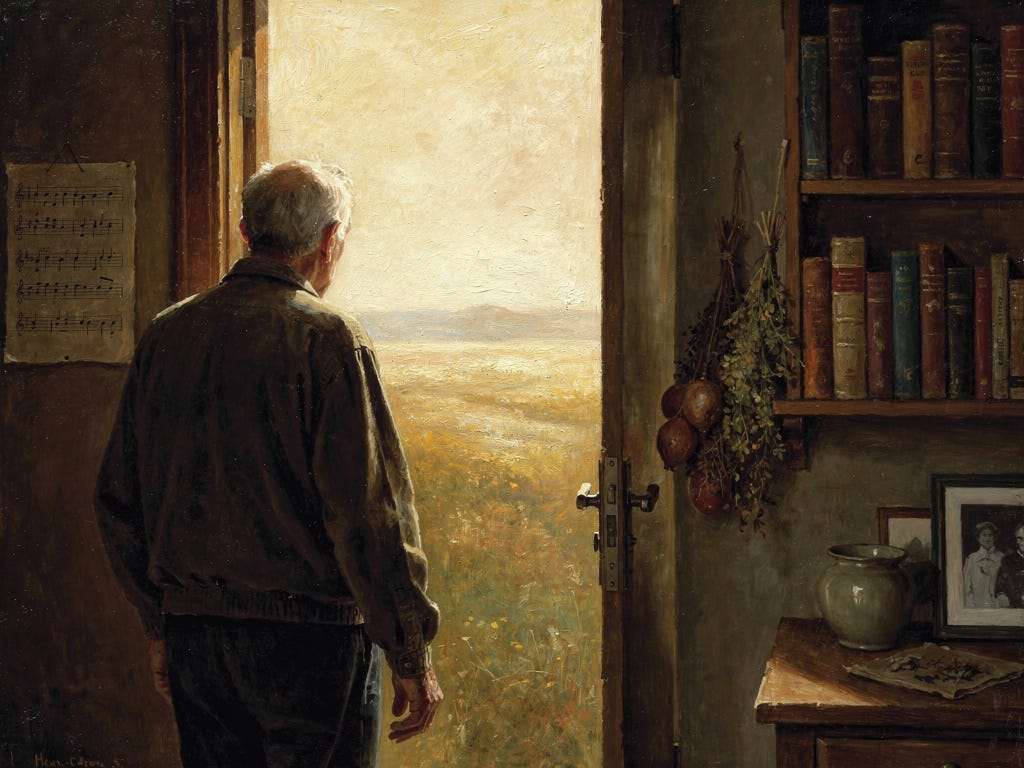
I am eighty years old, and I have never had a career. I have had a life — restless, digressive, occasionally embarrassing, frequently improbable — but not a career. The distinction matters more than it might appear. A career implies a trajectory, a recognised field, an accumulation of credentials pointing in a single direction. What I have had instead is a series of total absorptions, each one complete while it lasted, none of them planned, the connections between them visible only in retrospect and then only partially. Composer, teacher, physician manqué, an “accidental” futurist, taxi driver, philosopher, manager, mentor (pause for breath); adviser to governments and private enterprises across four continents; and author of more books than I can recite without hesitating. The thread running through all of it is not professional so much as temperamental. And beneath the temperament, if I am honest about what has actually driven the person rather than what the person has produced, it is something simpler and more ungovernable than any intellectual project: the need to love and be loved.
That is not how men of my generation typically account for their lives. We point to ideas, institutions, honours and achievements. The published work, the keynotes, the decades of advisory practice. Those things exist, and I don’t for one moment disown them. But they are the outputs from a life well-lived, not the source. The source has always been relational — specific people, encountered at specific moments, whose proximity changed what I was capable of seeing and becoming. Not through instruction. Hardly ever through the deliberate transfer of knowledge from one mind to another. Through something closer to osmosis: the slow, almost imperceptible transformation that occurs when two people are genuinely open to one another over time, when the membrane between self and influence becomes permeable enough that what passes through it cannot afterwards be cleanly identified or attributed. You don’t formally learn this way. You become.
What made this possible — indeed, what has made it possible across eight decades and without apparent diminishment — is a quality of consciousness I did not choose and can’t fully explain. It’s an aperture that has stayed open. Not through naivety, because I am aware of what openness costs. I have been betrayed three times by people I loved unconditionally. I have absorbed losses that most people, reasonably enough, would treat as instructions to want less, to admit less, and to protect the inner life by narrowing its exposure to the world. The narrowing never came. Whether this is a constitutional disposition, a decision made below the level of decision, or simply the inheritance of a woman who waited ninety-seven years for a man who never returned—I can’t say with certainty. Probably all three. What I can say is that the same capacity for pain and the same capacity for joy have always been, in me, a single gift. To close one has always meant closing the other. And the other was never something I was willing to lose.
This is, I have come to believe, also the actual mechanism of human formation – not curriculum but proximity, not instruction but relationship, not the career but the life lived alongside others with full devotion and full vulnerability. It is also, not coincidentally, the mechanism most comprehensively ignored by every institution we have built for the ostensible purpose of developing human potential. Schools, universities, professional bodies — all of them organised around the transmission model, the idea that knowledge is a substance that can be packaged, delivered, and assessed. All of them are structurally blind to the fact that the most significant transformations in a person’s intellectual and moral life happen sideways, in the margins, through sliding door moments and the specific quality of attentiveness one human being brings to another — and through the willingness to be changed by what that attention reveals.
Other than the birth of each of my children, I have had seven what I would refer to as ‘conspicuous transformations’. They came through my mother, through Peter Maxwell Davies, through W. Edwards Deming, through Elizabeth, through Suna, through Marvin Oka, and through my son Nico. None of them educated me in any institutional sense. Each of them, through the specific gravity of their presence, altered the orientation of my thinking or feeling so fundamentally that I can’t now reconstruct who I would have been without them. And in every case the transformation arrived not through any professional or pedagogical surface but through its human depth — through what became possible when I stopped managing the encounter and simply let it land.
My mother was the first and most enduring. She was a working-class woman from Norfolk Island who had entered domestic service at fourteen, raised by an aunt, and who carried that particular upbringing — practical, enduring, unsentimental about hardship and fiercely sentimental about love — throughout her entire life. When my father left, I was eight. She held what remained of our small family together with three concurrent jobs, a lodger taken in for extra income, and a refusal to accept “social security” along with another refusal so absolute it never required articulation to stop loving the man who had gone. She waited for him until she died at ninety-seven – blind by then, worn out in the most literal sense, but mentally present and, I believe, still expecting Jack to walk back through the door. I have turned this over in my mind for decades, and I no longer think it was delusion. I think it was a moral position. She had decided what love meant — that it was not a contract subject to renegotiation when the other party defaulted but a disposition of the self that, once given, was not retrievable. She held that position with a consistency that put to shame every more sophisticated account of human relationships I have since encountered.
I watched her keep hope open for fifty years after it had been given every reason to close. That’s the template I absorbed before I had language for it — not a lesson about love but a demonstration, enacted daily and without self-pity, of what it looks like to refuse the narrowing. I have spent my own life insisting on the same refusal, sometimes with her steadiness and sometimes without it, with results that have been by any conventional measure decidedly mixed. But the refusal itself has never felt optional. It’s the one inheritance I received without ambivalence.
The institution, when I eventually reached it, was less accommodating. The Royal College of Music awarded me a scholarship and expelled me two years later. The stated reason was impoliteness and disrespect. The actual reason was that I was constitutionally incapable of treating received authority as though it were the same thing as earned wisdom — a distinction the Royal College, in common with most institutions, preferred not to have drawn. Peter Maxwell Davies, already an anti-establishment figure of considerable creative and polemical force, found this rather entertaining. He took me on.
To work as an amanuensis to a composer of Maxwell Davies’s seriousness and originality was to enter the interior of a creative intelligence at full stretch — not as a student observing from a sanctioned distance but as someone present in the room where the thinking was happening, where the decisions were being made, where the revisions were occurring in real time. I was often at Barters Town, where Max lived with his cat Enid, in conditions of monastic creative intensity periodically interrupted by conversation – about art, politics, ethics, and the responsibilities of the serious artist to the society that would rather be entertained than disturbed – that I have rarely encountered since. The fire that took so much of what he had built there and drove him eventually to start again in the Orkneys was its own lesson in the relationship between catastrophe and renewal.
He commissioned Planh Super Carmen Gregorianum Ex Membrana Veteri Et Semilacera for instrumental ensemble, which was given its first performance by the Pierrot Players at the Akademie der Kunst in Berlin in May 1968. I learnt from him how to cook with fresh herbs and watercress and mushrooms we gathered from the fields. I learnt, more consequentially, that a life organised around creative integrity was not a romantic indulgence but the most exacting discipline available — answerable to standards no institution sets and no credential confers, and demanding a quality of candour about one’s own work that comfort and security actively corrode. What I received from Max, underneath the craft and the conversation and the politics, was something more fundamental: an undeviating understanding that authentic creative work requires keeping yourself open to the full range of what life’s experiences can do to you. The wound and the song, as a wiser tradition than ours has always known, are not opposites. To protect yourself from one is to lose access to the other.
Nadia Boulanger and Olivier Messiaen were a significant presence in that same period, as was Yvonne Loriod, Olivier’s pianist wife, who would prepare a tarte tatin for us when we returned to their apartment in Montmartre after a lengthy walk in the woods. But it was Max who showed me, by example rather than precept, what it costs and what it produces to refuse the accommodation that institutions perpetually offer in exchange for your most interesting and dangerous edges.
W. Edwards Deming arrived in my life, as the most consequential encounters tend to, entirely by accident. We met at a party — a gathering of London’s more avant-garde musical set, not the obvious habitat for a statistician who counselled corporations and composed liturgical music in his spare time. He was softly spoken, well-mannered, and slightly imperious about having been dragged there by his daughter. We exchanged pleasantries. He pressed his business card into my hand as he left. I pocketed it politely and thought nothing more of it until the following morning, when curiosity — that oldest expression of the open aperture — got the better of me. I made a phone call. Then another. What I had taken for a passing, inconsequential conversation turned out to be a portal into wholly unfamiliar territory.
Over the years that followed, Deming didn’t just introduce me to Total Quality Management or help rescue a company from the brink of bankruptcy, though he did both. He offered something considerably rarer: the relationship of a father figure to someone who had been navigating without one since the age of eight. I had always been wary, as an artist, of anything associated with corporations and the machinery of capital. What Deming’s proximity dissolved, gradually but without argument, was the assumption that the boundaries I had drawn between art and enterprise, intuition and rigour, creativity and systematic thought were anything other than self-imposed. The opposition blurred. What I had regarded as irreconcilable turned out to be partners in a strange new foxtrot. This was not an intellectual conversion. It was what happened when I stayed open to a relationship long enough to let it work on me — which is, I have come to understand, the only way any real conversion ever occurs.
The loves that followed were the continuation of that education by other means. Eight years with Elizabeth – a wild and generous intelligence, a genuine creative partnership, and a life that felt while it lasted like the closest I had come to what I actually wanted. She later worked alongside me at The Hames Group, which meant that what we had built personally became, in a different key, professionally generative as well. That is not a common thing. It requires a quality of trust—a willingness to be fully known by the person working beside you, to have your thinking challenged by someone who also knows your fears—that most professional relationships are carefully structured to prevent. What she gave me, in those years, was a capacity for a particular kind of giving: not the giving that keeps accounts, not the giving that expects reciprocity in a recognised form, but the giving that proceeds from genuine attention to another person’s actual nature. That I received this is inseparable from the fact that I was open enough to receive it—that I had not, despite what had come after twenty-three years of a marriage that slowly vanished, learned to ration my exposure to what another person could give.
Then Suna. I will not attempt to be brief about this because brevity would falsify it.
I encountered her by chance at a temple in Bangkok — Wat Pathum — during the Songkran festival and spent a weekend returning to the same café in Soi 33, waiting, before she appeared. Two months after that first almost dreamlike meeting, I left Melbourne and moved to Bangkok. I was in my mid-fifties. She had been born in 1981. The gap in years didn’t feel like a problem to either of us, though it looked like one from the outside, which we both found mildly amusing. What it felt like, from the inside, was the aperture opening further than it had opened in years — the particular quality of appreciation that arrives when you encounter something genuinely new and recognise it before you can explain what it is.
What followed was eighteen years of a transformation so total it’s difficult to isolate any single dimension of it. Language was one — learning to move through a culture whose entire structure of feeling, obligation, and social relation was organised on principles entirely unlike anything my own upbringing had prepared me for. The Thai family circle, once you are admitted to it, operates with a quality of collective care and lateral obligation that makes Western notions of the nuclear family look like a rather thin and brittle bargain. I learnt this not from books but from sitting in Suna’s home village of Ban Tha Rae near the Laos border, watching how a household eddies and settles, how laughter makes light of obligation, and how hospitality is not a virtue to be performed but simply the texture of how people move through the day. To absorb this required the same thing all genuine absorption requires: the willingness to be a stranger in one’s own assumptions, to sit with not-knowing long enough for something new to form.
My public work was at its peak during those years, and Suna travelled with me almost everywhere — France, Germany, Switzerland, Portugal, Italy, Scotland, Brazil, South Africa, China, Tibet, Cambodia, Vietnam, and Japan many times over. What I received from those journeys was not simply the world but the world seen through eyes that had not yet accumulated the protective coating that long familiarity deposits. In Brazil she tasted salami for the first time and pulled a face I still treasure. In Brighton she found the pebbled beach so comical — where was the sand? — that she laughed harder than any abundance of sun would have warranted. Each of these moments was a small restoration — the freshness of her encounter with the world reaching back and refreshing my own, which had grown accustomed to expecting what it already knew.
In Kyoto, in a city we had visited so often it had become a kind of second home, a message arrived about her nephew’s drowning. The world narrowed to a point. We flew back through tears and silence. Some losses redraw the map of a family permanently. That one did. And then, in 2011, Nico was born — perfectly himself from the first breath — and everything changed again, as it always does when a life for which you are responsible enters the world and immediately begins teaching you things no prior experience had prepared you to learn.
Marvin Oka arrived in my working life in the mid-nineties and became, over two decades of collaboration, something exceptional: an intellectual companion whose mind worked differently enough from mine to generate real productive friction and who trusted the friction rather than smoothing it away. We created substantial bodies of work together across multiple sectors and geographies, operating with a complementarity that occasionally baffled clients who expected a unified consultancy voice and received instead an Abbott and Costello double act, thinking out loud in public, disagreeing in real time, and arriving at positions that neither would have reached alone. What we built was not a methodology. It was a shared language, developed through years of actual practice with real stakes, that existed only in the space between us and could not have been extracted from either of us individually. What made it possible was the same thing that makes all genuine collaboration possible: the willingness to be changed by the encounter rather than merely enlarged by it.
And then Nico — my youngest son, nearly fifteen, whose education I have taken on directly because the institutions designed for the purpose were not, in any meaningful sense, designed for a mind like his. What he gives me — what the relationship gives me, which is not a symmetrical thing and is not intended to be — is a daily encounter with a way of perceiving the world that hasn’t been filtered through the assumptions that the rest of us have accumulated and long since stopped noticing. He asks the right question at the right moment – not the expected question, not the one that follows the conversational logic already established, but the question that arrives from a genuinely different angle and lands precisely in the middle of whatever I thought I was certain about. To receive that requires something specific: the willingness of a man of eighty to remain genuinely teachable, to hold the aperture open even — especially — to what arrives from the least expected direction.
What connects these seven is not that they were teachers in any accepted sense. None of them delivered a curriculum. None of them assessed my progress or conferred credentials for what I had absorbed. Each of them, through the specific quality of their presence and the specific nature of what passed between us, created conditions in which something in me could change that would not otherwise have changed. My mother through the model of her loyalty and labour. Max through proximity to a mind operating at full creative and moral stretch. Deming through the dissolution of a self-imposed opposition between art and business. Elizabeth through the practice of genuine giving. Suna through eighteen years of a world encountered freshly, a culture absorbed bodily, and a quality of attention that travel and love together produce in ways neither produces alone. Marvin through the productive friction of a complementary intelligence sustained across decades. Nico, through daily encounters, has a perception that has not yet learned to see only what it expects.
In every case, what I brought to the encounter — the only thing I consistently brought — was the refusal to close. That refusal is not a virtue I can claim credit for, any more than I can claim credit for the colour of my eyes. It is simply how I am made. But I have come to believe it’s also, in a very precise sense, how serious thinking is crafted. The mind that has protected itself too thoroughly from the full weight of experience — that has traded permeability for safety, deviance for conformity, openness for the comfort of settled conclusions — is not a more rigorous mind. It’s a deficient one. It has purchased its stability at the cost of the very sensitivity that makes genuine understanding possible.
This is why the argument running through the archive of my written work — about what a civilisational alternative to industrial economism might actually consist of — is not, finally, an argument about systems or institutions or policy frameworks, though it necessarily addresses all of those. It’s an argument about the kind of consciousness that any genuine alternative requires. Not the managed, defended, productivity-optimised self that the current operating system rewards and reproduces. But the self that has kept itself open to pain and pleasure in equal measure, that has allowed experience to work on it rather than simply accumulating experience as a credential, that understands — in the body as much as the mind — that the capacity for genuine care and the capacity for genuine thought are not separate faculties. They are, at their root, the same capacity.
My mother knew this. She just called it love, held three jobs to protect it, and waited ninety-seven years for it to be returned.