
Identity Shift
From Mastery of Task to Mastery of Thought

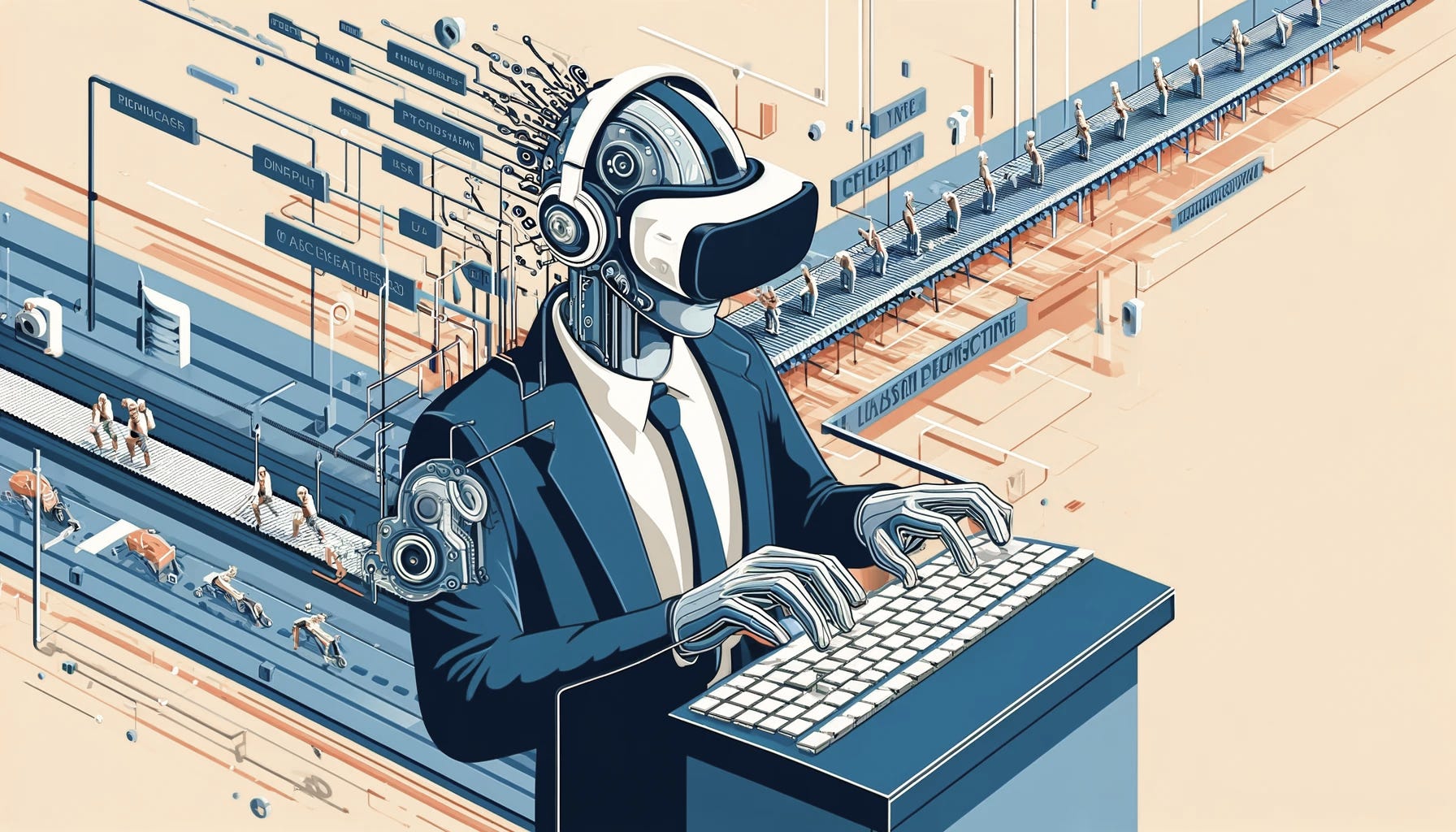
The real drama of what currently goes by the name of artificial intelligence is not economic. It is existential. For two centuries the modern self was built atop a single beam: the task you could do better than the next person. That beam is splintering. The carpenter who could eye a true line, the lawyer who knew cases by heart, the programmer who could sort the intractable—these identities were forged in repetition, in stubbornness, in the private storms of solving what resisted solution. Now an indifferent machine casually performs the trick in the blink of an eye and doesn’t even gloat. It simply moves on. We’re left confronting the thin story we mistook for a self: I am the sum of my outputs. Keep the spirit, change the grammar. You are not a bundle of tricks. You are that which you repeatedly choose under constraint, and the consequences you are prepared to carry. That is “doing” as enactment rather than production—conduct, not throughput—and it remains beyond the machine’s reach.
If that revision tightens your chest, you’ve touched the identity moment—when “doing” measured as output ceases to be the currency of self-worth. No doubt managers will continue to fret about productivity and employment; they are rearranging brochures while the foundations fracture. The myths surrounding the future of work are invariably misleading. Collapse is not that jobs go. It’s that the reward circuit of your being—competence sought, resistance encountered, mastery earned, dopamine dispensed—has been bypassed. Think of a climber who reaches the summit and learns the cable car opened yesterday. The view is the same. The meaning is not.
We can sentimentalise the struggle, or we can understand it. The long climb worked because difficulty functioned as an honest signal: I stayed, I endured, I earned the right to claim I did this. AI abolishes the signal by levelling the difficulty. When the signal goes, the identity tethered to production starts to unravel. That’s why the clever jokes about “prompt engineering” land like a bad aftertaste. We’re not mourning a keyboard shortcut; we are mourning a lineage of meaning. Machines did not steal our jobs. They stole the ritual through which we came to know ourselves—unless we relocate “doing” to the realm of authorship, where choice, constraint, and consequence still make us human.
The obvious response—raise regulatory sandbags around yesterday’s competencies—confuses obstruction with wisdom. This technological tide does not negotiate with nostalgia. Trying to preserve identity by outlawing the machine is like saving a candle by banning electricity. The better path is older, sterner, and personal. Buddhism says attachment is the root of suffering. Detach the self from the skill, and the loss of a task is no longer a mutilation of the individual. Confucian thinking adds the necessary steel: know your limitations and you become strong. In speed, precision, recall, you are outclassed. Admit it or be devoured by denial. The opportunity begins where vanity ends.
What emerges on the far side of that admission is a new definition of mastery—the real news. The performer seeks excellence in execution. The architect decides what must be built, what must be refused, and why. The economy trained us as performers because repetition was rentable. Reality now demands architects because selection, framing and purpose cannot be automated without automating our humanity away. Machines can exhaust the possible. Only people can choose which possibilities deserve to live, and on what terms.
This shift is more than a change of job description. It’s a change of moral posture. The person who has a library for a mind, who has all the answers, who prided themselves on having the facts, becomes a commodity in a world of omniscient parrots. The teacher—understood not as a classroom role but as a civic function—ascends. The teacher frames the inquiry, surfaces hidden variables, assigns constraints, invites dissent, and accepts responsibility for consequences. Questioncraft becomes the signature literacy: not the cheap parlour trick of coaxing a system with keywords, but the disciplined choreography of inquiry so that knowledge converges on clarity rather than amplifying noise. When information is free, the scarcest thing is a well-posed profound question.
Education is the first institution that must confess its obsolescence. We still seat children in rows and reward recall as though search engines didn’t exist. Replace the curriculum of answers with a curriculum of inquiry. Studios instead of classrooms. Public rationale instead of private grading. Systems literacy to grasp interdependence and unintended consequences; design literacy to shape humane interventions under constraint; contemplative literacy to examine the mind that is seeing and making. If a school cannot show how a learner’s questions evolve in complexity and care, it is manufacturing compliant operators for tasks that will be automated anyway.
Don’t wait for a ministry circular. Begin with your personal practice, because identity is rebuilt in habits, not slogans. Reserve time each day when you think without the machine. Friction is not a vice; it’s what develops cognitive tone. Keep a decision log for consequential choices made with AI assistance: your frame, the options you considered, the reasons you chose, the uncertainties you carried, the outcome. Review quarterly. You will find signature errors more valuable than signature achievements. Curate an error portfolio and make it public inside your team. In cultures addicted to performance, the courageous account of misjudgement is the only honest route to wisdom.
We should also create shared infrastructure for this new mastery. If we have ministries of finance and defence, we can surely establish a Ministry of Questions: a civic institution charged with improving public inquiry. Before a city reforms housing, a health service deploys diagnostics, or a school district adopts classroom AI, the ministry’s job is to convene citizens, domain experts and machines to refine the questions, the constraints and the criteria of success. This is not bureaucracy; it’s preventative intelligence. Better questions are cheaper than bad answers.
Alongside it, we need judgement gyms—dojos where teams practise consequence, not performance. Weekly simulations, red-teaming, scenario rehearsals, argument maps, moral casework with real trade-offs and real accountability. Certificates should not measure speed of output but quality of choice under uncertainty. We licence drivers of two-tonne vehicles after a test. We allow people to steer systems affecting millions with no training at all. That’s not freedom. That is negligence dressed up as pragmatism.
Because AI flattens the slope that once built our muscles, we must invent voluntary friction. Design constraint rituals into work: analogue first drafts, one-pass reasoning days, deliberate pauses before automation, windows where assistance is critique only, not creation. Athletes train at altitude, not because thin air is virtuous but because it makes lungs stronger. Your mind needs an altitude policy.
The economy, too, must stop pretending income is the sole antidote to meaninglessness. The new wisdom talks about a Universal Basic Income. But that proposal keeps bodies intact while leaving psyches unemployed. Try a Universal Basic Agency: funded time, tools, mentors and community explicitly for identity reconstruction. Six-month judgement residencies that place mid-career professionals alongside decision-makers in hospitals, councils, newsrooms, planning offices. Shadow what it means to carry consequences. Learn the choreography of trade-offs. Produce fewer hot takes and more grown-ups.
Let’s look a little further. There are more institutional upgrades within reach. Create a Right to Rationale: any automated recommendation touching your health, liberty or livelihood must come with a human-readable account of aims, constraints and trade-offs, signed by a responsible person. Establish a Public Error Ledger where agencies record consequential misjudgements, the reasons, the fixes, and the monitoring plans. Fund constraint bounties that reward citizens and researchers for designing tighter, fairer frames for wicked public problems. Require every board to seat a Director of Consequences with veto power over optimisations that externalise harm, and give them a budget to run societal impact rehearsals the way we run fire drills.
Is this extravagant? It’s cheaper than the catastrophe already in motion. A society of psychologically unemployed citizens with money but no agency will slip into cogno‑feudalism: not just market power, but control over the tools that mediate thought. A small priesthood of systems architects sets the questions; the rest of us are soothed with infinite answers and infinite entertainment. The feed becomes the forum, the model becomes the mediator, dissent is softened into a preference toggle. It begins as convenience and ends as dependence. We will forget we once knew how to want on behalf of those not yet in the room.
Clarity also requires refusing fairy tales about what machines are. They do not care. They do not regret. They do not carry shame into sleep. They cannot nurse a wound without widening it. They cannot hear the quiet minority within you that says, this is brilliant but wrong. Markets will call these limitations bugs. Civilisation knows them as the burden and dignity of being human. The point is not to deify our frailty but to recognise the prerogatives it confers: to hold purpose above throughput, to prefer reversible mistakes over irreversible harms, to choose slowly when the decision cannot be undone.
So the identity shift is not from mastery to mediocrity as so often and lazily defined; it’s from mastery of the thing to mastery of the self that decides the thing. In practical terms you become custodian of attention. Your calendar is less important than your aperture—what you permit to colonise your awareness, how you metabolise it, which signals you amplify, which you refuse. Attention is the gate to judgement. Guard it. Train it. Decline to squander it on performances engineered to harvest outrage. You also become a choreographer of possibility. Options will multiply without mercy. Your value lies in the sequence you impose and the constraints you respect so that potential doesn’t just dissolve into noise. That choreography rests on taste. Taste is not elitism. It’s the practical ability to tell what matters and what’s worth caring about.
Perhaps the most adult step is to honour the grief. A part of you invested years in being a superb performer. Allow time for a wake. Grief need not be dysfunction; it is evidence that you cared. Then stop comparing your speed with a server farm and compare your courage with your potential. Write the three lists that will anchor you: choices you will not outsource; harms you will not tolerate for efficiency; domains where you will stay deliberately slow to remain human. Read them aloud before work. It will feel archaic. That’s good. Voluntary friction is how identity grows edges again.
Who do you become when mastery shifts from what you do to how you think? If you accept the invitation, you will discover you’re becoming the kind of person no machine can imitate: not a faster calculator of options, but a wiser chooser and designer of futures.