

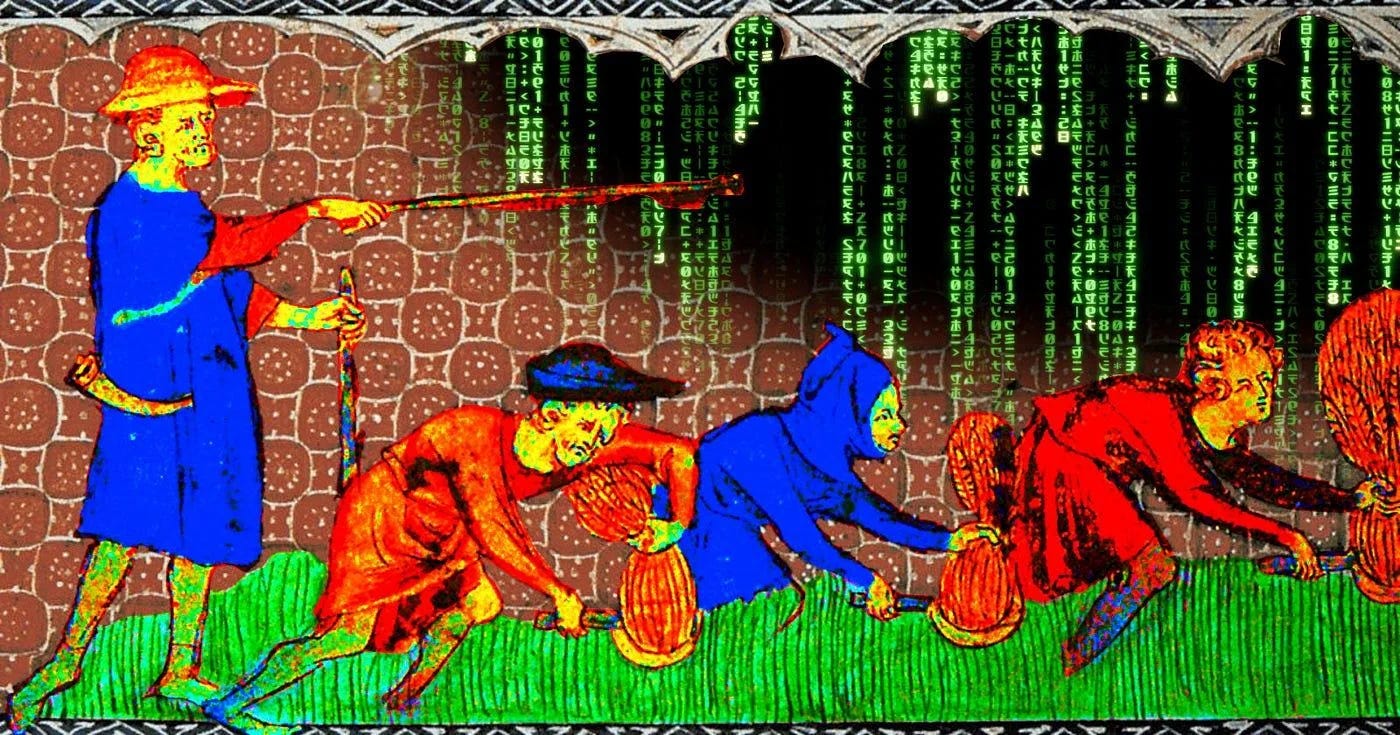
Power—who has it, how it manifests, and how it's used—continues to evolve, and in an eerily similar way to what occurred in the past. Rather like warlords in the Middle Ages, today’s oligarchs and the tech titan corporations they own are the modern equivalent of mediaeval city-states. Self-contained and immensely powerful, they operate both within and beyond the framework of the nation. These digital city-states, like the powerful trading cities of times past, wield economic, cultural, and political influence that far outstrips their formal boundaries. And they are reshaping the world order in the process.
Historically, city-states like Venice, Amsterdam, Malacca, Constantinople, Bruges, and Carthage grew wealthy and powerful by dominating the trade routes, establishing monopolies for valuable goods, and negotiating with or outmanoeuvring larger empires. They were centres of commerce, innovation, and governance, with their own rules and armies of workers. Similarly, today’s digital city-states—Apple, Microsoft, Amazon, Alphabet, and others—dominate not physical trade routes but the arteries of the digital economy. They control critical flows of information and commerce, making them indispensable to the global system. Their influence is so vast that they transcend the authority of the nation-states in which they technically reside, operating in a semi-sovereign manner.
Yet, beyond the analogy of city-states, the economic structures underpinning these corporations evoke a deeper, more unsettling framework. Like feudal lords of the past, these corporations preside over vast ecosystems in which users, workers, and even governments are bound by dependency. Platforms like Amazon, Google, or Meta are not merely tools but entire worlds in which billions live, work, and interact—often with little support or recourse. This techno-feudal dynamic reveals the true extent of their power, rooted in control over both economic systems and the social fabric itself.
The scale of their power is staggering. Consider Apple, with a market capitalisation of $3.7 trillion, rivalling the GDP of the United Kingdom. Microsoft, at $3.3 trillion, is comparable to India’s economy. Amazon’s $2.3 trillion valuation nearly matches Italy’s GDP, while Meta and Tesla sit comfortably alongside Canada and Mexico. These corporations, though ostensibly private entities, have amassed financial power on par with entire nations—and their influence doesn’t stop there. They also control critical infrastructure: the digital platforms that underpin communication, commerce, education, and even governance itself. In many ways, they are the new centres of human activity, much like the great trading hubs of old.
Like those city-states, these corporations operate within their own self-contained hierarchies. They are led by visionary "princelings"—CEOs and founders—whose decisions shape the fates of billions. Their structures are militarised in their efficiency, with tightly controlled layers of authority and vast armies of engineers, contractors, and executives executing their strategies. Their goal is not governance in the traditional sense but the relentless pursuit of profit and market dominance. Yet, in their quest for supremacy, they have begun to assume roles traditionally reserved for governments: policing speech, shaping public opinion, providing essential infrastructure, regulating marketplaces, influencing global policy, funding scientific research, and even addressing societal challenges like climate change and public health.
This shift in roles aligns them with the feudal lords of old, who often wielded local power that rivalled or even surpassed that of monarchs. Just as feudal lords controlled their territories and provided essential services to their subjects, these corporations now dominate digital territories and provide critical services on which modern society depends.
For the general public—analogous to the citizens of these city-states—the relationship with these corporations is highly complex and fundamentally asymmetrical. Their role is less that of empowered citizens and more akin to digital serfs, bound to these platforms for their livelihoods, social connections, and access to information. Like feudal peasants tethered to the land, opting out is no longer a viable option for most, as these corporations have become essential to participation in modern life.
This dependency is deepened by the fact that users have minimal agency within these systems. They are subject to opaque algorithms, exploitative data practices, and shifting terms of service that invariably prioritise corporate profits over user welfare—despite public messaging to the contrary. Their labour—manifested through data generation and engagement—enriches the lords of these digital realms, yet users have little say in how these platforms operate or how their data is monetised.
Much like the citizens of historical city-states, who were subject to the whims of their ruling elite, today’s users are bound to systems they cannot easily escape and seldom fully comprehend. This leaves billions vulnerable, dependent on platforms that wield immense power over their lives while offering little in return beyond convenience.
Nation-states, the traditional centres of political authority, are struggling to contend with these corporate city-states and their techno-feudal hierarchies. Historically, empires sought to control or co-opt powerful city-states, offering protection and trading privileges in exchange for loyalty. But in the modern era, governments often find themselves in a position akin to mediaeval monarchs, reliant on feudal lords for stability and resources.
These corporations operate globally, making them difficult to regulate within the confines of any single nation. Their financial power allows them to lobby for favourable policies, and their control over critical infrastructure gives them leverage over the very governments that seek to constrain them. For example, Amazon’s cloud services are so integral to US government operations that any attempt to regulate the company risks disrupting national security.
The case of Jack Ma, the founder of Alibaba, illustrates how precarious this balance of power can be. In China, Ma built a digital empire that rivalled the state in influence, controlling vast swathes of commerce and data. But when he publicly criticised the government, the central authorities acted swiftly, sidelining Ma from public life. This demonstrates that even the most powerful corporate leaders can be brought to heel when they challenge the sovereignty of the state. At the moment such decisive action is infrequent, especially in democratic systems where corporate lobbying and public-private partnerships blur the lines of accountability. But that's not to say it won't become more common in the future.
The implications of this new order are profound. If corporate city-states and techno-feudal structures continue to grow unchecked, what happens to the traditional nation-state?
Are we witnessing the advent of a new political paradigm, where sovereignty is shared—or contested—between governments and corporations? And if so, who holds these corporations accountable? Unlike governments, which are at least nominally answerable to their citizens, corporations are accountable only to their shareholders.
Or has the nation-state already become a corporate franchise owned by the banking cartel with politicians merely acting as staff? These questions are awkward, raising concerns about the future of democracy, equity, and public welfare in a world increasingly shaped by private entities.
History offers potential solutions. The trading empires of the past found ways to coexist with powerful city-states, often through mutually beneficial partnerships. Modern governments might adopt a similar strategy, collaborating with Big Tech to harness their resources while imposing stricter oversight. For instance, public-private partnerships in areas like AI development or digital infrastructure could ensure that these corporations serve the public good while remaining accountable. Alternatively, governments could encourage competition among these corporate city-states to prevent any single entity from becoming too powerful. In extreme cases, antitrust actions—akin to dismantling monopolistic trade cartels—could be used to break up the largest corporations.
However, these solutions will require immense political will and global coordination, as the transnational nature of these corporations allows them to evade traditional regulatory frameworks. Failure to act risks further entrenching the techno-feudal order, where power is concentrated in the hands of a few corporate lords, and the masses are reduced to digital serfdom.
The rise of corporate city-states signals a shift in how authority is distributed, with profound consequences for governance and human rights. The question is not merely whether nation-states can adapt but whether the public can reclaim a meaningful role in shaping the systems that now define their lives. If history is any guide, the balance of power will continue to evolve—but whether it does so in favour of the many or the few remains to be seen. For now, we find ourselves in an era where the centres of power are no longer bound by geography, and the future of governance lies in the hands of those who can navigate this new, borderless reality.