
Reading Outside the Lines

The heat in Bangkok’s early afternoon doesn’t rise from the pavement; it presses down from above, a heavy, wet weight that smells of charcoal, two-stroke exhaust, and the slow fermentation of canal water.
From the balcony of a concrete apartment block in the Din Daeng district, the city doesn’t look like a triumph of planning. It looks more like an organism that’s outgrown its skeleton. Below me, a young woman sits on a plastic stool, her fingers moving with rhythmic, unthinking speed as she threads jasmine buds onto a string for a temple offering. She is perhaps nineteen. She has spent her morning in a classroom three kilometres away, memorising the names of kings and the dates of treaties, absorbing a national narrative constructed to ensure she remains exactly where she is—quiet, deferential, a reliable unit of labour in a kingdom that fears its own youth. She is being prepared to inherit a world. But the preparation is actually a form of containment.
Looking down at her, the realisation dawns: we have built global architectures of learning that are, in truth, sophisticated systems of domestication. This isn’t a failure of the design; it’s the design itself. Across dozens of cities—from the high-walled academies of Shanghai to the drafty, underfunded classrooms of Sunderland—the fundamental transaction of formal education remains remarkably uniform. It’s the systematic trading of curiosity for compliance.
We comfort ourselves with the illusion that schools exist to open minds. In reality, they exist to standardise them.
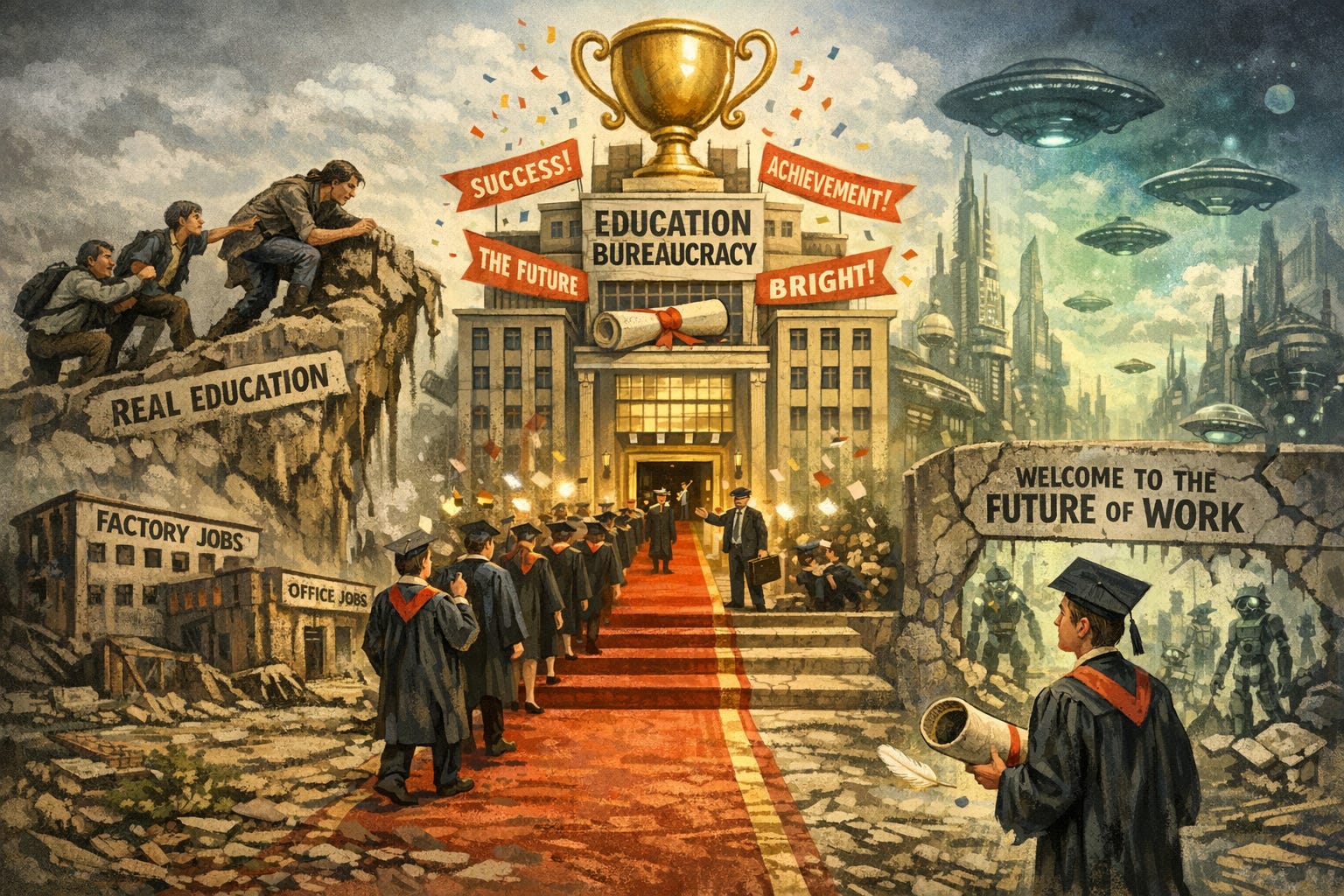
The machinery of modern schooling was forged in the furnace of the industrial revolution, designed to produce punctual, obedient factory hands who could tolerate monotony without rioting. We have replaced the steam whistles with digital bells and the assembly lines with screen-based curricula, yet the deep logic remains untouched. The modern classroom is an enclosure. It’s a space where the wild, erratic, and deeply inconvenient questions of the young are systematically harvested and replaced with pre-packaged answers.
This is not education. It’s an immune response. It’s also a profound anachronism. We are systematically preparing our children for a world that has already ceased to exist. In an era dominated by artificial intelligence, where the rote retrieval of information and the execution of predictable, specialised cognitive tasks can be performed in milliseconds by algorithms, our insistence on standardisation is a form of planned obsolescence. We continue to train human minds to behave like second-rate computers, drilling them in compliance and mechanical execution, precisely at the moment when actual computers have mastered those same behaviours. By forcing the young to compete with machines on the machines’ own terms, we are educating them not for a future of human agency, but for immediate redundancy.
Every established order possesses an instinct for self-preservation that operates far below the level of conscious conspiracy. An institution—whether a state department in Canberra, a corporate headquarters in London, or a municipal bureau in Pretoria—survives by ensuring that those who enter its ranks have already been pre-conditioned to accept its basic premises. The most successful graduates are not those who have learnt to think but those who have learnt to accommodate themselves most seamlessly to the prejudices of their predecessors. They have mastered the art of policing and censoring their own intellects. They have learned to love the cage.
This is not to say schools and schooling are entirely devoid of light. Within these same structures, there exists a quiet, exhausting guerrilla warfare waged by educators who refuse to be just wardens. In classrooms around the world, there are teachers who deliberately leave the door to the cage unlocked, who slip unapproved questions into the margins of standardised lesson plans, who pause the digital bells to allow a moment of genuine wonder, and who quietly validate the student who refuses to fit. Yet, these individuals must constantly fight the gravity of the machinery they serve. They are forced to operate as double agents, translating the wild language of human curiosity into the sterile, quantifiable metrics demanded by the bureaucracy above them.
The bureaucracy invariably wins the branding war. And yet, despite this quiet undercurrent of resistance, we still persist in treating the graduation certificate as a credential signifying intelligence.
The sheer scale of this deception is mind-boggling. We gather our young into rooms and arrange them in ways that convenience us—rows, grades, age. Then we subject them to a regime of fragmented hours—forty minutes of geography, forty minutes of mathematics, forty minutes of science—as if the world itself were divided into neat, non-communicating compartments. We teach them that knowledge is something to be consumed, rather than created. We train them to look to the front of the room for authority, to wait for the permission of a bell before they can move, and to believe that their worth is directly proportional to their capacity to spit back the approved consensus on a sheet of paper.
Then, we express surprise when they grow up to be passive consumers of political demagoguery and corporate marketing.
The tragedy is not that the education system is failing, but that it’s succeeding so spectacularly. It produces exactly what the paradigm of industrial economism requires: highly specialised, technically competent individuals who are utterly incapable of questioning the systemic logic or the morality of the enterprises they serve. We train brilliant engineers who can design predatory algorithms, brilliant chemists who can synthesise soil-killing pesticides, and brilliant economists who can justify the extraction of the planet’s last remaining resources—all of them completely blind to the civilisational catastrophe they are accelerating.
They have been educated into a profound, functional ignorance.
To question this is to invite immediate exclusion. The individuals who possess a more robust, stubborn independence—those who refuse to let their minds be flattened into the approved shapes—are marked out as problematic. They are the troublemakers, the dreamers, the ones who don’t fit. In the West, they are often medicated into compliance; in more authoritarian regimes, they are silenced or expelled. The global economy as currently structured has no use for the outlier who asks why the curriculum is structured the way it is, or whose interests are served by the history they are being handed.
The truly self-taught intellectual is a threat to any regime of thought. This is because real learning is an act of defiance. It doesn’t happen when we receive information; it happens when we begin to notice what we’re not being told. It begins when we look at the textbook and ask the following: Whose voice is missing here? Whose version of reality is this designed to protect? Why is this particular piece of knowledge deemed valuable, while other ways of knowing are dismissed as primitive or irrelevant?
Once those questions are asked, the spell is broken. The student ceases to be a resource to be managed and becomes an active participant in the world.
But this kind of awakening can’t be engineered by the institutions that benefit from its absence. It requires a different kind of stewardship—one that doesn’t seek to manage or direct but to create the conditions where independent thought can take root. It requires us to look at the young not as empty vessels to be filled with the prejudices of the past but as companions in an ongoing, highly uncertain experiment in survival.
This stewardship doesn’t live in grand lecture halls or official programmes of study; it exists in the margins and the undercurrents. It’s found in the quiet, self-organised spaces where the currency is curiosity rather than credentials—in the backrooms of independent bookshops, the hushed debates of underground reading circles, the digital forums where forbidden texts are shared, and the patient, unhurried mentorship of elders who have managed to keep their own minds wild. It is a decentralised, slow-burning network of intellectual sanctuary. In these spaces, learning is not a race to be won or a checklist to be completed but a shared, stumbling effort to make sense of a fractured world.
It is precisely this kind of sanctuary that finds its way to the balcony. As the afternoon storm finally breaks over Bangkok, turning the dusty streets into rushing canals, the young woman on the balcony packs away her jasmine strings. She has a book open on her lap now—not the textbook from her morning class but a battered, self-published translation of essays she found in a secondhand stall near the river. She is reading outside the lines.
The institutions that claim to educate her will never reward her for this. They will not grade her on her capacity to doubt their authority, nor will they offer her credentials for her refusal to fit their categories. But in the quiet, stubborn movement of her eyes across those forbidden pages, the architecture of control begins to fracture. The system will continue to protect itself, as it always has. But the future has a habit of belonging to those who find their own way through the dark.