
Stranded No More
Converting Dead Assets into Climate Infrastructure

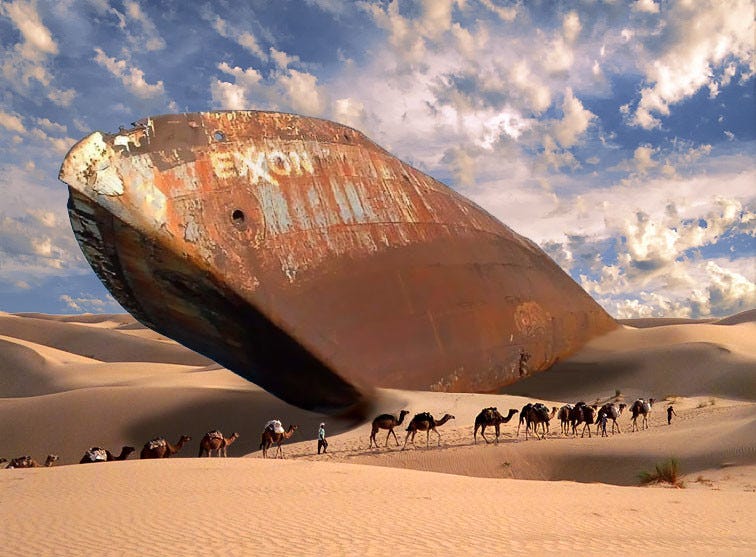
At least 35 years ago I stood up in front of an audience in Melbourne who had been tasked with considering the impacts of climate change on Australia’s way of life. I vividly recall the horror on the faces of fossil fuel industry executives when I suggested that, as a preliminary step, coal could be left in the ground. A group of them got up and left, deeply offended that a keynote speaker would even suggest such an outrageous idea.
We have long permitted a fable to stand in for strategy. The fable says the fossil fuel industry, having powered modernity, will discover within itself the curiosity, capital and conscience to become the architect of its own eclipse. That seems, to me, highly unlikely for a variety of reasons. This industry understood the physics, financed delay, mastered the dark arts of doubt, and normalised the externalisation of risk to forests, rivers, oceans and generations unborn. Excoriation is not only warranted; it’s cleansing. But indignation, by itself, is too brittle to carry us into a different future.
If we simply stand by and watch the old energy order implode under its own contradictions, the wreckage will not be confined to balance sheets. It will spill over into the everyday—a catalogue of spiking prices, orphaned infrastructure, worthless pensions, beached communities, and a toxic inheritance of abandoned wells and rusting pipes. A managed descent is hardly a favour to incumbents; it reads more like a social covenant to avoid chaos.
So let’s start with clarity. There is simply no credible route to a liveable climate that doesn’t involve a rapid, absolute decline in the extraction and combustion of coal, oil and gas. That trajectory needs to be made honest in law and finance, not just in speeches. New exploration sits uneasily within a budgeted exit. Production limits would need to ratchet down at a pace consistent with 1.5°Celsius, allocated across jurisdictions and companies, and enforced through revocable licences.
Methane—a short, sharp accelerant of warming—would have to be driven to near‑zero within a handful of years, verified by satellite imagery and audits rather than promises. A binding three‑year deadline could bring that resolve into focus—complete with a flat ban on routine flaring, satellite verification, and automatic shut‑ins for violators. And the discipline of every significant producer holding a living will—an asset‑by‑asset timetable for decommissioning or conversion, workforce transition and environmental remediation—would make the path legible.
That’s all very well, but red lines alone will not knit a resilient future. The far more interesting work begins when we work out how to redirect the competencies that dug the holes towards the task of filling them. Think about the subsurface knowledge embedded in firms like BP and Shell: geologists mapping caprock integrity, drillers threading needles kilometres beneath the earth, operators choreographing complex flows at continental scale. These are not just legacies; they are instruments that can be retuned. A carbon take‑back obligation points in that direction. Under such an approach, those who sell carbon would be responsible for preventing its release or, at the very least, returning it to safe, durable storage. Starting with a modest fraction and ramping towards 100 per cent would change the centre of gravity. The obligation could become a tradable discipline through Carbon Take‑Back Certificates that match a rising share of the emissions from the products sold. Certificates would be minted only for CO2 placed in corroborated, durable sinks, with liability for permanence following the certificate for decades. Suddenly depleted oilfields and saline aquifers are no longer dead ends but critical climate infrastructure. Pipelines and compressors find second lives carrying captured CO2. The business model shifts from extraction to remediation, and the value of knowledge migrates with it. [Incidentally, this is the same logic I have used in the context of militarism to redefine the role of armies and direct their expertise to peaceful projects.]
The same holds true above ground. Rigs and service crews could be repurposed for geothermal projects at oilfield scale, drilling closed‑loop systems and tapping deep heat. Oilfield brines, once a waste stream, might become a source of lithium and other minerals via direct extraction—new supply chains nested in old basins. Refineries, with utilities and logistics already in place, could pivot to become clean‑molecules parks—producing sustainable aviation fuels, green methanol, and the next generation of zero‑carbon chemicals using captured CO2 and green hydrogen as feedstocks. Where safe and economic, offshore platforms could be turned into bases for wind, hydrogen or marine science; where not, prompt and proper removal—at the sector’s expense—would follow.
To orchestrate this at scale we may need an institutional invention bold enough to hold contradictions and patient enough to resolve them. Call it a Carbon Legacy Bank, a public‑interest “bad bank” conceived for the endgame of the fossil age. Alongside it, Transition Asset Trusts could hold, convert and retire assets at pace, earning capped, utility‑style returns while decommissioning obligations are quarantined from bankruptcy. The mandate, as conceived by myself and Jasper Zimmerman, would be plain enough: ageing, high‑emitting assets are acquired at fair but disciplined valuations, operated under a transparent, declining carbon budget, and then decommissioned, converted or repurposed on an agreed schedule.
Such vehicles could be financed by a blend of windfall levies, transition bonds and multilateral capital. Liabilities would be ring‑fenced in bankruptcy‑remote trusts so that clean‑up is not socialised after profits are privatised. Managed like a utility, returns would be capped and paid for speed, safety and worker retention—not for pumping another marginal barrel. Existing rights‑of‑way can carry new high‑voltage lines, with suitable pipes lending themselves to hydrogen and CO2. Seen as a palimpsest rather than scrap, LNG terminals and cryogenic tanks could shift to green ammonia and hydrogen trade, and existing corridors—pipes, rail and roads—could provide the permitting fast lane that lets the system breathe.
A Rights‑of‑Way Conversion Authority might operate with standard designs, default approvals and fair compensation, so that stranded steel no longer anchors the future. Predictable cashflows from early retirement could be bundled into securities that replace fossil earnings with decommissioning payments, as some jurisdictions have done with coal. In the same spirit, a decommissioning surety market—with parametric bonds that pay out automatically when monitoring shows a leak, a flare or a missed milestone—would make enforcement both clean and timely.
If design is to prevail over disorder, there’s also a case for changing how the last particles are retired. Reverse auctions could be run for decline, basin by basin: firms bid to shutter production first in exchange for time‑limited, falling payments, with winning bids carrying hard milestones, public monitoring and clawbacks for slippage. The state, in effect, would buy absence rather than output, and the cheapest verified absence would win. That approach could be paired with a buy‑back of long‑dated licences, re‑issuing a rapidly shrinking pool of rights with automatic expiry so speculation on a late surge of barrels has nowhere to land. This is hardly fantasy: reverse auctions, securitised retirements, satellite‑verified methane standards and decommissioning bonds already work in adjacent markets—we would simply be recombining proven instruments to end an era with discipline.
The industry’s governance will likely need to be rewired concurrently. Corporate charters and licences could be structured to sunset by design, with explicit expiry aligned to climate budgets. Boards populated with climate‑literate directors—not merely advisers at the margin—would help close the gap between rhetoric and reality. Large incumbents might be separated into LegacyCos and FutureCos, with dividends from the legacy side locked until decommissioning obligations are fully funded and verified.
Executive remuneration could be tied not to production volumes or emissions intensity but to absolute Scope 1–3 reductions, verified decommissioning milestones, and the safe redeployment of labour into new roles. Access to capital could be made contingent on radical transparency: a public, asset‑level emissions and integrity ledger fed by satellites and ground sensors, with automatic coupon step‑ups on bonds and facilities when decline paths are missed. Political spending that contradicts transition plans might sensibly trigger licence consequences. And extended producer responsibility—routine in most other sectors—could be scaled to carbon: if you put it into commerce, you accept responsibility for its atmospheric consequences.
Of course, none of this holds if demand for fossil fuels remains elastic to price and indifferent to alternatives. Demand will need to fall intentionally and irreversibly. That points towards electrifying heat, mobility and low‑temperature industry; accelerating the build‑out of clean power and grids; and adopting standards that eliminate the so‑called green premium rather than subsidising it in perpetuity. Performance rules—emissions per kilometre, per kilowatt‑hour, per tonne of product—could pull markets towards zero. In the hard‑to‑abate sectors, fossil incumbency would be constrained by rising shares of zero‑carbon fuels and materials, backed by guaranteed offtake from public procurement so first movers are not punished. A ceiling on virgin petrochemical growth, coupled with design for reuse and high‑quality recycling, would shift plastics from a linear torrent to a circular stream.
Justice is not a garnish on this meal; it is the base stock. A Just Transition Compact could guarantee wages, benefits and training for the thousands of affected workers, with a community equity floor—no less than 15 per cent—in every repurposed site, including dividend minima and buy‑back protections. A Just Transition Passport would allow skills, benefits and seniority to travel with workers across employers and sectors, backed by wage insurance for three to five years so no one is asked to take a pay cut for doing the right thing. Unions and local authorities could hold a statutory seat in asset‑conversion plans, with veto rights over safety and clean‑up. An orphan‑well moonshot might aim to plug one million wells in five years, employing existing crews at good wages to eliminate methane leaks and groundwater risks. And a health dividend could be delivered first to fence‑line communities: air monitoring, clinics, green buffers, and capital for local enterprises that have too long been breathing the costs of someone else’s profits.
Internationally, finance might better align with physics. A Production Retirement Registry under multilateral oversight could allow countries to retire reserves and production rights permanently in exchange for debt relief, concessional capital and resilience funding. Debt‑for‑carbon and resilience swaps could be offered to producer nations that agree to verifiable production cuts, conservation, and investments in grids, health and industry. Market access could be tied to shipment‑level methane and carbon intensity, verified by open satellite data and independent labs; cargoes linked to routine flaring or super‑emitting supply chains might be restricted or barred. Public procurement can be the quiet superpower it so often is, by setting durable demand for green steel, cement, fuels and shipping.
Guardrails against greenwashing ought to be exacting. Offsets would have no place as alibis for new extraction. Carbon capture would earn a role only where substitutes do not exist, with transparent measurement, reporting and verification, and liability for permanence passing to those who profit. Asset‑level transparency on emissions, leaks, flares and spending—subject to independent scrutiny with real consequences—would take the theatre out of claims.
The point of all this is not to redeem an industry’s reputation. It’s to redesign the metabolism of a civilisation without detonating its social fabric. Ending the fossil era requires the ruthless clarity to say the business model itself is over, and the practical imagination to salvage from it the tools, sites and skills we can still use. The fossil sector will pay for the clean‑up; it will help build what comes next; and it may be remembered, at best, not for the damage it inflicted but for the discipline with which it helped dismantle its own primacy and seeded a safer inheritance.
We can stage this transition as a morality play of villains and ruins. Or we can practise capacity at a grand scale: turning liabilities into public value, anger into governance, and the metal of a bygone age into the scaffolding of the next. The choice is not between leniency and punishment. It’s between design and disorder.