
The Capitalist Mythos
and other seductions....

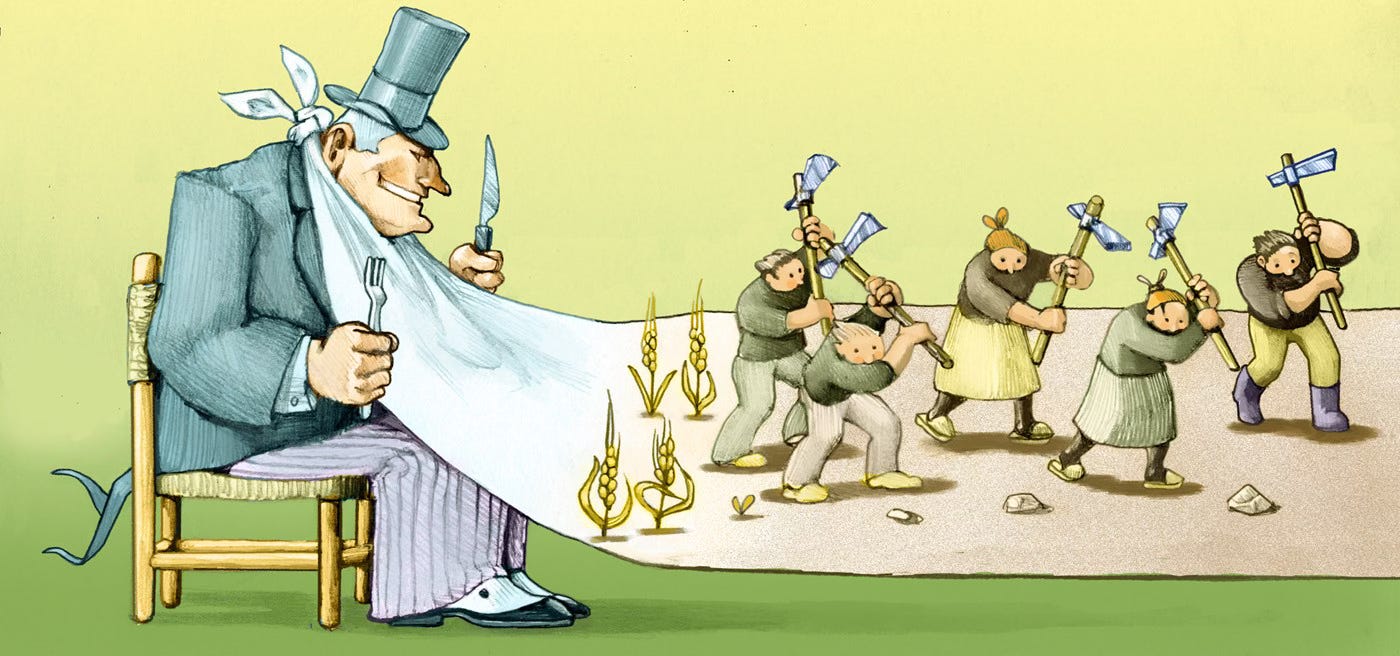
Every society has at least one overriding story. Think of it as the official public line: This is who we are, this is what we’re doing, and this is why we’re doing it. If we pay close attention we can detect other stories too. Stories that exist under the radar, or even in plain sight, refuting and challenging the official narrative. Or so it seems…
Think of Catholic saints beaming their polytheistic, atavistic messages from brightly coloured stained-glass church windows. See the majestic Mary, Mother of God, whose exaltation helps to constrain the tensions of a monotheistic, father-centered religion in denial of the divine feminine. Here the Queen of Heaven papers over cracks in the central story, making it more acceptable and far more practicable. The Church needs Mary. Without her, the dominant myth could easily fall apart.
So deployed, counter-narratives are not necessarily threatening. Indeed they can serve to constrain instabilities and balance inherent tensions. The prevailing story of capitalism works in precisely this manner.
Appearing at the height of Britain’s colonial power, capitalism’s official story charts a linear progression from traditional hunter-gatherers doing their bartering to today’s rational global capitalists engaged in free competition. This story insists — and here we come to an awkward part — that when individuals act in their own interest, the best results transpire for everyone. Millions of self-centered transactions add up to create an equilibrium that gives birth to a society which is fairer, more stable, creative, and abundant than it was before.
Quite a tale! But far from the whole truth. Accepting that narrative at face value blinds us to the ways in which capitalism harms us. Magical rites, sacrificial rituals, and sacred values were woven right into the story of capitalism from the beginning. Unspoken, they pop up in today’s most routine economic activities, permeating even the high-tech exchanges of the global marketplace.
This is disputed by most political economists who contend that the capitalist economy has exorcised such ghosts altogether. The new human being was hailed as “homo economicus” — a rational person pursuing wealth out of self-interest. He, for such a being was imagined to be male, belonged strictly to secular and material realms.
The great Victorian novelists, who were very much engaged with these developments, sensed that something was not quite right in that story. They noticed capitalism was producing inequality, misery and alienation, not just abundance and stability. Yet in slating the new system, they also accepted the separation of categories of experience insisted upon by social scientists. Thomas Carlyle’s famous condemnation of the “cash-payment” as “the sole nexus” of capitalism, for example, posited an economic sphere as one in which ethical and religious values held no sway.
But was it really so? Charles Dickens is often viewed as the great anti-capitalist of Victorian literature. He observed that a society of self-interested economic actors could produce tremendous poverty and horror. Ideologically opposed to various aspects of capitalism, he turned to sacred ideas like sacrifice and ritual to envisage a community vested in values like insouciance, reciprocity, and communality — the very values endangered by the capitalist model of self-interest.
In A Tale of Two Cities, whose plot begins in 1775, Dickens depicts Paris as a city stuck in a regressive socio-economic mode in contrast to the more productive, bustling, modern city of London. But in order for capitalism to work harmoniously in London, a dash of religion had to be added to the mix. Dickens casts a woman, Lucie, as the person who takes the stench away from the selfish business conducted by the men — a Victorian “angel in the house” and an emblem of all the non-utilitarian values that homo economicus supposedly had no time for. Lucie, like many other female characters in Victorian novels, is supremely compassionate and sacrifices for the greater good: she is “homo communis”.
Dickens makes this female homo communis the servant of homo economicus, keeping his house in order and guiding his better nature. Like Mary’s role in the Catholic Church, she makes the official story of capitalism more palatable and helps conceal its failures. Challenging the popular view of Dickens as something of a radical, his storytelling actually reintegrates sacred values in a way that ends up helping capitalism to expand. As a popular author selling books, capitalism was serving him quite well too.
What had been disinherited from economic thought and pushed out to the colonies returns to the city as the domestic woman who synthesizes market and non-market values. This is a frequent pattern not just in fiction, but in all of economic thought. It’s an underlying secondary narrative that conceals gaps in the official story.
Like their novelist friends, early social scientists were not insensible to the possibility that a society of self-interested economic actors might end up in constant conflict. When they asked how the interests of individuals could be harmonized, they often ended up thinking in terms of ethics. Homo economicus might drive the story of capitalism, but political economists kept returning to ideas like communality, consensus, reciprocity, and fair distribution — even ritualistic behaviour.
The theorists of economic equilibrium, for example, tended to present society as achieving a balance between self-interest and self-sacrifice for the success of the whole. Leading 19th century philosopher John Stuart Mill and William Jevons, an English economist and logician, described the ideal capitalist as a person with the discipline to make sacrifices — abstaining from short-term and vicarious pleasures, working hard today in order to hoard money for tomorrow. This ethos of sacrifice becomes key to social cohesion and stability — just as it was in so-called pre-literate societies.
The ideas of sacrifice and sacred values also come into play in theories of labour. Adam Smith described labour as “the most sacred and inviolable” form of property owned by an individual. He posited this as a sacred source of the nation’s wealth, and the pious foundation of the economic system itself. British political economist David Ricardo, Mill, and Jevons followed him in describing a circular, gift-sacrifice economy embedded within the labour theory of value.
John Ruskin, a critic of industrial economism, glorified the worker as a kind of holy martyr who ensures the reproduction of life and the stability of society through the sweat of his brow. In the creation of the worker-martyr, Ruskin bridges the rift between the sacred and the profane. In colonized countries, a herder sacrificing a cow to promote the well-being of the community would be considered primitive, but a modern person sacrificing her labour was something else entirely. Karl Marx also picked up the idea of labour as sacrifice, although for him it was offensive, rather than glorious, that capitalists could accumulate wealth on the backs of sacrificing labourers.
Economists, despite their professed adherence to rationality, also continually presented economic forces as quasi-magical energies. Think of Smith’s famous invisible hand, a sort of god of the market that coordinates human actions and somehow overcomes individual avarice. The idea of communality also lurks here — people unconsciously coordinating their actions to arrive at a societal consensus.
Late 19th century economist Alfred Marshall went so far as to invoke the concept of medieval chivalry to explain how modern economic systems should ideally function. Criticising contemporary accounts of the free market and describing a middle path between government non-interference and a systemic welfare state, he called on a “spirit of chivalry” that could drive a combination of self-interest and self-sacrifice. This model would uphold the paternalistic administration required for the British Empire to function.
As the discipline of economics continued to develop professional practitioners focused on mathematics and scientific objectivity. Nevertheless, they could never fully banish the old ghosts — chiefly because they weren’t ghosts, but central players in the new order. The contemporary capitalist system cannot do without the ethics of communality, interdependence, and reciprocity that are formally associated with pre-capitalist societies. Market and non-market values invariably operate alongside one another.
If you have lived and breathed global capitalism since birth, scrutinising its myths in this manner can feel a bit like a fish analyzing water. But we have to examine the dominant narrative because its flaws and strains are threatening to dry up the entire pond. The excessive production demanded by a global populace of 8.2 billion inhabitants is simply not feasible without changes to the capitalist mythology.
It gets tougher every day to deny the human wreckage wrought by capitalism everywhere it exists — the steaming heap of alienation, market failures, inequalities, corrupt practises and rigged outcomes. Proponents of globalization cheer unfettered capitalism as the vehicle for spreading democratic values, freedom, and reciprocal exchange. But access and participation are not equally open to all.
This reality is currently erupting into worldwide unrest and the rise of right-wing populism. Clearly, the official story and what happens on the ground differ substantially. Many people work hard long hours for little benefit, while a large number who don’t work at all get rich. Belief that the magic of markets will result in global solidarity, social advancement, and wealth for all is beginning to sound a bit like magical thinking.
Capitalism’s main narrative is easy enough to see, but the secondary ones are less visible. You need to piece them together. Marx described capitalism as ideological false consciousness. But it’s not quite as simple as that - there is something more complex going on. If we can show that the ethical ideas and the sacred, communal values baked into capitalism’s own paradigms and premises are real, we can also hold it accountable for those ideals in the globalized world economy.
For example, we can acknowledge that human beings are not simply atomistic competitors, but beings that seek to share a common experience, desires and fate. Perhaps that is why the Occupy Movement was such a heady experience for many. The slogan “We are the 99%” was a respite from the oppressive “I” — the painful anomie of individualism to which the official capitalist story swears allegiance.
When we speak about this undeclared side of the capitalist myth we can give up pretending that moral and economic values are opposed, or somehow disconnected. We can say clearly, for example, that the financial crisis of 2007-8 was not just a failure of markets, but a failure of morality — for what else can you honestly call it when predatory banks escape justice while ordinary people suffer? We can question who is doing the sacrificing, and for whose good the system was designed and is really working.
We can also see how the strategic deployment of sacred values and rituals are used to conceal harmful deeds. In Silicon Valley, executives inject eastern values and practises such as mindfulness and meditation into the workplace in a way that conceals the mistreatment of workers and consumers that many companies are built around. A company may well spy on people to turn a profit, but the espousal of sacred values (recall Google’s former “Don’t be evil” motto) helps hide the true exploitative mission. We can call out executives who ascribe intrinsic value to people, even as they calculatedly strip away what people need to survive.
If we can clearly see the double narrative in play, maybe we can insist that homo communis should not be the servant of homo economicus, but the master. If that is the case, capitalism can be made to work for the greater good as originally intended.