
The Empire That Ate Itself
On the long collapse of American hegemony

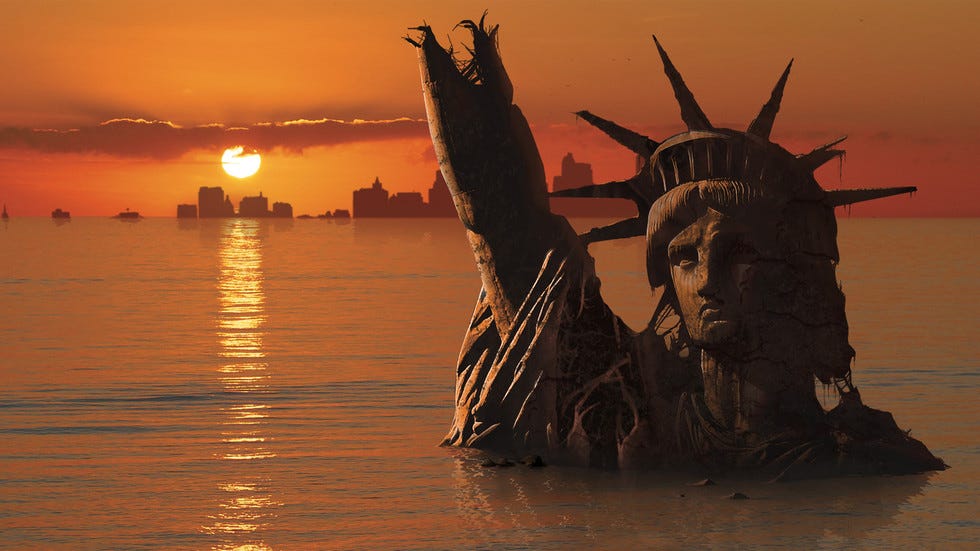
There is a particular kind of blindness that afflicts those who live inside power. Not the blindness of ignorance — the powerful are often extraordinarily well-informed — but the blindness of investment. To see the system clearly would be to see yourself implicated in it. And so the system is not seen. It is inhabited, like we inhabit the weather.
This essay is an attempt to see it.
What follows is not a polemic against America. It is something harder to dismiss than that: a structural account of how the most formidable empire in modern history has spent a quarter century dismantling the very foundations on which its authority rested — moral, institutional, financial, and strategic — and has now arrived at a moment of free fall so vertiginous that even its architects can no longer pretend the trajectory is controlled. The question is no longer whether American hegemony is ending. The question is what gets buried in the rubble, and what, if anything, is capable of growing through it.
I. The theology of chosenness
Before the events, there was the idea. And the idea was this: that America is not merely a country but a proposition, not merely a state but a covenant — chosen by history, ratified by providence, exempted by virtue of its founding ideals from the moral accounting applied to lesser nations. This is the doctrine of American exceptionalism, and it is the indispensable premise without which nothing that follows makes any sense.
It is also, examined with any rigour, a form of organised delusion.
The doctrine has deep roots — in the Puritan vision of a city on a hill, in the revolutionary mythology of a republic born not from ethnicity or conquest but from universal principle, in the Manifest Destiny that sanctified the elimination of indigenous peoples as the westward march of civilisation. What changed in the twentieth century was the scale of the claim. After 1945, American exceptionalism was no longer a domestic mythology; it was an export product, and the world was the market. The United States had, genuinely, played a decisive role in the defeat of fascism and the reconstruction of a shattered world order. The Marshall Plan was real. The founding of the United Nations, whatever its subsequent capture, was a genuine institutional achievement. The temptation to conclude from these facts that American power was inherently benign — that what was good for America was, by definition, good for humanity — was understandable. It was also wrong, and the consequences of that error have been compounding ever since.
Exceptionalism functions, in practice, as a pre-emptive absolution. It does not merely assert that America is good; it asserts that America cannot be otherwise, that American violence is by definition defensive, that American interests are by definition aligned with human progress, that American failure is by definition the result of insufficient resolve rather than a flawed premise. It makes self-examination structurally impossible, because self-examination requires the willingness to entertain the possibility that you are wrong about yourself, and exceptionalism forecloses that possibility at the level of founding mythology.
The practical consequence is a political culture that cannot learn from its own disasters. Every failed war — Korea, Vietnam, Iraq, Afghanistan — is processed not as evidence that the premises of American power require revision, but as evidence that the application was imperfect: the wrong generals, the wrong tactics, insufficient political will, hostile media, treacherous allies. The system produces the error and then protects itself from the lesson the error would otherwise teach.
This isn’t stupidity - even if it appears like that on the surface. It’s something structurally worse: a self-sealing ideology that converts every falsification into confirmation. And it has brought the most powerful military in human history to a state of chronic strategic failure so comprehensive that its own generals, in their retirement memoirs and congressional testimonies, describe it in terms that the ideology forbids them to apply while still in service.
The rest of the world, which has been on the receiving end of this exceptionalism for the better part of a century, has its own, considerably less reverential assessment. They watched the country that proclaimed itself the indispensable nation become indispensable primarily to the contractors who built its prisons, to the lobbyists who drafted its trade agreements, and to the weapons manufacturers who profited from its wars. They noted, with a precision that no American newspaper ever quite managed, that the rules America proclaimed were the rules it enforced selectively, and that the freedom it exported was the freedom to operate within a system America controlled. The mythology persisted at home long after it had ceased to be believed abroad. It persists still, in the mouths of politicians who have not noticed that the audience has long since left the transept.
II. The machine that runs on war
In January 1961, Dwight D. Eisenhower — a man who had commanded the largest military operation in history and spent two terms as president — used his farewell address to warn the American people about what he called the military-industrial complex: the dangerous conjunction of an immense military establishment and a large arms industry, whose combined influence, he said, was felt in every city, every statehouse, every office of the federal government.
Eisenhower’s warning was prescient. It was also, in retrospect, a dramatic understatement.
What has grown in the six decades since that speech is not a complex but an ecosystem — vast, self-replicating, politically irresistible, and now so thoroughly fused with the state’s intelligence apparatus and the technology sector’s surveillance infrastructure that calling it a complex understates its reach and calling it a lobby understates its power. It’s better understood as a permanent war economy: a system in which the production of conflict is not an instrument of policy but the policy itself, in which the incentive structures of the most powerful financial, political, and technological interests in the country are all, without exception, directed toward the perpetuation and expansion of armed confrontation.
The numbers are not subtle. The United States spends more on its military than the next ten countries combined. The defence budget has grown, in real terms, in virtually every year since the 1990s, through Democratic and Republican administrations alike, regardless of whether the country was at war or at peace, regardless of whether the threats it faced were expanding or contracting. The logic of this growth is not strategic. It is institutional. The defence contractors — Lockheed Martin, Raytheon, Boeing, Northrop Grumman, General Dynamics — are among the largest employers in dozens of congressional districts. Their lobbyists are among the most generously funded in Washington. Their former executives occupy senior positions in the Pentagon. Their former generals sit on their boards. The revolving door doesn’t merely facilitate influence; it has become the primary mechanism by which defence policy is made.
The surveillance dimension, added with enormous velocity after September 11th 2001, has made this system qualitatively more powerful and qualitatively more dangerous. The National Security Agency’s collection architecture, exposed by Edward Snowden, is not a government programme in any traditional sense; it’s a public-private partnership in which the intelligence community and the largest technology companies in the world jointly administer a surveillance infrastructure of planetary scale. The companies provide the platforms; the government provides the legal cover and, periodically, the contracts. The data flows in both directions. Corporate surveillance and state surveillance are not parallel systems. They are the same system, invoiced differently.
What Eisenhower could not have anticipated is the degree to which this system has become politically self-sustaining. The war economy doesn’t just capture politicians; it manufactures the conditions that make war politically indispensable. Think tanks funded by defence contractors produce threat assessments that justify defence spending. Media organisations dependent on defence advertising amplify those assessments. Politicians dependent on defence industry contributions legislate the spending. The spending produces the capacity. The capacity generates the doctrine. The doctrine identifies the threats. The threats justify the spending. The circle is closed, and the ordinary citizen — whose taxes fund the system, whose children staff it, and whose communities bear the cost of the blowback it generates — is structurally excluded from the loop in which these decisions are made.
The feral quality of this system — and feral is the correct word, because it has long since outgrown any capacity for human direction or restraint — is most visible in the relationship between the defence industry and the wars it requires. The invasion of Iraq was not only a strategic error; it was, for the defence sector, a revenue event of historic proportions. Halliburton, then bearing the direct imprint of Dick Cheney’s former executive tenure, received contracts worth tens of billions of dollars to rebuild the infrastructure that American bombs had destroyed. The private military contractors who flooded into Iraq — operating outside military law, immune from Iraqi jurisdiction, accountable to no one — were not a support function. They were the business model. War had become, by this point, an industry like any other, with its own supply chains, its own market cycles, its own customer relationships, and its own need to ensure continued demand for its product.
This is the system that now confronts the possibility of war with Iran. And it is essential to understand what confronting that possibility means in practice: not a sober calculation of strategic interests and likely outcomes, but the activation of the most powerful commercial and institutional lobby in the history of democratic governance, oriented by its every incentive toward the conclusion that war is necessary, manageable, and profitable. The generals who will be asked to assess the risk will know, from decades of institutional socialisation, which answer extends their careers and which ends them. The think tanks that will produce the threat assessments will know which conclusions maintain their funding. The politicians who will cast the votes will know which positions keep the donations flowing and which invite a primary challenge. The American public, which does not have these incentives, has arrived at a rather different assessment.
III. The misread signal
The attacks of September 11th, 2001 were a military and intelligence failure of a specific, bounded kind. What followed them was a civilisational failure of an entirely different order.
Within days of the towers falling, the architecture of what would become the American surveillance state was already being assembled. The Patriot Act — drafted with dubious speed, and passed with almost no scrutiny — gave the executive branch powers that three generations of American jurisprudence had previously refused. Habeas corpus was suspended for categories of person. The category was defined by the executive. The definition was secret.
This was the first and perhaps most consequential signal: that the republic, when frightened, would devour its own constitutional organs. Not reluctantly. Not temporarily. Permanently — and with a facility that suggested the appetite had always been there, waiting for permission.
The doctrine of pre-emption — the arrogation of the right to attack any state deemed to pose a future threat, as determined unilaterally by Washington — was the international extension of the same logic. Law, whether domestic or international, was reframed as an instrument available to power rather than a constraint upon it. The United Nations was not reformed; it was bypassed. The Security Council was not persuaded; it was ignored when inconvenient and weaponised when useful.
These were not aberrations. In retrospect they were the announcement of a new operating doctrine: that the rules-based international order the United States had constructed after 1945 was always, at its foundation, a rules-based order for others.
The tragedy is that the world mostly believed it wasn’t. The tragedy is that many Americans believed it too.
IV. Iraq and the manufacture of permission
If September 11th revealed the fragility of the republic under pressure, the invasion of Iraq in 2003 revealed something darker: the willingness of the state’s most senior figures to fabricate the justification for mass violence, and to do so in full view of the world.
Colin Powell’s performance at the United Nations — the vials, the satellite imagery, the grave authority of a man known for his integrity — was not simply a lie. It was a demonstration of how completely the machinery of democratic accountability had been captured. The intelligence services were not deceived; they were co-opted and, where recalcitrant, overruled. The press was not misled; it was, with honourable exceptions, willing. The congress was not uninformed; it was afraid of being seen to be unpatriotic.
The war that followed killed, by the most conservative credible estimates, several hundred thousand Iraqis. By wider measures, accounting for the cascading mortality of destroyed infrastructure, collapsed healthcare, and the sectarian violence that the invasion deliberately detonated, the figure runs to over a million. The Islamic State — the single most destructive non-state actor of the twenty-first century — was born directly in the detention facilities of the American occupation, where ideologues were held alongside ordinary criminals and radicalised them systematically. Abu Musab al-Zarqawi was a creation of Camp Bucca as much as of any ideology.
None of this produced accountability. None of it produced a reckoning. The men who made these decisions remained on the lecture circuit, on the boards of defence contractors, in the green rooms of television studios where they were introduced as foreign policy experts. Dick Cheney, whose former company received no-bid contracts worth over $39 billion to service the war he had organised, retired in comfort and dignity. The war economy paid its dividends. The bodies did not.
This impunity was itself a signal. What it told the world — and, crucially, what it told the American political class — was that consequences did not apply to the powerful. The lesson was absorbed and acted upon, iteratively, by every subsequent administration.
V. The body and what it does to the face
In April 2004, photographs from Abu Ghraib prison circulated globally. American soldiers were shown humiliating, degrading, and torturing Iraqi detainees. The images were not ambiguous. They were grinning selfies. The perpetrators were not hiding; they were celebrating.
The political response was to prosecute a small number of low-ranking soldiers and to argue, with almost no opposition from the mainstream press, that these were isolated bad actors rather than the product of a system of authorised abuse. The Bybee and Yoo memos — legal documents produced by the Justice Department’s Office of Legal Counsel explicitly redefining torture so that a very great deal of torture did not legally qualify as such — were already in existence. The authorisation chain ran upward.
Abu Ghraib mattered less for what it revealed about American military conduct — empires have always practised cruelty — than for what it revealed about the relationship between American self-presentation and American behaviour. The democratic experiment that the United States had insisted was both its identity and its gift to the world was visibly, undeniably, a performance. Not in every instance. Not without genuine believers. But structurally, systematically, a performance: a set of values invoked to justify power and suspended when they constrained it.
This is the mechanism at the heart of what we’re watching. Hegemony does not require only military and economic superiority. It requires what the political theorist Antonio Gramsci called hegemony in its deeper sense: the capacity to make your values the world’s values, to make your interests appear as the general interest, to make your order appear as order itself. Once that capacity is visibly broken — once the gap between the sermon and the conduct becomes unmistakable — the edifice begins to be excavated from within. The military power remains. The ideological power, which is the power that makes the military power legitimate, does not.
Abu Ghraib was not the moment this happened. It was one of the moments when the excavation became visible.
VI. The financial collapse and the delegitimisation of the model
In 2008, the global financial system — built on American financial architecture, regulated by American regulatory principles, rated by American ratings agencies, denominated overwhelmingly in American dollars — collapsed under the weight of its own fraud.
The fraud was not incidental. As I had pointed out to a group of bankers in May 2005, it was structural. The deregulation of the financial sector, pursued with evangelical fervour across both parties from the early 1980s onward, had created a system in which the extraction of value from the productive economy was not merely permitted but incentivised, in which risk was systematically shifted to those with the least capacity to absorb it, and in which the complexity of financial instruments was a deliberate strategy for obscuring the transfer of wealth upward.
What followed was equally instructive. The perpetrators were bailed out with public money. Not a single senior executive of a major financial institution went to prison. Millions of ordinary people lost their homes. The political class, which had enabled the system and received its patronage, declared that the system was too important to be allowed to fail and proceeded to make it fail them anyway — just more slowly.
The ideological consequence was enormous, though it took a while to be recognised. The Washington Consensus — the package of financial liberalisation, privatisation, and fiscal austerity that the United States and its institutional proxies had imposed on the developing world for three decades — had just visibly failed on its own terms in its own home. Beijing, which had watched these prescriptions destroy economies across Latin America, Africa, and Southeast Asia while building its own industrial capacity under heavy state direction, took careful note. The argument that the American model was not merely powerful but correct — that the free market, properly constituted, produced optimal outcomes — had been falsified by the country that invented it.
The recovery that followed was, in the United States, a recovery for capital. Wages stagnated. Inequality deepened. The social contract that had made the American model politically sustainable — the belief that growth produced broadly shared prosperity — was broken openly. The political consequences arrived in 2016, though their causes reached back decades.
VII. The crumbling republic within
It is possible to speak of American power in abstract terms — military reach, financial architecture, diplomatic leverage — and to miss the most important thing: that power of this kind depends, ultimately, on the vitality of the society that generates and sustains it. By that measure, the internal evidence of decline has been accumulating for decades, and is now in plain sight.
The infrastructure of the United States — its bridges, water systems, electrical grid, rail networks, roads — has been the subject of sustained alarm from engineers for thirty years. The American Society of Civil Engineers has consistently awarded the nation’s infrastructure a grade of D or D-plus. The reasons are structural: a political system captured by the logic of short-term return, a tax base hollowed by decades of cuts to federal revenue, and a governing ideology that treated public investment as waste unless it passed through a defence contract. The result is a country in which Flint, Michigan’s children were poisoned by lead in their water for years while officials denied the problem, in which the Northeast’s rail corridor — the most heavily used in the western hemisphere — operates on infrastructure built in the 1930s, in which the electrical grid fails with increasing regularity under climate pressures that the country’s political class spent twenty years refusing to acknowledge.
The inverse relationship between defence spending and public investment is not an accident; it’s the budget logic of a state that has chosen, decade by decade, to fund the projection of power abroad while allowing the social substrate of power at home to decay. Every dollar that flows to Raytheon in a no-bid contract is a dollar not spent on the water pipes in Jackson, Mississippi; the schools in rural Appalachia; the hospitals in the county where maternal mortality rivals the developing world. This isn’t a metaphor. It’s a federal budget, and the priorities it encodes are the priorities of the people who wrote it.
The COVID-19 pandemic exposed this with shocking clarity. The United States — with the world’s largest healthcare expenditure per capita, the most advanced biomedical research infrastructure on the planet, and a two-month warning from what was happening in Wuhan — produced one of the worst per-capita death tolls among wealthy nations. The failure was not technical. It was institutional and political: a federal system stripped of the capacity for coordination, a public health bureaucracy that had been systematically defunded, a media environment optimised for conflict rather than information, and an executive branch that spent the critical early weeks alternating between denial and magical thinking.
The same society that couldn’t coordinate a vaccine rollout efficiently, that couldn’t maintain its water pipes, that couldn’t keep the lights on in Texas during a cold snap, is supposed to project overwhelming force across the globe indefinitely. The gap between the self-image and the reality has become not simply visible but grotesque.
VIII. The transparency of empire
Between 2010 and 2013, two figures — Julian Assange and Edward Snowden — provided the world with primary documentary evidence of what the American imperial project looked like from the inside.
WikiLeaks published diplomatic cables that revealed, in the words of the diplomats themselves, the gap between public American positions and private American conduct: the coercion of allies, the subversion of judicial processes in foreign countries, the targeting of individuals for diplomatic retaliation on behalf of corporate interests. The Iraq War logs documented civilian casualties that the military had denied and a policy of ignoring evidence of torture by allied Iraqi forces. The video released as Collateral Murder showed the killing of civilians — including journalists — from an Apache helicopter, accompanied by the commentary of the crew: not the commentary of men under pressure, but of men performing a routine task with evident satisfaction.
Snowden’s revelations were of a different register: the systematic, industrial-scale surveillance of the communications of hundreds of millions of people, including the leaders of allied governments. The surveillance was not targeted. It was total. The architecture was designed not for the interception of suspected terrorists — the canonical justification — but for the collection of everything, stored against future use. This is not a surveillance state in the classical sense. It is something new: an infrastructure of anticipated control, built in advance of the need for it.
The American government’s response to both revelations was to pursue the messengers with a ferocity it had conspicuously failed to direct at those who had committed the crimes being revealed. Assange spent twelve years in various forms of confinement without trial. Snowden remains in exile. The officials who lied to Congress about the surveillance programmes received no sanction. The pattern, again: impunity for power, exemplary punishment for transparency.
But the information was now out. And the information changed the geometry of international trust in ways that no subsequent diplomatic assurance could repair.
IX. Libya and the grammar of intervention
In 2011, the United States and its NATO allies intervened militarily in Libya under a UN Security Council mandate authorising the protection of civilians. What followed was regime change — the overthrow and killing of Muammar Gaddafi — for which no mandate had been sought or granted.
The intervention was presented as humanitarian. It produced, within years, a failed state, multiple competing governments backed by different foreign powers, open slave markets, and a corridor for the movement of arms and militants across the Sahel that destabilised Mali, Niger, Burkina Faso, and contributed to the chain of coups that have since reoriented large portions of West Africa away from Western alignment and toward Russia and China.
This matters not as a discrete policy failure — empires inevitably endure catastrophic policy failures — but as a demonstration of a structural pathology: the inability to connect intervention to consequence, the substitution of intention for analysis, the persistent confusion of military capability with strategic coherence. The war economy had, by this point, generated an institutional culture in which the question of what happens after the bombing is structurally less interesting than the question of what ordnance is required to begin. The humanitarian framing provided moral cover. The consequences landed on people who were not represented in the decision. And the contractors collected their fees regardless of the outcome, because the contracts were written on the basis of services delivered, not results achieved.
X. The hollow superpower: economic myth and military reality
There’s a story that American power tells about itself that runs something like this: the United States possesses the world’s largest economy, the world’s most advanced military, the world’s reserve currency, and therefore the world’s unrivalled capacity to project force and affect outcomes wherever it chooses. This story was never entirely true. It is now operationally false in ways that matter enormously and that the exceptionalist ideology makes very difficult to acknowledge.
Let’s begin with the economy. The headline figure — America’s GDP remains the largest in the world — conceals more than it reveals. The productive base of the American economy, the manufacturing capacity that gave the United States its decisive advantage in the Second World War and sustained its global reach through the Cold War, was systematically offshored from the 1980s onward in the pursuit of shareholder returns. The consequences of this decision, celebrated for decades as the efficient allocation of comparative advantage, have now become impossible to ignore. During the COVID pandemic, the United States discovered it could not produce sufficient surgical masks, ventilators, or even basic pharmaceutical ingredients — the majority of which were manufactured in China. The semiconductor crisis of 2021 revealed that the advanced chips on which virtually every modern weapons system depends were overwhelmingly manufactured in Taiwan and South Korea. The defence industrial base — the factories and supply chains that would need to produce ammunition, vehicles, and equipment at scale in a sustained conflict — has atrophied to a degree that the Pentagon’s own assessments describe with alarm.
The financial framework is similarly compromised. The national debt has passed $36 trillion. Interest payments on that debt now rival the entire defence budget. The tax base has been progressively narrowed by forty years of cuts that disproportionately benefited capital over labour, corporations over individuals, the already-wealthy over everyone else. The result is a state whose fiscal position structurally limits its capacity to invest in the things that underpin long-term power: infrastructure, education, research, public health. The United States is, by any serious measure, living beyond its means in ways that are not indefinitely sustainable, and is doing so while cutting the public investments that might extend the timeline.
Then there’s the military itself — and here the story becomes genuinely alarming, in ways that the American political establishment has been very reluctant to admit, because admission would require confronting the exceptionalist premise that makes all other premises possible.
The all-volunteer force has, for the past decade, struggled persistently to meet its recruitment targets. In 2023, the Army fell short of its recruitment goal by fifteen thousand soldiers — its worst shortfall in fifty years. The Navy, the Air Force, and the Marine Corps have all reported similar difficulties. The reasons are multiple and compounding: a declining pool of physically and educationally eligible young people — a direct consequence of decades of disinvestment in public health and education — the declining attractiveness of military service in a society where the wars of the previous twenty years produced visible trauma and invisible institutional accountability, and a growing ideological fracture between the military’s traditional recruitment base and the civilian leadership it serves.
That fracture has moved, in the second Trump administration, from tension to something approaching open rupture. Senior military officers have, in extraordinary numbers for an institution that prizes hierarchy and deference, chosen early retirement rather than serve under a civilian leadership they regard as lawless and incompetent. The firing of the Chairman of the Joint Chiefs, the purging of general officers deemed insufficiently loyal, the explicit subordination of military command to political patronage — these have produced, within the officer corps, a crisis of institutional confidence documented in internal surveys, in the testimony of retiring officers, and in the public statements of former senior commanders who have broken with the convention of post-service silence to say, in terms that become less guarded with each passing month, that what they are witnessing is the corruption of the military’s constitutional function.
Beneath the officer level, the signs are, if anything, more troubling. Reports from within the enlisted ranks — circulating through military forums, leaked to journalists, described by veterans’ organisations — speak of a culture of demoralisation, of soldiers uncertain whether orders they might receive are lawful, of a profound disconnect between the professional ethics instilled in training and the political environment in which that training is now deployed. The word mutiny has entered the conversation — not as imminent event but as conceptual threshold: a point that a growing number of people within the institution are, for the first time in living memory, willing to name as a possibility. That the word is being spoken at all is the signal. Institutions don’t arrive at mutiny suddenly. They arrive at it through a long accumulation of small betrayals, each of which is absorbed until the capacity for absorption is exhausted.
An empire whose armed forces are under-recruited, demoralised, and in a state of suppressed institutional revolt is not an empire at the height of its power. It’s an empire consuming the last of its strategic reserves. And it is this empire — hollowed, fracturing, presided over by a civilian leadership that has purged its most experienced commanders and replaced institutional judgement with personal loyalty — that is now being steered, with gathering momentum, toward a confrontation with Iran.
XI. The Iran precipice: when the public refuses to follow
Polls published in the early months of 2025 tell a story that the Washington foreign policy establishment has not yet found language to process. A clear and consistent majority of Americans — across party lines, across regions, across demographic groups — oppose military action against Iran. Not a majority of Democrats, or of independents, or of young people. A majority of Americans. The opposition is not marginal. In some polls it exceeds sixty per cent.
This is, in the history of American public opinion on military action, unusual. The manufacturing of consent for war has, over the past century, been one of the most reliable functions of the American political and media system. The run-up to Iraq produced majority support even when the specific justifications were disputed. The public has, historically, deferred to the executive on matters of military necessity, particularly in the early stages of a conflict when the costs are abstract and the rhetoric of threat and resolve is at its most vivid.
That deference is no longer available. Something has broken in the relationship between the American public and the institutions that have, for a generation, told them which wars are necessary. The people who were told that Iraq was an imminent threat have watched the architects of that claim face no consequences. The people who were told that Afghanistan would be rebuilt have watched it return to Taliban rule after twenty years and two trillion dollars. The people who have watched, in real time, the horror of Gaza and the seamless transition of the political class from humanitarian rhetoric to arms delivery have absorbed a lesson about the relationship between official language and actual conduct that no subsequent official language can simply overwrite.
There’s also the lived economic reality. The people being asked to support a war with Iran are, in very large numbers, the same people who cannot afford insulin, who are carrying student debt they were told would produce middle-class lives, who watched their savings evaporate in 2008 while the banks that caused it were rescued, who have spent the past decade watching their wages stagnate while defence contractors reported record profits and their executives collected nine-figure compensation packages. National security is an abstraction. The hospital bill is not. In that contest, abstraction invariably loses.
The political class, embedded in the war economy and its incentive structures, has not yet found a way to relate to this reality. The gap between elite foreign policy consensus — which treats a military confrontation with Iran as, at worst, a matter of timing and risk management — and public sentiment, which increasingly refuses the premise that another Middle East war serves any recognisable human interest, is now wider than at any point in post-war American history. This gap is itself a form of institutional crisis. Democracies that make war over the sustained and clear opposition of their citizens are not functioning as democracies. They are functioning as something else, and the something else does not have a comfortable name.
XII. The dollar turns on itself
After the Russian invasion of Ukraine in 2022, the United States and its allies took a step that was, in historical terms at least, extraordinary: they froze approximately $300 billion of Russian central bank reserves held in Western financial institutions, effectively confiscating a sovereign state’s national savings.
The action was presented as a sanction. It was experienced globally as a demonstration that the dollar-based financial system was not a neutral infrastructure but a weapon available to Washington and, therefore, a risk to be managed by any state that found itself in potential conflict with American interests.
The consequence was not immediate. The dollar remains the dominant reserve currency. But the direction of travel shifted in ways that will compound over years and decades. China accelerated its work on alternative payment systems. Saudi Arabia began accepting yuan for oil sales. The BRICS grouping began serious discussions about settlement currencies that bypassed dollar intermediation. India deepened its rupee-rouble trade arrangements with Russia. None of this should be seen as representing an imminent dollar collapse. All of it represents a rational response — by governments operating in their own interests — to the revelation that the dollar’s role in the global economy was not a feature of an open international order but a tool of American statecraft.
A self-righteous empire that weaponises its currency teaches the world to build alternatives. That this process is slow is undeniable. But it’s underway.
XIII. The internal mirror
There’s always a temptation, when analysing imperial decline from the outside, to treat the domestic and the external as separate stories. They are not. They’re the same story, told from different vantage points.
The political dysfunction that produced the January 6th assault on the Capitol — the culmination of a decade-long process in which one of America’s two major parties deliberately delegitimised democratic norms as a tactical instrument — was not independent of the foreign policy pathology described above. Both are expressions of the same structural conditions: the capture of public institutions by concentrated private interest, the replacement of governance with extraction, and the substitution of performance for substance.
The hollowing out of American democracy — the gerrymandering, the voter suppression, the judicial abduction, the campaign finance system that has functionally legalised the purchase of legislative outcomes, the media ecosystem optimised for polarisation rather than accurate reporting — is not a crisis that arrived alongside the foreign policy failures. It is the same crisis, differently expressed. The republic’s domestic institutions and its international conduct have always been in a relationship of mutual constitution. The values performed abroad were always a projection, in both senses: a throwing outward, and an image that concealed as much as it revealed.
What has changed is that this concealment no longer works. The gap is too wide. The images are too immediate. The contradictions are no longer manageable by the customary instruments of narrative control.
XIV. Gaza, the Book of Joshua, and the language of extermination
Nothing in the first quarter of the twenty-first century has been as consequential for the moral standing of the United States — and of the Western order it anchors — as its conduct in relation to Gaza since October 2023.
The facts are not in serious dispute among those willing to consult primary sources. The International Court of Justice has found it plausible that Israel is committing genocide. The International Criminal Court has issued arrest warrants for Israeli leaders. The death toll among civilians — a very high proportion of them children — is documented by multiple independent sources, including the Lancet, which estimates that the total death toll, accounting for indirect mortality from the destruction of healthcare, water, and sanitation infrastructure, may exceed 180,000. The deliberate destruction of hospitals, universities, the entire built environment of a territory of 2.3 million people — these are documented. They are not baseless allegations.
But to attend only to the strategic and legal dimensions of what’s happening in Gaza is to miss something that has no precedent in post-war Western political discourse: the mainstreaming, at the highest levels of government, of explicitly genocidal and biblical-apocalyptic language as the justification for mass killing.
Israeli ministers and officials have described the population of Gaza as human animals, as Amalek — the people whom God commanded Saul to annihilate utterly, man, woman, child, and beast — and as a population that must be made to understand it has no future in the land. The Defence Minister’s declaration that the army was fighting human animals and would act accordingly was not an outburst. It was a policy statement, delivered before cameras, met with no sanction, and followed by conduct consistent with its meaning. The finance minister’s calls for the complete annihilation of Gaza and the voluntary migration of its entire population were reported, noted, and responded to with continued arms supplies by the country that calls itself the leader of the free world.
This language is not incidental. It is the theological infrastructure of eliminationist violence, drawn from specific texts in the Hebrew Bible in which God commands total destruction — the herem, the sacred ban, the obligation to leave nothing alive. When modern political leaders invoke Amalek, they are not speaking metaphorically. They are activating a millennia-old framework in which the killing of a specific people is not only permitted but divinely mandated, in which mercy toward the enemy is itself the transgression. The original sin of Saul, in the text, was that he spared the Amalekite king. The lesson, as applied in Gaza, is that restraint is disobedience.
That this language has been spoken aloud, in government statements, in military briefings, in the speeches of ministers who continue to attend Cabinet meetings, while the United States supplies the munitions and the diplomatic cover, represents a moral and civilisational threshold that has not been crossed in the Western world since the mid-twentieth century. The horror is not only what’s being done. It’s the language in which it is being done, and the impunity with which that language is deployed.
The political consequences have been seismic in ways that Western media has been slow to process. In the Global South, the combination of real-time documentation of mass civilian killing and real-time documentation of Western government support for that killing has resolved, finally and irreversibly, a question that many had held open: whether the Western liberal order, at its foundation, applies to everyone or only to some. The answer delivered by Gaza is that it applies only to some. The lesson has been received with a clarity and a permanence that no subsequent Western diplomatic initiative will be able to undo.
There’s a further dimension that has received insufficient attention. The embrace of messianic-nationalist ideology within significant portions of the Israeli military and settler movement has created an alignment between American evangelical Christianity and Israeli religious nationalism that is now one of the most politically consequential coalitions in the domestic politics of the most powerful state in the world. The rapture theology that animates a significant portion of the American evangelical right requires the Jewish people to be in possession of the biblical land of Israel as a precondition for the Second Coming of Christ and the End Times. It is, therefore, structurally indifferent to the survival of the Jewish people in any human sense — what matters to this theology is their presence in the land as eschatological scenery — and structurally committed to Israeli territorial maximalism regardless of its human cost. Empires have always had their mythologies. Rarely have those mythologies been so literally apocalyptic, in the technical sense: oriented toward the end of the world as a desired and imminent outcome.
XV. The Netanyahu variable
To completely comprehend the current acceleration of collapse, it’s necessary to grasp something that most Western political commentary has been reluctant to name directly.
Benjamin Netanyahu is not a client of American power. He is the most consequential manipulator of it.
Over several decades, the relationship between Israel and the United States has undergone an inversion; one that has no precedent in the history of great power patron-client relationships. The United States provides Israel with military hardware, intelligence sharing, diplomatic protection, and approximately $3.8 billion annually in direct aid. In return, Israel provides the United States with what is now, functionally, a set of domestic political constraints that no other foreign government exercises over a superpower.
The mechanism is well-documented, though rarely stated plainly. The American Israel Public Affairs Committee and allied organisations have constructed a system of political pressure — campaign finance, primary challenges, reputational consequences — that makes meaningful criticism of Israeli government conduct, in either party, politically catastrophic for most elected officials. This lobby operates within American law, and with extraordinary efficiency. Its consequence is that the foreign policy of the most powerful nation in the world, in relation to one of the most volatile regions in the world, is substantially constrained by the domestic political interests of a foreign government.
Netanyahu has understood this with unusual clarity and has exploited it with cunning ruthlessness. The relationship is not bilateral. It is triangular: he manages his relationship with the American right — particularly the evangelical-Likud ideological fusion described above — in ways that give him leverage over American executive power independent of who occupies the White House. The support flows not from American strategic calculation but from a religious-nationalist nexus that is utterly impervious to strategic argument.
The upshot, in the current moment, is that Israel’s maximalist war aims — the permanent demographic transformation of Gaza, the annexation of the West Bank, and the destruction of Iran’s nuclear capacity using American firepower — are being prosecuted at a cost to American moral authority and strategic positioning that no American interest calculation could possibly justify. The empire is being used as a weapon against itself. The patron is serving the client. And the client’s war is accelerating precisely the dynamics — Global South alienation, multilateral institutional delegitimisation, the rupture between the West and the rest — that most threaten American hegemony’s long-term foundations.
There’s a further consequence that goes largely unspoken in Western political discourse, and that may prove, in the longer run, among the most damaging of all. Netanyahu presents himself, and is widely accepted in certain quarters, as the indispensable defender of the Jewish people. The evidence runs the other way. Antisemitic incidents globally have risen sharply in direct proportion to the visibility of Israel’s conduct in Gaza — not because criticism of Israeli government policy is inherently antisemitic, as his apologists insist, but because the conflation of Israel with Judaism, which Netanyahu’s own political project has spent decades constructing and enforcing, means that the moral outrage provoked by what is being done in Gaza attaches, in the minds of the ignorant and the malicious alike, to Jewish communities everywhere. This is not an observation from outside. It is one that prominent Jewish scholars, rabbis, and diaspora organisations have made with increasing urgency, and with increasing anguish, as the casualty figures have climbed. He has made diaspora Jews the collateral of a war they did not choose. The guardian has now become the threat.
Netanyahu also understands something about Trump that most Western analysts have been reluctant to state plainly: that a Trump administration mired in foreign entanglement, consumed by the politics of Israel and Iran, distracted by the theatre of apocalyptic conflict in the Middle East, is a Trump administration unable to attend to the rivalry with China that Washington regards as the defining contest of the century. The regional war serves Netanyahu’s immediate political survival. It also serves the objective of keeping the most powerful state in the world looking in the wrong direction — which is, of course, a direction it was already facing. Whether this calculation is explicit or intuitive is immaterial. The effect is the same.
XVI. Trump as symptom, accelerant, and instrument
Donald Trump is frequently analysed as an aberration: a demagogue who captured a party and, through it, a state, and an empire. This framing is comforting because it locates the problem in a person rather than a structure. It is also wrong.
Although obviously a deeply flawed and unhinged individual, Trump is just a symptom of the structural conditions described above — the inequality produced by financialised capitalism, the abandonment of the working class by the party that once claimed to represent it, the collapse of institutional trust that decades of elite impunity had made inevitable. He is also an accelerant of the collapse of those structures. Both things are true simultaneously. He didn’t cause the fire. But he has poured a very great deal of fuel onto it, with evident narcissistic pleasure.
What is so distinctive about the second Trump administration is the degree to which the dismantling of institutional constraints has become not a means to other ends but an end in itself. The attack on the judiciary, the undermining of the civil service, the defunding of international institutions and commitments, the withdrawal from alliances, the purging of the military command structure — these are not policy positions in the conventional sense. They are the expression of a worldview in which power is its own justification, accountability is an obstacle, and the distinction between the state and the interests of the man who leads it is an inconvenience to be dismissed. This is a worldview entirely compatible with, and in many respects derived from, the exceptionalist ideology that preceded it: if America is exempt from the rules that apply to others, why should its leader be subject to the rules that apply to other leaders?
This is the grammar of autocracy. And it’s being applied to the most powerful state in the world.
The international consequences are significant. Every alliance is a structure of mutual expectation. Every treaty is a framework of anticipated behaviour. Every international institution is a condensation of agreements about how disputes will be managed. When the state that anchored those structures announces, through its conduct, that they apply only when convenient — that they can be withdrawn from, defunded, or simply ignored at whim — it doesn’t simply weaken those specific structures. It degrades the very concept of binding international commitments. The world that follows is one in which every state must calculate that any agreement may be unilaterally repudiated, which means every state must make its own arrangements accordingly.
This is already happening. It is called multipolarity. It also implies, less neutrally, the end of the American century.
XVII. The pattern beneath the events
Taken individually, each of the events described above can be contextualised, qualified, mitigated in the telling. Empires have always practised cruelty. Great powers have always lied. Financial systems have always been captured by the interests they nominally regulate. Leaders have always conflated their own interests with the national interest.
What resists contextualisation is the pattern: each failure eroding the conditions that might have contained the next one, each exercise of impunity making the next exercise far more likely, each gap between performance and conduct widening until the performance is no longer credible even to those who once found it useful to believe it. We just have to join the dots.
Ideological exceptionalism made self-examination virtually impossible, so the lessons of Korea and Vietnam were never learned. The war economy ensured that military engagement remained the default response to every crisis, regardless of whether military engagement was the appropriate instrument. The unlearned lessons produced Iraq. Iraq’s impunity normalised the disregard for law that enabled the financial fraud of 2008. The financial crisis’s impunity deepened the inequality that produced the political conditions for Trump. The offshoring of the productive economy left the military without the industrial base it needs for sustained conflict. The military’s twenty years of inconclusive counter-insurgency produced a recruitment crisis and a crisis of institutional confidence. The surveillance complex that expanded after September 11th, in the name of security, became a permanent infrastructure of domestic control that is now available to a presidency that has demonstrated it will use every available mechanism against its political opponents. And the Trump moment’s institutional delegitimisation has created the context in which genocide can be enabled in real time, justified with the language of sacred scripture, and met with continued arms deliveries from a country that has spent eighty years presenting itself as the world’s moral sponsor and saviour.
Each link forged the next. The chain is long. And it is visible, in its entirety, to anyone willing to look at it whole.
There’s also a deeper and far more disturbing pattern: the structures built after 1945 — the United Nations, the Bretton Woods institutions, the Geneva Conventions, the Universal Declaration of Human Rights, the entire architecture of what was called the liberal international order — were built, in part, as a response to the catastrophe of the Second World War. They were built on the insight, hard-won at unimaginable cost, that the unrestrained competition of sovereign powers, each pursuing its interests without institutional constraint, produces outcomes that ultimately destroy everyone, including the powerful. The United States was the principal architect of those structures. It has spent the last twenty-five years systematically dismantling them — first selectively, then habitually, now comprehensively. In doing so, it has not freed itself from constraint. It has freed everyone from constraint, including those whose unconstrained behaviour is most dangerous to American interests.
This is the deepest form of self-destruction: to dismantle, in the service of short-term advantage, the architecture that was built precisely to make long-term survival possible.
XVIII. What the world is building in the rubble
The non-Western world is not waiting. It has not been waiting for some time.
China’s Belt and Road Initiative, whatever its specific failures and contradictions, represents the construction of a parallel infrastructure of economic interdependence that doesn’t pass through Washington or Brussels. The Shanghai Cooperation Organisation, the BRICS grouping, the African Union’s increasing insistence on African solutions to African problems, the realignment of Gulf states — Saudi Arabia’s simultaneous maintenance of security relationships with the United States and deepening economic relationships with China, the normalisation of relations between Saudi Arabia and Iran brokered by Beijing — these are not random events. They are the construction of an alternative architecture, built from the parts available, motivated by the demonstration that the existing architecture is neither neutral nor reliable.
This doesn’t mean the emergence of a coherent alternative order. The world being assembled in the interstices of American retreat is multipolar in a literal sense: multiple centres of power, each pursuing its own interests, without the ideological coherence that — even if always partly fictional — gave the post-war order something resembling a lingua franca. What’s emerging may be more honest than that which it replaces. It will also be more hazardous, because the mechanisms for managing conflict between great powers depend on a shared framework of rules, and that framework is being stripped from the global architecture at exactly the moment when the number of potential great power conflicts is on the rise.
The tragedy is compounded by an awareness that the challenges which most require concerted international action — climate breakdown, entrenched inequality, species extinction, pandemic preparedness, the ethical governance of artificial intelligence, the prevention of nuclear war — are precisely the challenges that cannot be met by any single state, however powerful, or by any set of competing powers, however numerous. They require exactly what is being destroyed: the capacity for binding collective commitment, the willingness to accept constraint in the service of shared survival.
An empire that devours its own institutional architecture does not merely harm itself. It harms the possibility of the kind of coordinated response that the planetary situation urgently requires. This is the dimension of collapse that is hardest to hold in view, because it operates on a timescale that exceeds the attention span of most political analysis. But it’s the dimension that matters most.
XIX. On seeing what cannot yet be named
There are people — many of them, in positions of considerable influence — for whom the analysis offered in these pages will feel like partisanship. It is not partisanship. It is the application of the same analytical standards to American conduct that those same people would readily apply to any other state exhibiting similar patterns.
The main difficulty we face is that the United States has, for eighty years, been so central to the world’s self-understanding — so deeply embedded in the institutional architecture, the cultural imagination, and the economic infrastructure of the planet — that seeing it clearly requires an act of perceptual will that most people in positions of institutional power are neither trained nor incentivised to undertake. The exceptionalist mythology does not merely flatter. It insulates. It makes the clear-eyed assessment of American power feel, to those inside it, like disloyalty rather than sane analysis.
But the patterns are there. They have been there for twenty-five years, legible to those willing to look. The signal of September 11th was not the attack. It was the response, which revealed, in compressed and urgent form, what the republic was prepared to do to itself and to others when frightened. Everything that has followed has been the elaboration of that revelation: the paranoia, the torture, the financial fraud, the surveillance, the failed wars, the crumbling bridges and poisoned water, the demoralised soldiers, the purged generals, the feral war economy feasting on permanent conflict, the biblical language of extermination spoken from cabinet offices, the weapons flowing to a conflict that international courts have found plausibly genocidal, and a majority of ordinary Americans — the people in whose name all of this is done — looking at a prospective war with Iran and saying, quietly, with the authority of people who have absorbed the lessons of the last quarter century: no.
That refusal is, perhaps, the most important thing happening in American politics right now. Not the machinations of the political class. Not the procedural convulsions of an institutional order in crisis. But the growing, documented, cross-partisan refusal of ordinary people to believe the next story, to defer to the next expert, to sacrifice the next generation to the next war that the machine requires for its own continuation.
Empires end in many ways. They are sometimes conquered from without. They are sometimes bankrupted from within. They are sometimes simply abandoned by the populations that once sustained them — populations that conclude, without drama or ideology, that the bargain no longer serves them and decline to perform their assigned role in it any further.
We are in the interregnum. The old order is losing its grip faster than most of its beneficiaries can bring themselves to admit - faster than I had foreseen even a decade ago. The new order has not yet found its form. In this interval, the most important factor — the thing that makes everything else achievable — is the capacity to see accurately: to look at the pattern whole, to name what’s happening without the consolation of euphemism, and to refuse the comfortable blindness of those who have too much to lose by seeing clearly.
This empire didn’t fall in a day. It ate itself, slowly and then quickly, in full view of anyone who was paying attention. Some of us were paying attention. The question, now, is what we do with that knowledge.