
The Future as Potential
Sloughing Our Industrial Skin

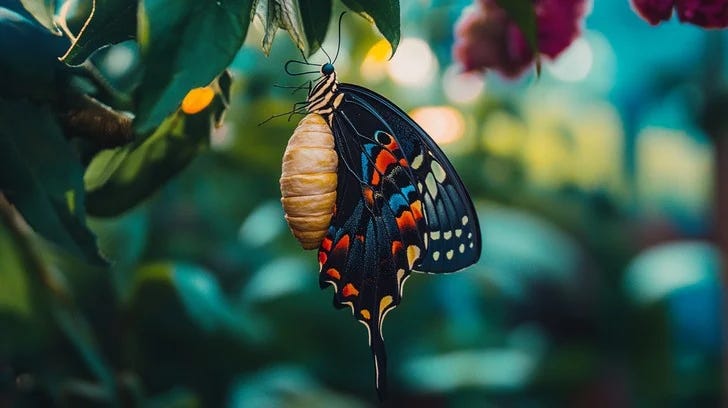
As those of you who are familiar with my work will know, I’ve spent a great deal of time studying patterns and cycles, trying to make better sense of these opening years of the 21st century. One of my routines is to challenge assumptions and to pose deeper and more profound questions. As a result I have been pondering whether perhaps the world isn’t in such a mess as we often project. Looking at transitional events in history, perhaps we’re in a period of a civilisational moult.
That distinction matters. A mess is something you tidy up. A moult is something you endure – and grow through – or die trying. I suspect we’re not just living through another swing of the pendulum or turn of the wheel. We’re living through a species-level phase transition – the rough, bewildering passage from one organising principle of world-system to another.
We reach too quickly for the wrong metaphors. We say history is cyclical, that it “comes around again”, as though we were condemned to an eternal carousel of empires rising and falling, bubbles inflating and bursting, revolutions devouring their children. That image is comforting because it implies familiarity. Whatever we’re going through, we tell ourselves, we have been through it before. But the wheel is a lie. A more faithful image is the spiral.
On the spiral, familiar motifs reappear – war, panic, exuberance, collapse – but never at the same altitude. Each recurrence exposes us to similar patterns under utterly different conditions. The French Revolution was not the Roman Republic in replay. The collapse of Lehman Brothers was not 1929 with smarter suits.
For roughly sixty years at a time – a long human heartbeat – industrial civilisation has lurched from expansion through hubris into crisis, and then contrived some kind of reset. I don’t believe what we’re experiencing today is just another slight course correction. The anxiety we’re feeling might signal something far deeper. It’s possible we’re nearing the apex of a multi-millennial spiral that began when our ancestors first tethered themselves to soil and surplus, exchanged roaming for roots, and domesticated not only plants and animals but each other.
If the 60-year heartbeat is valid – and there’s considerable evidence to suggest that large-scale technological, financial and geopolitical rearrangements tend to cluster around such a cadence – then what we’re living through today is not a mere arrhythmia. It’s a metamorphosis. Not an adjustment of policy settings, but a shift in the very state of the human psyche and world-system.
Physics has a term for this: phase transition. A phase transition is what happens when ice becomes water, or water becomes steam. Immediately before the transformation, the material becomes strangely unstable. Inputs that once produced predictable outputs suddenly fail. The system hesitates, shudders, “forgets” how to behave. Physicists sometimes call this a “critical slowing down”: the old order resists the new until it can resist no longer.
Civilisation is now in that superheated state. Everywhere we look, the structures we relied upon to keep the world intelligible are both hyperactive and paralysed. Governments legislate frantically while losing control of events. Central banks twitch the levers of interest rates with diminishing effect. Media systems shout louder and reach fewer open minds. Corporations try to algorithm their way out of ecological reality. It feels, to many, like systemic failure. Perhaps that’s one explanation. There’s another, less fatal, more demanding interpretation: we are witnessing the friction needed to break the molecular bonds of the Industrial–Materialist Age.
For five centuries, the dominant architecture of human coordination has been based on centralised verticals. Banks interposed themselves between savers and investment. States stood between communities and power. Editors filtered what could be said. Managers mediated between the labour of multitudes and the goals of a few.
This “middleman” scaffold was not an accident. Intermediaries were a necessary adaptation to a world in which information travelled no faster than the horse, the ship, or the telegraph; in which decisions had to be composed slowly and enforced physically; in which the majority were deliberately kept in varying degrees of ignorance, and a minority were trained to interpret and command.
As I have consistently pointed out in The Hames Report, that edifice is now disintegrating under its own latency. Light-speed information makes slow, hierarchical control look increasingly absurd. A planetary population, educated just enough to be dangerous, now expects to talk back. A child with a smartphone can see more of the world in an afternoon than most emperors glimpsed in a lifetime.
So the centralised verticals thrash and clutch, trying to remain indispensable by doing more of what made sense in a different epoch: more surveillance, more censorship, more securitisation, more financialisation, more institutional theatre. But a different architecture has already begun to appear in the cracks: distributed horizontals.
The term “decentralisation” has been debased by hype, but the underlying drift is unmistakable. Value is increasingly created, sensed and validated at the edges rather than the centre. Knowledge arises from lateral conversation rather than approved curricula. Collective action immunises itself, where it can, against capture by unaccountable elites.
In biological terms, an organism once governed by a few crude ganglia is in the act of growing a brain – and with a brain, a mind swiftly unfolds. The individual is no longer merely a subject, but a living node: signalling, learning, adapting, and at times sparking genuine novelty in concert with countless others.
We are not there yet. We’re in the ugly middle, where we manage to combine the worst of both worlds: the brittleness of old hierarchies with the cacophony of half-formed networks. But the direction of travel is not hard to discern.
The difficulty we encounter when we try to “fix” the present is that we’re still using an operating system written for scarcity, linear cause and effect, and the illusion of separation - from each other and from the more-than-human world.
The Industrial–Materialist worldview – what I have dubbed the world-system of industrial economism – was shaped by a Newtonian imagination: the cosmos as a gigantic clockwork, societies as collections of parts, economics as the art of extracting finite resources and allocating them through competition. It required zero-sum thinking to make sense. If I win, you lose. If my nation grows, yours must fall behind. If shareholders gain, ecosystems must cough up the difference.
Under that operating system, we trained generations to see themselves primarily as competitors in a marketplace, or cogs in a machine, rather than as participants in a living web. That worldview is now colliding, very publicly, with the real geometry of the world: a mesh of interdependencies so intricate that the old game looks reckless.
After all, a warmer ocean doesn’t much care which flag you salute. A virus doesn’t ask to see your ideology before it spreads its contagion. A financial product designed in New York can bankrupt a farmer in Kenya, who didn’t even know the product existed.
In science, a different set of images has been gaining traction for over a century now – quantum entanglement, network dynamics, non-linear feedbacks. These are not just toys for physicists or mathematicians. They are invitations to understand that we’re embedded in systems where the wellbeing of one node alters the potential of all the others.
We can phrase that clumsily as “interdependence”, or we can experience it viscerally as a reality: an upgrade in the health of a river basin in Brazil upgrades the climatic stability of villages in Pakistan and vineyards in Spain. A breakthrough in literacy for village girls in Mali alters the demographic, nutritional and political trajectory of entire regions over decades. A reduction in the anxiety of one child sleeping tonight in Gaza or Kiev or Yangon alters, infinitesimally but genuinely, the psychic sea in which every other child learns to swim.
When you begin to inhabit that kind of logic – call it complexity-logic if you must – the preoccupations of industrial economism start to look faintly deranged. If your trusted accounting system treats whole ecosystems, cultures and species as “externalities”, then the problem is not just moral. It is cognitive. You are misperceiving the field of play.
Astrology is rarely taken seriously in polite analytical circles. Yet even here, in this supposedly rational age, an awkward fact persists: human cultures have always sought to relate inner time – the tides of meaning and mood – to outer time – the patterns of the heavens. Whether the correlation is causal, symbolic, or coincidental remains a matter for debate. For a sceptic like me, what’s intriguing are the resonances that appear when we zoom out far enough.
I have to thank my friend Peggy Liu for drawing my attention to an intriguing historical resonance. Astronomers and historians can identify a conjunction of Saturn and Neptune around 4361 BCE, close to what astrologers later labelled 0° of Aries. Without leaning on any esoteric claims, we can treat that moment simply as a convenient timestamp – a marker on the long arc of human development.
Around that era, give or take a few centuries, we see the consolidation of sedentary agriculture, the rise of the first cities in Mesopotamia, the early formalisation of social hierarchies, and the advent of writing on clay tablets. The coincidence is at least suggestive: a celestial configuration used symbolically to denote “beginnings” aligns roughly with a period in which human civilisation was, demonstrably, reinventing its foundations.
We went from wandering to dwelling. From oral memory to recorded account. From clan to state. From immediate reciprocity to abstraction – debt, law, sovereignty. We domesticated animals more efficiently, but we also domesticated human beings by fencing them, counting them, taxing them, and conscripting them.
If that was the last great macro-reset – the graduation from nomadic bands to sedentary civilisation – then the resonance with our own period is chilling. For around that time, intelligence itself is being tamed.
Artificial intelligence, quantum computation, and ubiquitous sensing are not just new tools. They are a new medium for organising perception and action. Where the horse and the sail extended our muscles, and the plough extended our capacity to disturb the soil, we are now building extensions for cognition, memory and choice. The substrate of power is migrating from land and labour to data, models and code.
Just as the first writing systems enabled the palace and the temple to project authority across distance and time, so neural interfaces and energy-data infrastructures will, if we’re not vigilant, enable new forms of enclosure and control. Of that we should have no doubt. The warnings concerning a rampant Artificial Technology must be taken seriously. But they also carry the dormant possibility of a different sort of sovereignty: not the sovereignty of states over subjects, but of networks of humans over their own attention, creativity and care.
If the last reset gave birth to the State, this one will decide whether we can give birth to the Network as a genuinely emancipatory form, rather than as a more efficient cage.
We should not be surprised that everything feels cracked and sore. A species that has organised its affairs for six thousand years around the manipulation of physical stuff – grain, cattle, metals, oil – is now being dragged into a realm where value is increasingly to do with information and energy. In such a world, it’s no longer obvious how to “own” anything. It’s no longer obvious what a border means. For that matter, it’s no longer obvious who or what is labour, or capital, or citizen.
Our legal codes, institutions and moral reflexes were shaped for a world of fields and factories. Yet we now inhabit a space in which a teenager’s offhand video can tilt an election, an algorithm can quietly delete a culture’s memory, and an unseen server farm can consume more electricity than a small country.
We are like a snake half out of sloughing its old skin: part of us still anchored in the familiar constraints of geography and matter, part of us already moving in an intangible, always-on topology that pays little attention to maps. The friction between those two realities is what many, including myself, are experiencing as existential vertigo.
In mythic language, 0° Aries is that enigmatic threshold between void and form, a place where initiative explodes out of latency. What might that symbolise, if we use it as a thought experiment for this transition?
For much of modernity, the individual and the collective have been cast as adversaries. Either we worshipped the sovereign ego – the entrepreneur, the rugged pioneer, the self‑interested buyer – or we melted the person into the mass: the party, the nation, the race. Both framings belong to the industrial imagination. Both are now collapsing.
In a mature networked world, the “I” and the “we” no longer need to claw pieces off each other. The most autonomous person is the one most capable of entering into resonant relationships without losing their centre. The most resilient community is the one composed of individuals who don’t need to be coerced or bribed into contribution because in their bones they know that their wellbeing is inseparable from that of the whole.
What, then, does stability look like in such a world? It can’t rely on permanent employment contracts, obedient bureaucracies, or the pretence of technocratic omniscience. Those props are visibly crumbling. Stability must become internal: the capacity of human beings to remain coherent – attuned to their own purpose and values – while everything around them is in motion.
This is not a call for stoic withdrawal. It is closer to what musicians mean by “holding a key”: the ability to improvise wildly without losing the underlying tonality or pulse. To cultivate that kind of inner stability is not therapy for the privileged. It’s a civilisational requirement if we’re to pass through this phase transition without shredding our collective mind.
If the scaffolding of the Industrial Age is dissolving, what new forms might emerge in its place? One can already glimpse the outline of “liquid nations”: communities defined not by the soil they occupy but by the values they practise, the protocols they share, and the mutual obligations they accept. Some may well be anchored to existing states; but others will spread across jurisdictions, half-legal, half-ignored, experimenting with new ways of holding assets in common, resolving disputes, educating children, or regenerating land.
Such entities could deepen the current fragmentation, producing echo-chambers and gated tribes. Or they could offer an escape from the stale monoculture of neoliberalism – a pluralistic ecology of experiments in how to live well within planetary boundaries. Whether they become one or the other will depend less on the brilliance of their code and more on the maturity of their participants.
Here again, the “new human” is not a superhero in the Marvel comics sense, but a different quality of attention. Someone less fascinated by identity as spectacle and more committed to presence as praxis. Someone who can inhabit multiple affiliations without needing to weaponise them. Someone for whom leadership is not a role bestowed by hierarchy, but an emergent quality when people gather to improve some aspect of the conditions neededd for life.
At first glance, the world is being eaten by complexity. Supply chains, derivative markets, climate feedbacks, information cascades – the labyrinth seems endless and, for most, impenetrable. Our instinct is to respond with more of the same: more dashboards, more compliance regimes, more performance indicators, more surveillance, more five-year plans.
But all genuinely living systems, when they reach a certain threshold of convolutedness, face a more fundamental question: evolve simpler, more elegant patterns of organisation, or collapse under the weight of their own complication.
I don’t envisage the “Great Simplification” we’re headed towards as a return to some pastoral fantasy. It’s far more likely to be a re-alignment between what is technologically possible and what is humanly intelligible. A stripping away of bureaucratic barnacles that no longer serve, and an insistence that our tools become transparent enough for ordinary people to understand and govern.
Paradoxically, this may require us to embrace more advanced technologies – not as fetish objects, but as prosthetics for wisdom. Systems that reveal externalities instead of hiding them. Infrastructures designed to regenerate commons rather than plunder them. Interfaces that encourage reflection rather than addiction.
We are a caterpillar in a chrysalis state. From the caterpillar’s perspective, the world is ending: its body liquefies, its old coordinates dissolve, the appetites that once defined it become meaningless. Seen from a different vantage, nothing is dying except a particular form. Within the liquefaction, imaginal cells – tiny clusters of future potential – begin to recognise each other, to cluster, to insist on a new pattern. Has our species reached its imaginal moment?
Whether we emerge with wings or as a puddle of squandered possibility is not preordained. The 6,000-year resonance doesn’t dictate our choices; it simply reminds us of their magnitude.
The wheel is gone. The spiral has brought us to a precipice from which we can glimpse, if faintly for now, a civilisation in which intelligence is domesticated without being caged, power is exercised without domination, and stability arises from inner coherence rather than outer control.
Getting from here to there will continue to feel messy. History’s moults always do. But perhaps, if enough of us can learn to inhabit this turbulence as a phase transition rather than an apocalypse, we might yet deserve the wings that are struggling, in the dark, to form.
An amazing piece, an orchestration of more than a dozen realms of big picture comprehension forming what feels like a slowly coming-into-focus historical moment and potential future trajectory! From a necessary, though still glancing, critique of neoliberal capitalism and its foundation of industrial economism, to complexity theory and a hint of ecological awareness, to a nod toward cyclical patterns of history maturing into being seen as a spiral, to a place at the table for astrology, even if gently held at a distance from your corpus of sense-making, to the use of the biomimicry-like metaphor of chrysalis, to distributed vs centralized nearly everything - and yet a noted merger /marriage/co-existence of I and thou, agency and community (writ fractally), and finally both hope and threat of technology's sharp artificial edge. I would hope you might perhaps look further into archetypal representations of Saturn and Neptune, just as a lens to try on, not as an abdication of empiricism. And maybe to accentuate more the ecological crisis and how if not pastoral, at a minimum, ecological awareness is a critical piece of our potential coming wisdom, artificially extended, or not. I would strongly recommend Said Dawlabani's book, Second Sapiens: The Rise of the Planetary Mind and The Future of Humanity , as bringing together the pillars of ecological awareness, capitalism and its malignant end-game of neoliberalism, and human evolutionary development.
Your posts so often give me that “Aha!” moment. This one particularly gives me a sliver of hope; a feeling more absent than present nowadays. I had the best of times to be alive, I realise - growing up in the 60s/70s; my working life from the mid 70s to the early 2010s, and then what I’d hoped would be a period of reflection and consolidation. I’ve been saddened by what I see as reversals in values like kindness, thoughtfulness and the desire for the greater good. Your writing helps me to refine my own ideas and see a better way.