
The Gathering Storm
The Climate Crisis and Systemic Banking Collapse

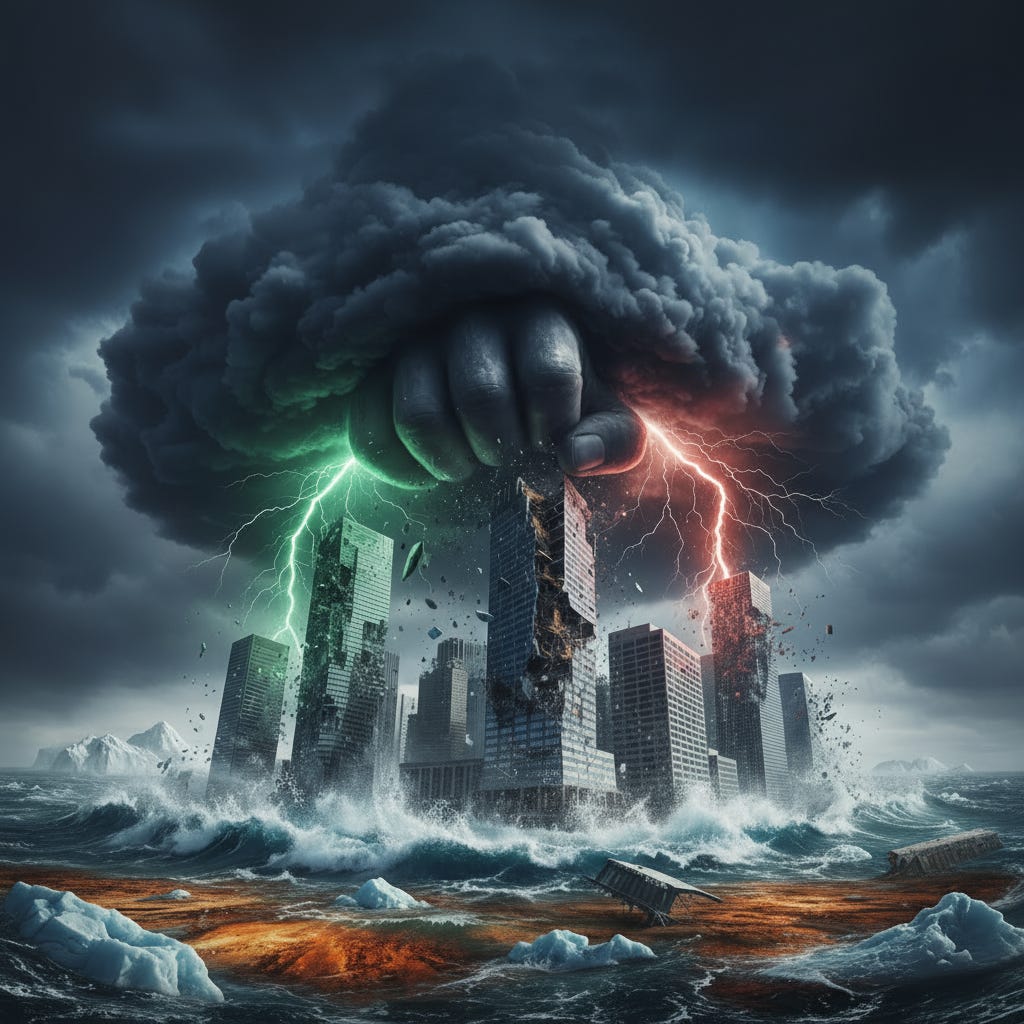
In May 2005 I warned a group of bankers at a luncheon in New York of a forthcoming financial crash. The 2008 crisis had its origins in the United States housing market, where years of loose lending and speculative confidence created a bubble that seemed unshakable. Banks and lenders handed out mortgages to millions with poor credit histories, betting that house prices would keep rising and allow even the riskiest borrowers to repay. At the same time, Wall Street was busily bundling these home loans into complex securities, packaging slices of risk and selling them on to investors across the globe. Rating agencies stamped them with reassuring grades, spreading the illusion that these instruments were far safer than they really were. For a time, it worked: rising prices masked the fragility beneath.
But when house prices began to fall in 2006 and 2007, the foundation crumbled. Borrowers defaulted, foreclosures multiplied, and the supposedly watertight mortgage‑backed securities turned toxic. Banks suddenly realised they had no idea who was holding the bad debt or how much was at risk. Fear took over. Financial institutions stopped lending to one another, starving the system of liquidity. Trust, the true currency of banking, evaporated. The collapse of icons like Lehman Brothers and the near‑failure of AIG sent shockwaves worldwide, dragging down banks in Europe and Asia in a rapid contagion. What began as a housing downturn in America metastasised into a global banking crisis, threatening to bring commerce itself to a halt. Only massive government and central‑bank intervention prevented a financial collapse even deeper than the Great Depression.
Today we are standing on the threshold of a catastrophe that will make 2008 appear, in retrospect, as a dress rehearsal for the main event. The signs are unmistakable, yet the financial establishment continues its somnambulant march towards disaster, just as it did in the years preceding subprime. This time, however, the catalyst is not merely human greed and regulatory failure, but the inescapable physics of a warming planet colliding with the brittle assumptions of our global banking system.
The architecture of modern banking rests upon a foundation so fundamental it is rarely questioned: the insurability of collateral. Banks, those paragons of risk aversion, extend credit primarily against secured assets, with property forming the backbone of their loan portfolios. In the United Kingdom alone, more than 85 per cent of all bank lending is secured against real estate. This system functions only so long as these properties remain insurable, for insurance converts uncertain future risks into manageable present costs. Remove insurance from the equation, and the entire edifice begins to crumble.
The climate crisis is systematically dismantling this foundation, property by property, region by region. From the fire‑scorched hills of California to the flood‑prone Thames estuary, from cyclone‑ravaged Queensland to sinking Jakarta, from the drought‑stricken Mediterranean to the typhoon‑battered coasts of the Philippines, properties are becoming uninsurable at an accelerating pace. This is not a distant possibility; it is happening now, as insurers withdraw from markets they deem too risky. When a property becomes uninsurable, it is effectively worthless as collateral, transforming what banks thought were secured loans into unsecured liabilities overnight.
The parallels to 2008 are striking, yet the differences are even more alarming. Then, uncertainty about the value of mortgage‑backed securities froze interbank lending as institutions lost faith in each other’s balance sheets. What we face today is not uncertainty but certainty—the undeniable knowledge that vast swathes of property collateral will become uninsurable. When that realisation dawns simultaneously across the global banking system, the panic will dwarf anything we witnessed fifteen years ago.
Consider the mechanics. As the climate emergency deepens, insurers will continue their retreat. Banks holding mortgages on these newly uninsurable properties will face catastrophic losses. Unlike 2008, when some institutions could profit from others’ distress, this crisis will offer no safe harbours. Every bank, in every climate‑affected nation, will face the same poisoned loan books. There will be no greater fool to whom these assets can be sold, no clean balance sheet to provide rescue finance.
The banking establishment’s response to this existential threat has been a masterclass in denial. Risk models continue to rely on historical data, as if the past could somehow predict a future fundamentally altered by atmospheric disruption. Some bankers privately console themselves with fantasies of offloading risky assets before the crisis hits, oblivious to the fact that the climate breakdown, unlike the subprime mortgage situation, cannot be hidden or repackaged. It manifests geographically in ways that are both specific and predictable. When sea‑walls in Miami are overtopped by rising seas, when Jakarta’s defences against flooding collapse, or when the Brisbane River surges once more into its floodplain, every institution will know simultaneously which properties have become worthless.
The consequences of a climate‑driven banking collapse would cascade with devastating speed. Modern civilisation depends utterly on functioning payment systems. When banks cease to trust one another, when transactions freeze and payments fail, the intricate supply chains that deliver food to supermarkets and fuel to petrol stations will shatter. Within days—even hours—panic buying would empty shelves. Salaries would go unpaid. Commerce would grind to a halt. The veneer of civilisation, we would quickly discover, is precisely as thick as our ability to make electronic payments.
Yet this catastrophe is not inevitable. We already possess the knowledge and tools to avert it—if only we can muster the will. Accounting frameworks are beginning to recognise planetary destabilisation as a systemic financial risk, though in radically different ways.
At the most cautious end are disclosure‑based approaches such as the Task Force on Climate‑related Financial Disclosures (TCFD), now incorporated into the International Sustainability Standards Board (ISSB), and the European Union’s Corporate Sustainability Reporting Directive (CSRD). These require companies to reveal how the climate crisis might affect them, offering investors clarity. But disclosure alone does not prevent collapse: it shows us exposure without testing survival.
A step further are valuation methods like Natural Capital Accounting and corporate Environmental Profit & Loss statements. These monetise the costs of water use, pollution, biodiversity loss, and carbon emissions. They give us a more holistic picture of business impacts, but still position the numbers at the margins of reports, not in the binding sections of balance sheets where solvency is tested.
At the most radical end stands Sustainable Cost Accounting (SCA). Rather than asking companies to merely describe risks or cost their externalities, SCA requires them to account for the full expense of aligning with environmental sustainability, including the true price of reaching net zero. These costs are treated like any other liability. A firm unable to show it can fund the transition is, under SCA, technically insolvent. It is the starkest lens we have: if you cannot afford to exist in a sustainable future, you cannot pretend to be a going concern today.
Taken together, these frameworks trace an arc—from cautious reporting, through broader valuation, to binding accountability. Each has its role. But history suggests disclosure alone will not avert systemic collapse. Without a methodology that forces costs onto balance sheets and tests solvency against ecological reality, the banking system will drift towards crisis while appearing deceptively healthy.
The insurance industry must also be restructured to remain viable in a climate‑destabilised world. This may require public‑private partnerships, with governments acting as insurers of last resort. It will certainly mean vast investment in resilience measures—flood defences, firebreaks, strengthened building codes—to keep properties insurable. Some regions may need to be abandoned entirely, their populations relocated through managed retreat rather than chaotic displacement.
Most critically, we must prepare public banking alternatives capable of keeping payment systems alive when private banks fail. Payment infrastructure is as vital to modern life as electricity or water. Governments must guarantee its continuity regardless of private collapse. This means creating state‑backed institutions ready to assume these roles permanently—not just in emergency, as in 2008, but as a standing safeguard against systemic failure.
Time is not on our side. The convergence of climate tipping points and financial fragility suggests we have perhaps a decade, possibly less, to act. Each year of delay shortens the road to systemic collapse. The choice before us is not merely whether to act, but how far we are prepared to go.
Disclosure‑based reforms may yield transparency, but they will not prevent insolvency cascades when whole regions become uninsurable. Broader valuation frameworks give us fuller pictures but keep liabilities at arm’s length. Only Sustainable Cost Accounting demands the full weight of the climate emergency be booked today. It alone forces confrontation with the contradiction between financial fiction and physical fact.
We can either content ourselves with incremental reform—comforted by better reports—or we can face the uncomfortable truth: our current banking system cannot endure. The storm is coming, whether or not we measure it. Only by bringing climate costs onto balance sheets, and by ensuring public institutions can sustain payment systems when private ones fail, do we preserve stability.
History will not remember which disclosure framework produced the prettier charts. It will remember whether, having seen the gathering storm, we built structures strong enough to withstand it. The atmosphere warms, the seas rise, the forests burn—and our time grows dangerously short. Those with eyes to see must choose now, for tomorrow may already be too late.