
The Hallucinated Self
An Inquiry into the Architecture of Perception

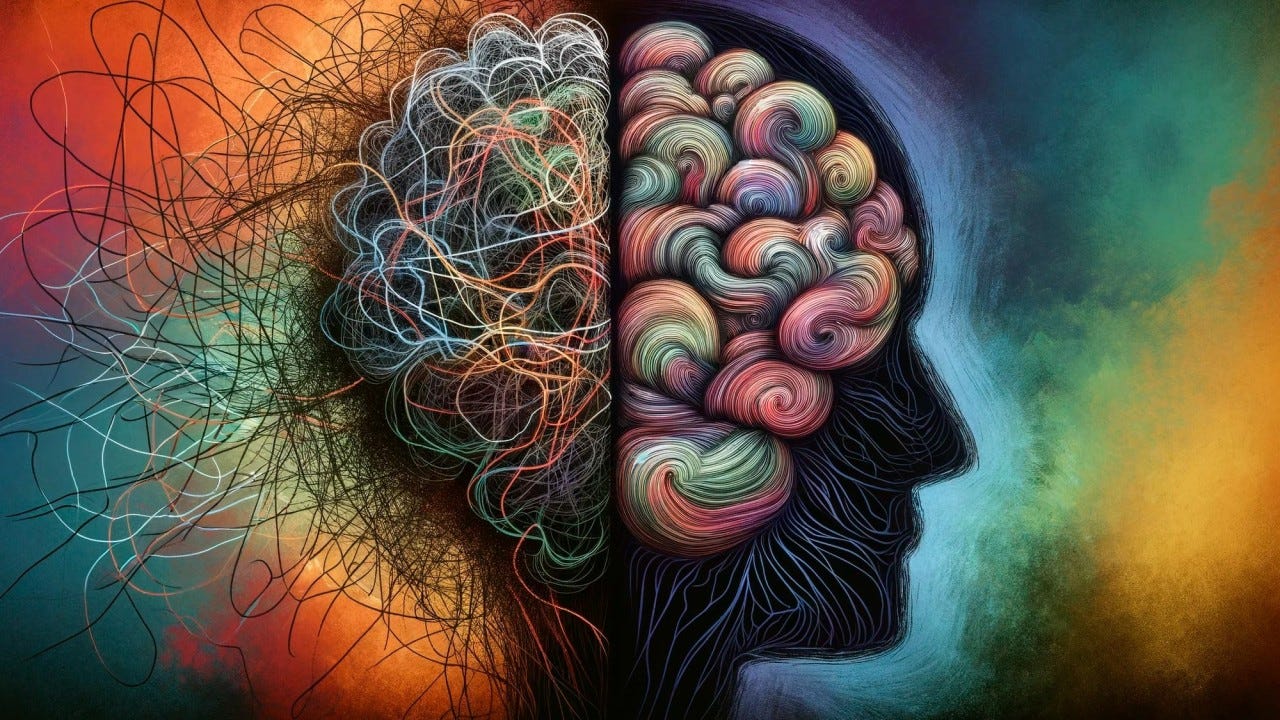
We don't see the world as it is. We see the world as we are—or, more precisely, as our nervous systems have conditioned us to expect. This fundamental truth about the nature of human perception was elegantly revealed in a simple yet insightful psychological experiment conducted in the 1980s. Specifically, a study by psychologists Robert Kleck and Angelo Strenta, published in the Journal of Personality and Social Psychology, which serves as an illustrative example rather than definitive proof of universal perception. Yet what it reveals about the mechanics of consciousness has implications that ripple through every sphere of human experience, from our individual psychology to collective political movements.
The researchers applied realistic makeup to participants, creating the appearance of a visible facial scar. After allowing subjects to confirm its presence in a mirror—thus anchoring their self-perception to this new reality—they were sent to interact with strangers, fully expecting to encounter judgement, rejection, or at minimum, uncomfortable attention.
Here's where the experiment takes its ingenious turn: the scar had been secretly removed before these encounters ever took place. Unknowingly, the participants entered their social interactions bearing no visible mark whatsoever. Yet when they returned to report their experiences, nearly all described having to confront rudeness, avoidance, or pity—reactions they naturally attributed to their facial disfigurement. The reactions they perceived were entirely imagined, a phantom projection of their own expectations. Their suffering, however, was undeniably real; its cause not the world's rejection, but their own anticipatory awareness of a scar that no longer existed.
This experiment illuminates a fundamental principle of neuroscience that has only become clearer in recent decades: the brain doesn't show us reality—it constructs a sophisticated hallucination based on expectations, prior experience, and predictive models. Once convinced of the scar's presence, the participants' minds filtered every glance, every pause in conversation, every subtle shift in body language through that anticipatory lens, warping neutral interactions into confirmation of their feared narrative. The brain, in essence, became a meaning-making machine calibrated to detect evidence of its own assumptions.
We all carry these invisible scars—traumas both personal and collective, insecurities embedded in our neural pathways, and stories that fundamentally distort our perception of the present moment. The experiment's genius lies not just in exposing this mechanism but in revealing its universality: much of what we call "reality" is our nervous system projecting old wounds, learned patterns, and anticipated futures onto the raw data of new moments. The pain feels viscerally real because it is neurologically real, but its origin often isn't "out there" in the external world. It resides "in here," in the stories we can't stop telling ourselves, the neural loops we can't escape. To be able to see clearly—to perceive with something approaching objectivity—we must first notice the scars we have forgotten we're bearing.
This is not merely a psychological curiosity or an interesting footnote in perception research. It represents a basic insight into the architecture of the human experience. Our brains do not present us with objective reality; they generate a simulation, a best-guess model based on past data, current sensory input, and future predictions. This understanding draws from cutting-edge predictive processing theories in neuroscience, such as those advanced by Anil Seth and Karl Friston, which posit perception as a form of "controlled hallucination"—though it's crucial to note this is a theoretical framework still being refined, not an absolute description of all cognition. The brain is constantly generating models of reality and testing them against incoming sensory data, adjusting when prediction errors become too large to ignore.
When the historical data feeding these predictive models includes trauma—whether personal, social, cultural, or even intergenerational—the model becomes systematically distorted. We begin to see threats where none exist, detect slights where none were intended, perceive oppression in neutral interactions. The pain is no less real for being internally generated, but its origin is not external. It exists within a self-perpetuating loop: expectation shapes perception, perception generates experience, experience reinforces expectation, and the cycle continues, often across generations.
Perception, we must understand, is not passive reception—it is active construction. The brain is not a camera faithfully recording reality but rather a sophisticated prediction engine, constantly generating hypotheses about the world and selectively attending to information that confirms or challenges these hypotheses. Paranoia, imposter syndrome, jealousy, and political tribalism all follow the same fundamental neural script: the brain, primed by expectation and past experience, filters reality to confirm its biases. A trauma survivor's nervous system scans constantly for threat, detecting danger in ambiguous stimuli. An insecure mind dismisses praise as politeness while amplifying criticism as truth. A jealous lover misreads innocent warmth as evidence of betrayal. Partisan brains literally split the same objective facts into opposing truths, each side convinced of their clear-eyed rationality.
The pain each person feels in these scenarios is undeniably, neurologically real—it activates the same brain regions as physical pain—but its origin is internal, a self-reinforcing hallucination maintained by selective attention and confirmation bias. To see clearly, we must first develop the metacognitive capacity to notice the stories we're unconsciously telling, then cultivate the courage to ask: Is this the world revealing itself to me, or is this my nervous system's worn-out prediction, a ghost of past experience haunting present perception?
Victimhood, I would argue, falls squarely into this category of perceptual distortion. It's not merely a social role one adopts or a political stance one takes. It's a neural habit, a deeply ingrained pattern of perception and interpretation. The brain, once primed by trauma or its narrative—whether experienced directly or inherited culturally—becomes exquisitely hypersensitive to confirmation. Like a radio tuned to a specific frequency, it filters out static and amplifies signals that match its anticipations. This neurological tuning explains why two people can inhabit the same moment, witness the same events, and experience entirely different realities—one sees hostility where another sees neutrality; one detects conspiracy where another observes mere coincidence; one perceives systematic oppression where another sees isolated incidents or even progress.
Consider, as a particularly poignant example, the intergenerational trauma of Holocaust survivors and their descendants. The unimaginable horror of genocide leaves scars not just in memory and culture but potentially in the very wiring of the nervous system itself. Emerging research on epigenetics, including groundbreaking studies by Rachel Yehuda and colleagues examining Holocaust survivors and their children, suggests measurable changes in stress-related genes that can be passed down through generations, though this field is still evolving and cannot fully explain all aspects of transmitted trauma. These potential biological changes, combined with familial narratives of persecution and cultural memories of existential threat, may condition later generations to anticipate danger, to see in present circumstances the shadows of historical horror.
This hypervigilance is adaptive in the short term—it may indeed be lifesaving in genuinely dangerous contexts—but over decades and generations, it can progressively distort perception. A raised eyebrow at a dinner party, a political disagreement about Middle Eastern policy, a critique of contemporary Israeli government actions—each may be interpreted through the lens of historical trauma, as evidence of resurgent antisemitism rather than ordinary social friction or legitimate political discourse. The pain and fear are authentic, viscerally felt, but the cause may be misattributed—a projection of past collective trauma onto present individual interactions.
Of course—and this is crucial—this analysis doesn't negate instances of genuine antisemitism, Islamophobia, gender inequality, racism, or any other form of discrimination, which absolutely exist and must be confronted directly and forcefully. The point is to develop the discernment to distinguish between actual present threats and the phantom echoes of historical wounds, to know when we're responding to real danger versus when our projections are amplifying or misdirecting our responses to ambiguous stimuli.
Nor is this analysis intended to dismiss real discrimination or minimize historical injustices. It is to acknowledge, with both compassion and clarity, that the brain, once scarred, tends to project that scar onto the world, seeing its shape in every shadow. And when entire communities share the same scars—the same historical traumas, the same narratives of persecution, the same epigenetic inheritance—the projections become collective, a shared hallucination of threat that shapes political movements, international relations, and cultural identities.
Importantly, this dynamic isn't limited to those who identify as victims. Oppressors and dominant groups often have their own profound perceptual distortions—blindness to privilege, elaborate rationalizations of harm, inability to perceive suffering they've caused, defensive reactions to any challenge to their worldview. These complementary distortions create a mutual cycle of misunderstanding, a kind of perceptual arms race where each side's projections confirm the other's worst fears, perpetuating conflict across generations.
There is, we must acknowledge, a seductive power in victimhood that goes beyond mere sympathy-seeking. It offers moral clarity in an ambiguous world, a stable sense of identity in fluid times, and—perhaps most ironically—a form of agency and control. To be a victim is to be innocent by definition; to accuse is to claim a particular kind of authority that's difficult to challenge. The participants in Kleck and Strenta's study were not just passive observers of their own suffering. Their belief in the scar most likely shaped their entire demeanour—their interactions, their posture, their tone of voice, their eye contact patterns. They may have emitted subtle cues—hesitation, tension, defensiveness, expectation of rejection—that actually influenced how others responded to them. In this way, victimhood can become a self-fulfilling prophecy, creating the very reality it claims to only observe.
The ego thrives in this space of righteous suffering. Nothing inflates the sense of self more than the conviction of having been wronged, of standing on the moral high ground, of being part of a persecuted elect, the chosen ones. And yet, this very inflation is a trap, a prison of perception. When victimhood becomes a core identity—when it moves from something that happened to you to something you are—it progressively narrows the field of possible experience. The world becomes rigidly split into oppressors and allies, threats and safe spaces, those who "get it" and those who don't. All subtlety collapses into Manichean clarity. The mind, desperately seeking coherence in its constructed narrative, filters out anything that contradicts its narrative, any evidence of progress, kindness, or common humanity that doesn't fit the victimhood script.
The solution to this perceptual prison is not positive thinking, which merely overlays one delusion with another: it doesn't help to urge a depressed person to cheer up. It is not denial, which refuses to acknowledge real pain and real history. It is not even "resilience" - at least in the clichéd, bootstrap-pulling sense that's often prescribed. It is something far more radical and demanding: the willingness to ruthlessly interrogate the scaffolding of one's own perceptions, to become a scientist of one's own consciousness. This means acquiring the pluck to ask confronting questions: What scars am I still carrying that no longer exist? What wounds am I keeping fresh through constant rehearsal? Is this pain coming from the present moment, or from an old story I can't stop repeating? How much of what I perceive as objective reality is actually a neural prediction error, a ghost of past experience projected onto neutral present circumstances?
This process of perceptual archaeology is tough. The brain actively resists uncertainty—it's metabolically costly and existentially uncomfortable. We prefer the familiar comfort of known suffering to the anxiety of an uncharted world. Our neural patterns, etched deep through constant repetition, don't yield easily to conscious intervention. Moreover, this work requires support structures—accessible therapy, contemplative practices, community dialogue—and carries risks, such as the potential for self-doubt to veer into invalidating genuinely harmful experiences or gaslighting oneself about real injustices.
But liberation—true perceptual freedom—begins when we recognize that our experienced reality is, in significant part, a construction, an hallucination that can be revised through conscious effort and new experience. This isn't about denying objective facts but about recognizing how much of what we take to be objective is actually deeply subjective, filtered through the lens of our conditioning.
The implications of this perceptual revolution are vast and disruptive across every sphere of human experience.
In the therapeutic context, it calls for more than symptom management or coping strategies—it demands nothing less than perceptual rewiring. Traditional therapeutic approaches often focus on teaching patients to cope with "reality." But if that reality is itself a neural construct based on outdated predictions, the real work involves a dismantling of the brain's faulty predictive models. Techniques like mindfulness meditation, somatic experiencing, and exposure therapy aren't just tools for building resilience; they're methods for debugging our neural software, helping patients distinguish between present-moment sensory experience and the persistent echoes of past conditioning. However, we must acknowledge that access to these transformative therapies remains tragically unequal, stratified by class, race, and geography. Any serious societal solution must include broader mental health resources, psychedelic-assisted therapies where appropriate, and public education about the constructed nature of perception, to make this kind of perceptual rewiring feasible for all, not just the privileged few.
In our social relations, this insight demands a radical epistemic humility. Our fiercest debates—about justice, power, identity, truth itself—often collapse into deadlock not because one side is right and the other wrong, but because we mistake our neural habits for objective facts. What we call "common sense" is often just well-rehearsed bias, so familiar we've forgotten it's learned. What we dismiss as "irrational" or "hysterical" may be someone else's equally coherent (but differently wired) reality, based on different coding. Progress in our fractured societies requires learning to hold any certainties lightly, recognizing that even our most cherished convictions are, to some degree, personalised hallucinations shaped by our particular path through life.
In the political realm, the stakes of this perceptual revolution are nothing less than existential. Ideological polarisation thrives not simply because competing groups disagree on policy—it thrives because they inhabit fundamentally different perceptual worlds, each group convinced the other is not just wrong but deluded, malicious, or insane. The solution isn't bland compromise or false equivalence but rather the cultivation of collective metacognition: the ability to step back from our own perceptual apparatus and ask, "Is this grievance rooted in current harm that requires immediate action, or is it the replay of historical trauma seeking a contemporary target? Am I responding to what's actually happening, or to what I've been programmed to expect?" Without this discernment, we risk mistaking projection for principle, recycling old wounds as new conflicts, fighting yesterday's battles with today's weapons.
The path forward doesn't start with dismissing subjective experience as "mere perception"—that would be both cruel and futile. It starts with mapping the origins of our perceptions, tracing their genealogy, separating the signals of present injustice (which demands action) from the noise of neural habits (which demands healing). Only when we can make these distinctions will we be able to construct a shared reality sturdy enough to hold us all, flexible enough to evolve, and accurate enough to guide wise action.
For the descendants of trauma—whether Jewish, Black, Indigenous, Palestinian, or any other group with histories of persecution written into their collective psychology—the challenge is particularly acute: how to pay tribute to memory without being imprisoned by it. How to remember the past vividly enough to prevent its repetition, but without letting it totally colonize the present. How to recognise that while the historical scars were absolutely real, they need not forever distort our vision of what's possible.
This empowerment cannot be achieved through individual struggle alone. It needs collective effort—community dialogues that simultaneously validate historical experience while fostering tools for perceptual discernment, educational curricula that teach both history and metacognition, therapeutic modalities that address both personal and collective trauma, and political movements that can hold the paradox of acknowledging past harm while working toward future healing. We must ensure that honouring history serves to strengthen and liberate rather than confine and perpetuate cycles of mutual projection.
We are not, despite our subjective experience, passive recipients of an objective reality "out there." We're active engineers, the architects of our own perceptual worlds. Our brains are prediction engines, and we are both their programmers and their products. And if we can learn to see not just through our perceptual apparatus but to see the apparatus itself—to understand its mechanisms, its biases, its ghosts—we might be able to begin the most important work of our time: designing a less haunted world, one where the scars of the past inform but don't imprison, where trauma is transformed into wisdom rather than perpetuated as blindness, where we can finally see each other clearly enough to recognise our shared humanity beneath the projections and behind the masks.
This is the future I hope for and desire—not one where we transcend human perception (an impossibility), or allow machine intelligence to do it for us—but one where we become conscious collaborators in its construction, aware of our role as both artist and artwork in the great canvas of experienced reality. In that awareness lies our freedom, and in that freedom, perhaps, lies our only hope for genuine healing across the chasms that divide us.