
The Illusion of Command
Why Politics Explains More Than It Determines

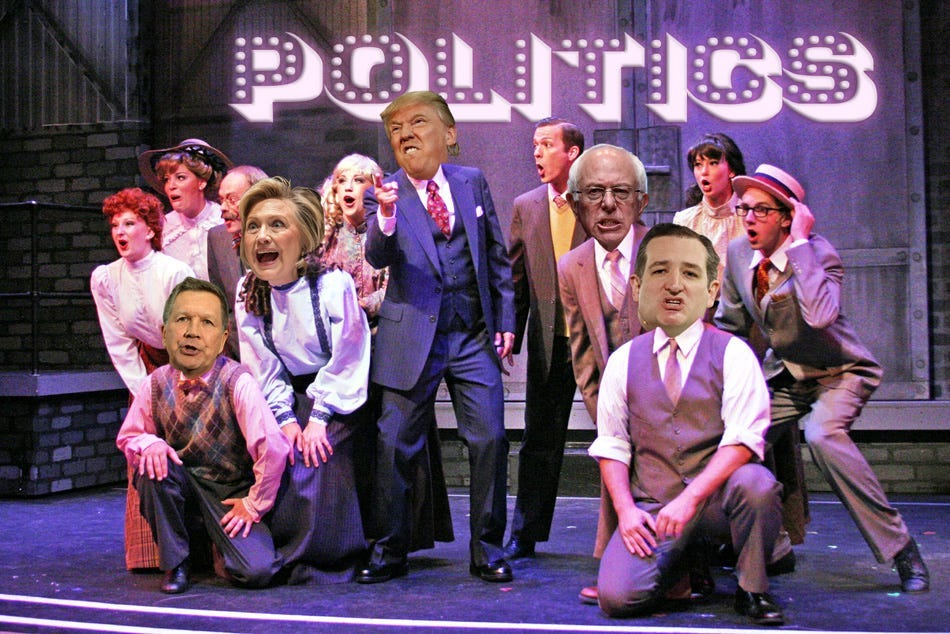
There’s something peculiarly comforting in the belief that someone is steering the ship. We crave the reassurance that behind the turmoil of contemporary life sits a control room—staffed by politicians, lobbyists, bureaucrats and power brokers; anyone with any competence in fact—where decisions cascade down through society like water through an irrigation system. This is the fairy tale of modern civics: that electoral mandates translate into policy, policy into law, law into lived reality.
But what if this entire architecture is largely theatrical? What if politics functions less as the engine of history and more as its narrator—arriving breathless at scenes already unfolding, claiming authorship of dramas it barely comprehends?
This isn’t a cynical dismissal. It’s an invitation to see the reality more clearly.
The Mirage of Centrality
Walk into any parliament, any congress, any legislative chamber, and you’ll witness the performance of governance. Debates rage. Amendments are tabled. Votes are tallied. The machinery hums with apparent purpose. Yet step back far enough and a different picture emerges: politics as ritual, not causation. A kind of civic theatre where the actors believe their lines matter more than they do.
History’s genuine turning points rarely wait for permission slips from elected officials. The printing press didn’t pause for a parliamentary committee. Penicillin didn’t seek regulatory approval before saving millions. The internet exploded across the planet not because governments willed it into being, but because engineers, entrepreneurs, and users created networks that outpaced any legislature’s capacity to comprehend them, let alone direct them.
Technology reshapes reality first. Economics redistributes power second. Culture absorbs or resists these shifts third. Politics arrives last, drafting legislation for worlds already transformed, then takes credit—or assigns blame—depending on which way the wind blows.
The Real Architects
If politicians aren’t piloting civilisation, who or what is?
Begin with technology itself—not as neutral tool but as autonomous force. Every major technological leap redraws the boundaries of possible human organisation and potential. Agriculture birthed hierarchy. Literacy enabled empires. Fossil fuels ignited industrialisation. Digital networks dissolved geography. These weren’t policy choices. They were ontological upheavals that politics scrambled to accommodate.
Then there’s economics, that relentless tide of incentives and constraints. Capital flows where it finds fertile ground, indifferent to borders or ballot boxes. Supply chains self-organise across continents. Markets punish inefficiency faster than any electorate can. Politicians may claim to manage economies, but mostly they surf waves they can’t see coming.
Beneath both sits an entire substrate of non-political institutions: central banks calibrating interest rates, standards bodies defining technical protocols, insurance actuaries pricing risk, credit rating agencies determining sovereign credibility, logistics firms choreographing global trade, platforms mediating human connection. These entities rarely appear on front pages, yet they set the operating conditions for everything else. They are the silent legislators of our age.
And deeper still? Culture. That vast, slow-moving ocean of norms, taboos, aspirations, and unspoken agreements about what constitutes a good life, a just society, a tolerable compromise. Politicians can pass laws forbidding what culture permits, but culture digests law like an acid, dissolving what doesn’t fit. Same-sex marriage became legal only after it had already become culturally inevitable. Cannabis prohibition crumbles not because legislators suddenly saw the light, but because millions of people simply stopped caring about the prohibition. If culture is the bedrock; politics is the weather.
What Politicians Actually Do
So if they’re not running the world, what exactly are politicians doing? Well may you ask!
First, they function as speed bumps. They slow things down, filter proposals, blunt sharp edges. Sometimes this stabilises volatile situations. Often it just delays necessary adaptation. Regulatory frameworks designed for yesterday’s technologies constrain tomorrow’s possibilities. Bureaucracies optimised for industrial-era problems flounder before exponential change.
Second, they legitimise what’s already occurred. Once a transformation becomes undeniable, politics steps in to ritualise it through legislation, to weave it into the national story, to assign heroes and villains. Civil rights legislation didn’t create the moral imperative for racial justice; it acknowledged a cultural shift already evident. Environmental laws didn’t invent ecological consciousness; they codified values that activists, scientists, and citizens had been cultivating for decades.
Third, they do their best to manage crises—those acute moments when coordination becomes existential. Conflicts. Pandemics. Financial collapses. Here politics can matter enormously, but even then outcomes depend less on speeches than on administrative capacity, stable relationships, institutional memory, and public trust. The disparity between South Korea’s and Brazil’s pandemic responses, for instance, wasn’t rhetorical flair; it was state competence, cultural cohesion, and decades of investment in public health infrastructure. Politicians stood at microphones, but systems determined outcomes.
The Myth of the Puppet Master
We love conspiracy theories because they offer a perverse comfort: at least someone is in control. The notion of shadowy power brokers pulling strings from behind velvet curtains satisfies our hunger for narrative coherence. If only we could identify the real decision-makers—the financiers, the oligarchs, the tech titans, the military-industrial complex—then we could understand how the world really works.
But power today is far more diffuse and contingent than these fantasies allow. Yes, certain actors wield disproportionate influence. A handful of tech platform owners and media barons shape global discourse. Energy conglomerates can topple governments. Financial institutions can trigger cascading collapses. Yet even these titans operate within constraints they didn’t design and cannot fully escape: such as technological path dependencies, market volatilities, legitimacy crises, and unintended consequences that ricochet back upon them.
Take the fossil fuel industry, often cast as an omnipotent villain. For decades it successfully delayed climate action through lobbying, disinformation, and regulatory capture. Yet now it faces an existential threat not primarily from activists or politicians, but from the plummeting cost of renewable energy—a technological and economic shift that no amount of lobbying can reverse. Power, it turns out, is situational and fragile.
The fantasy of total control is mostly retrospective. We look back at history and impose coherent narratives on what was actually a churning mess of contingency, accident, and emergence. We tell ourselves the Second World War was inevitable, that decolonisation was orchestrated, that globalisation was planned. But talk to the people who lived through these transformations and you hear stories of improvisation, confusion, and surprise. History happens first. Politics explains it later, usually badly.
When the Dashboard Becomes the Engine
The most dangerous delusion at the heart of modern governance is politicians mistaking the instruments for the machine. They monitor GDP growth, unemployment figures, inflation rates, approval ratings—and convince themselves these metrics represent reality rather than thin abstractions of infinitely more complex processes.
A finance minister announces stimulus measures and watches stock markets rise, then claims to have “saved the economy.” But what actually happened? Most probably liquidity flooded into asset prices while structural inequalities deepened. Supply chains remained fragile. Innovation ecosystems either thrived or withered based on factors far removed from fiscal policy. The dashboard lit up in encouraging ways while the engine sputtered.
This confusion between representation and reality pervades political discourse daily. We debate immigration policy as if it were the primary driver of demographic change, when fertility rates, urbanisation patterns, climate displacement, and economic desperation matter far more. We argue about education reform as if legislation could fix schools, when learning outcomes depend on poverty levels, family stability, cultural attitudes toward knowledge, and technological disruption of traditional pedagogy.
Let’s face it. Politics operates in the realm of the legible—those aspects of social life that can be counted, regulated, and legislated. But most of what matters unfolds in the illegible spaces: informal networks, tacit knowledge, emergent norms, slow cultural evolution. You cannot legislate trust into being. You cannot regulate your way to social cohesion. You cannot mandate innovation or forbid decline.
The Industrial Paradigm’s Last Gasp
What we’re witnessing today isn’t just political dysfunction but the exhaustion of an entire worldview. The industrial paradigm—that seductive civilisational operating system I’ve elsewhere called industrial economism—rests on assumptions that no longer hold:
It assumes linear causation: pull this lever, get that result. But complex adaptive systems don’t work that way. They exhibit emergence, feedback loops, tipping points, and phase transitions. They respond to interventions in perverse and unpredictable ways.
It assumes hierarchy and centralisation: power flows from the top down, and those at the apex can direct those below. But networks long ago displaced hierarchies as the ost dominant form of organisation. Information flows horizontally. Authority fragments. Legitimacy becomes provisional.
It assumes infinite growth on a finite planet, externalising ecological and social costs onto future generations and marginalised populations. This extractive logic has generated immense wealth and equally immense devastation, and now approaches biophysical limits that no amount of political rhetoric can wish away.
Politics, as currently constituted, is the institutional expression of this dying paradigm. It cannot solve problems it was never designed to address. Asking twentieth-century political structures to govern twenty-first-century realities is like asking a steam engine to run on quantum entanglement. The fundamental architecture is mismatched to the task.
Where Leverage Actually Lives
If politics is mostly theatre, where does genuine agency reside? In the design of systems, not the occupation of offices. In the cultivation of culture, not the winning of arguments. In the patient construction of institutions that embody different values, different logics, different possibilities.
Think about how Wikipedia came to exist. No government commissioned it. No parliament debated its necessity. A handful of people around Jimmy Wales imagined a different way of organising knowledge, built tools to enable it, and invited participation. Within just two decades it became humanity’s most comprehensive encyclopaedia, maintained by volunteers, accessible to anyone with internet access. It didn’t defeat Encyclopaedia Britannica through political action; it rendered that entire model obsolete by demonstrating a superior alternative.
Or consider the spread of permaculture—not through agricultural ministries but through farmer-to-farmer networks, design courses, and lived demonstration that regenerative systems can outperform extractive monocultures. Seeds of change, quite literally, dispersed through informal channels while official policy remained captured by industrial agriculture’s lobby.
Or the quiet revolution in decentralised energy: rooftop solar, community microgrids, battery storage. These technologies diffuse through economic logic and grassroots adoption, not legislative mandate. By the time politicians notice, the transformation is already underway, and their role becomes merely to remove obstacles or claim credit.
This is where moral energy and strategic intelligence should focus: on designing and building the world we need rather than begging permission from those who benefit from the world in which we’re trapped. Not withdrawal from politics entirely—voting matters, advocacy has its place—but a recognition that electoral politics is one small implement in a much larger toolkit.
The Uncomfortable Questions
If this analysis holds, we face several disquieting implications.
1. Democracy as currently practised may be structurally incapable of addressing exponential change. Electoral cycles reward short-term thinking. Representative systems aggregate preferences poorly. Media ecosystems incentivise outrage over understanding. Lobbying ensures that concentrated interests outmanoeuvre diffuse publics. These aren’t bugs; they’re features of a system designed for slower, simpler times.
Does this mean democracy should be abandoned? Probably not. But it may need a degree of renewal and reinvention so fundamental that calling the result “democracy” might be misleading. What would effective governance look like if designed from scratch for a networked, multipolar, ecologically constrained, technologically accelerating civilisation? Nobody knows, but the answer won’t resemble Westminster or Washington, that’s for sure.
2. The nation-state itself may be an increasingly obsolete organising principle. Capital, data, pollution, pandemics, and cultural memes all ignore borders. Yet politics remains stubbornly territorial, trapped in Westphalian logic centuries old. We face planetary challenges with parochial tools. This mismatch will only intensify.
3. If politicians are mostly friction rather than propulsion, then obsessive focus on electoral outcomes may be a catastrophic misallocation of our attention. Millions of people pour their hopes, fears, and identities into partisan combat while the actual drivers of their lives—technological trajectories, economic structures, cultural narratives—evolve largely unnoticed and uncontested.
None of these mean politics is irrelevant. It means politics-as-usual is dangerously insufficient and a theatrical gloss on top of the real job of governance.
Beyond the Binary
I can already hear the objections. Isn’t this just libertarian fantasy dressed in philosophical garb? A convenient excuse for the wealthy and powerful to dismantle what little democratic accountability remains? Not remotely. The critique cuts in all directions.
Yes, markets and technologies shape outcomes more than legislatures do. But markets themselves are political constructs, rule-systems designed to favour certain interests. Intellectual property regimes, corporate personhood, limited liability, subsidies, bailouts: these are political choices that create the economic playing field. Recognising that politics often fails doesn’t mean embracing market fundamentalism. Markets fail spectacularly too, just differently.
And yes, culture evolves organically—but culture is also contested terrain, shaped by who controls media, education, and mythology. The stories we tell about who we are and what’s possible determine which futures we can imagine, let alone build. Recognising the power of culture doesn’t mean passive acceptance of existing norms. It means engaging in the deeper work of cultural transformation rather than mistaking legislative battles for civilisational change.
The point isn’t to replace political engagement with technocratic management or market veneration. It’s to see clearly what politics can and cannot do, so we stop expecting salvation from institutions designed for different problems.
The Heretic’s Proposition
Let me offer a proposition that will satisfy neither progressives nor conservatives, neither anarchists nor authoritarians: politics matters most when it gets out of the way.
Hang on… isn’t this just small “l” conservatism in disguise – the familiar hymn to small government and the invisible hand? That suspicion is understandable, given the way the phrase “get government out of the way” has been weaponised to justify everything from the looting of public assets to the abandonment of entire communities. But that’s not what I’m pointing to.
I don’t mean slashing public services, privatising everything that moves, and trusting industrial economism to magically convert private greed into public good. We have half a century of evidence, from Latin America to Eastern Europe to the rust‑belts of the old “developed” world, that such dogma simply deepens inequality, hollows out civic life, and hands the future to those already in possession of capital and lawyers.
Nor do I mean the opposite reflex: the fantasy that a more muscular, omnipresent state can engineer virtue from above so long as the “right” faction is in charge. That experiment has also been run, in various ideological costumes, with results that are amply documented in the scars of surveillance, bureaucracy and fear.
When I say politics matters most when it gets out of the way, I am talking about something more subtle and, I suspect, more subversive. Politics should clear space for stewardship in a far deeper sense: ordinary people, in all their messy particularity, organising to improve one or more aspects of community life. The role of formal politics, in that framing, is to enable those energies – to set simple, transparent ground rules, protect the vulnerable, prevent concentration of unaccountable power – and then withdraw from micro‑managing the living tissue of society.
Getting out of the way, in other words, is not abandonment. It’s restraint. It’s the refusal of the state, or the party, or the “leader”, to colonise every domain of public life as if citizens were errant children to be scolded or pacified, consumers to be herded, or units of labour to be optimised. In practice, that might mean:
Laws that guarantee open information, basic rights and ecological limits – and then trust communities, cooperatives, local enterprises and translocal networks to invent the specific arrangements that fit their context, rather than dictating uniform solutions from the capital.
Fiscal and regulatory structures that curb predatory behaviour and monopoly, but stop short of deciding which stories people may tell, which questions they may ask, which forms of association they may explore.
A politics willing to accept that some of the most vital work in a culture – raising children, tending land, holding rituals, caring for elders, defending rivers – will never show up on a minister’s scorecard, yet is the very ground on which any civilised society rests.
Both the conventional left and right find this uncomfortable. Authoritarians of every stripe distrust unchoreographed collective life; they want obedience, or at least deference. Market fundamentalists are equally suspicious of anything that cannot be monetised; they want consumers, not citizens.
But if time will pass anyway, and if “leadership” in its healthiest form is a shared phenomenon, then any political arrangement that habitually blocks, exhausts or trivialises citizen initiative is a theft of time on a grand scale. It converts human potential into queueing, form‑filling, algorithmic nudging and televised outrage.
Politics matters most when it gets out of the way of that: when it stops monopolising the definition of what a good life is, stops scripting every conversation in the language of growth and security, and allows other vocabularies to flourish – of sufficiency, reverence, repair, conviviality. The finest moments of governance aren’t grand visions imposed from above but the removal of obstacles to human enterprise and flourishing that already wants to happen. The repeal of unjust laws. The dismantling of extractive monopolies. The protection of commons from enclosure. The creation of space—legal, economic, cultural—for experimentation and emergence.
This isn’t laissez-faire ideology. It’s recognition that wisdom is distributed, not concentrated; that solutions to complex problems rarely come from central planning but from the edges, the margins, the places where necessity breeds invention. The role of good governance, then, becomes less about directing society and more about tending the conditions under which societies can direct themselves.
Think of it as cultivating rather than engineering. A gardener doesn’t make plants grow—that’s just what plants do. A gardener creates conditions: soil fertility, water availability, protection from pests, strategic pruning. The gardener works with living systems, respecting their autonomy while shaping their environment. An engineer, by contrast, imposes design on inert materials, controlling every variable.
Industrial-era politics imagined itself as engineering. It built massive bureaucracies to manufacture social outcomes through policy interventions, assuming human communities were inert materials awaiting expert configuration. This occasionally worked for simple, clearly-defined problems: building highways, eradicating smallpox, establishing pension systems and the like. But it fails catastrophically when applied to complex, adaptive challenges where the “solution” itself transforms the problem.
What we need now is political gardening: governance that understands itself as participating in living systems rather than controlling mechanical ones. This requires the kind of humility and aptitude that most politicians lack and most electorates don’t reward.
The Civilisational Hinge
We’re in an age where ultiple crises are converging. Ecological breakdown, technological disruption, the collapse of legitimacy, and the failure to make sense of what’s happening aren’t discrete problems but symptoms of a single underlying condition—the exhaustion of the industrial worldview and the absence of a coherent successor.
In such moments, politics becomes simultaneously more important and less effective. More important because the stakes verge on the existential; less effective because the tools available were forged for earlier battles. It’s like trying to perform surgery with a chisel—the urgency is undeniable but the only available instrument is catastrophically inappropriate.
History suggests that civilisational transitions don’t happen through political processes. They happen beneath and around them. The shift from feudalism to modernity wasn’t legislated; it emerged from technological change (printing, navigation, industrialisation), economic transformation (mercantilism, capitalism), and cultural revolution (humanism, scientific method, individual rights). Politics eventually caught up, sometimes accelerating the transition, more often resisting it, ultimately accommodating what had already become inevitable.
We’re in the early stages of another such transition, though what lies on the far side remains obscure. The old indstrial world is dying; the new ecological world struggles to be born. In this interregnum, as Gramsci observed, morbid symptoms appear. And one of those symptoms is the frantic insistence that if we could just elect the right leaders, pass the right laws, defeat the right enemies, everything would be fine and hunky dory.
But it won’t be fine. Not because politics is irrelevant, or at least doesn’t need to be, but because the crisis is ontological, not managerial. We need new ways of being human on a finite planet, new stories about meaning and purpose, new institutions embodying different values. These emerge from the bottom up, the edges in, through experiment and dialogue and the patient work of cultural transformation. Politicians can help or hinder this emergence, but they can’t create it through fiat.
The Paradox of Power
I have often proclaimed that we’re governed by the least of us. It’s the deepest irony that those who most loudly proclaim their power to fix things are usually those with the least capacity to do so. Meanwhile, those with genuine leverage—the system designers, the culture shapers, the institution builders—often work in obscurity, their contributions invisible until decades later.
Look at the way cities have been shaped far from the ballot box. Across Europe, Asia, Latin America and Africa, the everyday choreography of streets, housing and public space has been decided less by elected officials than by planners, engineers, investors and bureaucrats whose names never appear on campaign posters. Le Corbusier’s schemes for “radiant” cities, for example, left their imprint on urban form from Chandigarh to parts of Marseille. In Japan, the post‑war fusion of construction companies, national ministries and local brokers produced a landscape of dams, concrete riverbanks and elevated expressways – what some Japanese commentators have called the “construction state”. In both cases the lived experience of millions was altered not by a single election, but by a long deposit of decisions taken in committees and design studios that most citizens never saw.
Or take the way ideas rearrange political possibility long before they win formal office. Václav Havel did eventually become president of Czechoslovakia, but his most destabilising work was done beforehand, when he was still officially a dissident playwright whose essays circulated in clandestine form. His reflections on “living in truth” gave disparate opposition groups a shared moral grammar without any party platform. In different ways, Paulo Freire’s work on critical pedagogy altered educational practice not just in Brazil but across the global South. His was not an electoral mandate but an insurgency of language, reframing the relationship between teacher and student, power and voice, in classrooms and community centres from Maputo to Manila.
Then there are the armatures of infrastructure and finance. Chinese planners and state‑owned enterprises, operating through five‑year plans and internal party deliberations, have redirected rivers, built ports and railways from Xinjiang to Kenya, and rewired global supply chains. The Belt and Road Initiative is experienced, in villages along its routes, as a new viaduct cutting across fields, a market relocated, a debt whose terms were never translated into local idioms. In Europe, the conditionalities attached to sovereign debt and austerity programmes have been written largely in the quiet offices of finance ministries, central banks and supranational bodies, yet they determine which hospitals close, which youth leave, which industries wither. These are profoundly political acts carried out, for the most part, off‑stage.
Meanwhile, some of the most vital expressions of leadership – in the sense of people coming together to improve some aspect of the human condition – arise in places the news bulletins rarely visit. In Thailand’s northeast, networks of villagers and monks have worked patiently to regenerate forests and rivers damaged by industrial agriculture, drawing on local cosmologies and informal agreements rather than parliamentary decrees. In parts of West and East Africa, women’s savings groups and rotating credit associations have created parallel financial ecologies sturdy enough to buffer families against the shocks generated by distant commodity traders, currency speculators and climate disruptions. In Latin America, indigenous communities have defended watersheds and forests through a mixture of ritual, legal ingenuity and sheer endurance, often years before any national government has found the courage to enshrine those protections in law.
Once you see this, the polite fiction that politics is something that happens mainly in parliaments, presidential palaces or party conferences becomes impossible to maintain. Formal politics furnishes the visible stage. But the scripts, the props, sometimes even the architecture of the theatre are devised elsewhere – in engineering firms, investment funds, religious councils, standards bodies, software companies, activist networks and village assemblies.
When I say politics matters most when it gets out of the way, I am pointing to this wider ecology. Politics earns its keep when it resists the temptation to colonise every domain of life, when it refrains from smothering or distorting these other forms of agency, and instead sets clear, simple boundaries – around violence, corruption, ecological vandalism – within which diverse ways of organising, caring, making and imagining can flourish. That is neither small‑government romanticism nor big‑state paternalism. It’s an appeal for restraint, so that leadership in its fuller, collective sense has room to breathe.
This pattern repeats endlessly. The Bretton Woods architects—technocrats and economists, not elected leaders—designed the post-war financial order. Tim Berners-Lee, a researcher at CERN, invented the World Wide Web without anyone’s permission. Activists like Wangari Maathai planted thirty million trees across Kenya, transforming landscapes and livelihoods while politicians debated forestry policy. The people who change the world rarely campaign for office.
Yet we remain fixated on electoral theatre, as if swapping one set of performers for another will somehow alter the underlying script. This fixation isn’t accidental. It serves those who benefit from the status quo by channelling dissent into controllable rituals—vote, petition, protest within designated zones—while the actual architecture of power remains untouched.
What Gets Hidden
There’s a valid reason civic education emphasises electoral politics while ignoring systems thinking. A population that understands how change actually happens is far more difficult to manage than one that believes its only power lies in periodic voting for one of only two possible parties.
If we fully grasped that our consumption patterns shape corporate behaviour more directly than any shareholder activism; that our attention determines which narratives dominate culture; that our participation in or withdrawal from institutions grants or revokes legitimacy; that our daily choices about how to live, work, and relate constitute the real fabric of society—well, that would be genuinely threatening to established interests.
Better to keep everyone focused on the next election, the next scandal, the next outrage. Better to maintain the illusion that power resides in capital cities, behind closed doors, in the hands of those who wear suits, sit in leather chairs, and know better. Because once you see that power is everywhere and nowhere, concentrated and diffuse, that it flows through networks rather than hierarchies, that it emerges from millions of small decisions rather than descending from above—once you see this, you can’t unsee it.
And then you become dangerous. Not because you’ll storm parliament buildings, but because you’ll start building alternatives. You’ll create institutions that embody different values. You’ll participate in networks that bypass official channels. You’ll tell stories that make the old order look absurd or insane rather than inevitable. You’ll live as if the future you want already exists, and in doing so, call it into being. This is what frightens power: not opposition but irrelevance.
The Asian Mirror
Living in Southeast Asia for two decades has afforded me a perspective largely unavailable to those who remain embedded in Western life and assumptions. Here, the pretence that politics drives history is thinner, more obviously performative.
In Thailand, governments come and go—elected, then overthrown, then elected again. Yet the underlying social order persists, shaped by monarchy, military, bureaucracy, and Buddhism in ways no ballot can touch. In China, the Communist Party maintains ideological supremacy while presiding over the world’s most dynamic capitalist economy, a contradiction that only makes sense if you recognise that politics is narrative, not mechanism. In Vietnam, “Doi Moi” economic renewal transformed the country far more profoundly than any political rhetoric, proving that pragmatic adaptation matters more than ideological consistency.
Across the region, the developmental state model—where technocratic planning guides market forces toward strategic goals—has generated prosperity that electoral democracies have struggled to match. This doesn’t validate authoritarianism; it reveals that governance effectiveness depends more on institutional capacity and cultural coherence than on regime type. Singapore’s success isn’t replicable through copying its political bicameral structure; it emerged from specific historical conditions, cultural values, and administrative competence that can’t be legislated into existence elsewhere.
The lesson isn’t that Asia has discovered superior political models—each system carries its own pathologies and injustices. The lesson is that Western political forms aren’t universal templates, and the assumption that electoral democracy represents the apex of human governance is parochial hubris. Different civilisational contexts generate different institutional arrangements, and effectiveness matters more than conformity to ideological templates.
Toward a Politics of Emergence
So where does this leave us? If politics-as-usual is inadequate, and politicians mostly obstruct or narrate rather than direct, what form should governance take?
I don’t pretend to have blueprints. Anyone offering detailed plans for the future is either deluded or selling something. But certain principles suggest themselves, drawn from observing how complex living systems actually function rather than how mechanical metaphors claim they should.
First: subsidiarity. Decisions should be made at the most local level competent to address them. Not because local is inherently virtuous—parochialism can be as toxic as distant bureaucracy—but because proximity to consequences generates feedback loops that distant authority never receives. When those who decide are also those who live with the results, accountability becomes embodied rather than abstract.
Second: polycentricity. Multiple centres of authority, overlapping jurisdictions, competing approaches. Not the chaos this might suggest but the resilience that comes from diversity. Monocultures of all kinds are fragile. When one disease, one shock, one failure mode can collapse an entire system, you’ve optimised for efficiency at the expense of survival. Polycentric governance is messier, far less elegant, and often harder to diagram. It’s also more adaptive, more innovative, and more likely to survive contact with reality.
Third: reversibility. Policies should be treated as sall scale experiments, rather than set-in-stone commandments. Build in sunset clauses, evaluation criteria, proof-of-concepts, exit strategies. The inability to reverse course—because of sunk costs, entrenched interests, or ideological commitment—has generated some of history’s worst catastrophes. Wisdom lies not in getting everything right the first time, which is impossible, but in learning quickly from mistakes and adjusting accordingly.
Fourth: transparency of consequence, not just process. We obsess over procedural transparency—who voted how, who donated what—while remaining blind to actual outcomes. Did the policy reduce suffering or simply reshuffle it? Did the intervention solve the problem or just displace it? Did the reform empower people or create new dependencies? These questions matter infinitely more than whether proper protocols were followed.
Fifth: protection of the commons. Not through nationalisation necessarily, but through recognition that certain resources—air, water, knowledge, genetic heritage, and cultural memory—cannot be enclosed without impoverishing everyone. Markets are magnificent at allocating private goods; they’re utterly hopeless at managing commons. Politics, at its best, protects what cannot be commodified without destroying its essential nature.
None of this requires abandoning representative democracy - although that wouldn’t be a bad thing. But it demands supplementing the current system with participatory mechanisms, deliberative forums, citizens’ assemblies, and distributed decision-making that reflects how people actually live rather than how eighteenth-century theorists imagined they should be governed.
The Practitioner’s Path
For those reading this who feel the weight of these times, who sense that something fundamental is breaking and something new struggles to be born, what’s the practical application?
Stop waiting for politicians to save you. They won’t, because they can’t. The problems we all face are systemic, and systems don’t change from within through normal channels. They change when enough people start living differently, building differently, relating differently—until the old system becomes irrelevant and collapses, not through opposition but through abandonment.
This doesn’t mean ignoring electoral politics entirely. Vote if you must, and in Australia you must or be fined. Advocate for harm reduction. Support candidates who might slow the worst outcomes. But recognise this as defensive action, holding the line while the real work happens elsewhere. It’s building alternatives. Creating institutions that embody the values you want to see: cooperative enterprises, mutual aid networks, learning communities, regenerative farms, open-source technologies, gift economies, restorative justice practices. These functioning realities already appear in the cracks of the dominant system, demonstrating that other ways of organising human activity are always possible.
The real work is cultural transformation. Telling different stories about who we are and what we’re for. Challenging the narratives that make exploitation seem natural, competition inevitable, growth infinite, hierarchy necessary. Creating art, music, literature, philosophy that expands the horizon of imaginable futures. Raising children who question rather than comply, who create rather than consume, who cooperate rather than dominate.
The real work is also personal transformation. Becoming the kind of person who can inhabit the world you want to create. Developing capacities for empathy, courage, creativity, discernment. Learning to sit with complexity rather than fleeing into simplistic certainties. Cultivating relationships based on reciprocity rather than extraction. Living with integrity even when it’s costly, because integrity is contagious and hypocrisy is corrosive.
None of this is easy. All of it is necessary.
The Heretic’s Conclusion
I began by asking whether the world actually functions through political systems and power brokers, or whether politicians mostly get in the way or slow things down. I am increasingly persuaded that what truly matters is governance – the dispersed, ongoing work of coordinating life in common – and that politics, as currently practised, often obscures more than it enables in its more performative mode.
Politics may matter far less than its practitioners would have us believe. If it does matter – and I am no longer certain it does in any deep causal sense – its significance is largely cosmetic. Politics presents itself as the engine room; in practice it’s more often the painted hull.
It operates as a noisy surface where rival sketches of the good life are staged, amplified and occasionally stitched into temporary compromises. It functions as a ritual of authorisation, conferring a gloss of public consent on decisions already shaped in ministries, boardrooms, military councils, party committees and now in opaque algorithmic systems. It offers a theatre in which societies rehearse stories about their values, their past and their supposed destiny – stories that soak into identity even when they have only the faintest correspondence with the material arrangements and power structures underneath.
Governance is something else altogether. It’s the largely unglamorous choreography by which water flows or does not flow, food is grown or not grown, care is available or withheld, streets are safe or dangerous, ecosystems are tended or plundered. In healthy societies, politics serves governance – clearing obstacles, setting simple, just constraints, and then stepping back. In unhealthy ones, politics feeds on governance, colonising it, turning real coordination problems into permanent dramas and reducing collective intelligence to a contest for advantage between factions.
But politics doesn’t drive history. It rides atop deeper currents: technological transformation, economic restructuring, ecological limits, cultural evolution. These forces move with or without political permission, indifferent to electoral outcomes, reshaping the possible faster than legislatures can comprehend.
The politicians who matter most are those who recognise this – who understand and appreciate their role not as facilitators and gardeners, rather than commanders or engineers. They are vanishingly rare. Most mistake the performance for the substance, the dashboard for the engine, the map for the territory. They genuinely believe their speeches move mountains, their policies redirect rivers, and their mandates reshape civilisations.
You see it in the reflexive compulsion to attack “the other side” at every microphone, on every platform, regardless of the issue at hand. Ask about education, and they recite a litany of the previous government’s sins. Raise climate, health, housing, and you get the same well‑worn talking points, calibrated not to illuminate but to wound. Their primary craft is not governance but blame: a permanent election campaign in which the highest art consists of making rivals look incompetent, corrupt or unpatriotic.
This might be comical were it not so dangerous. Time and attention that could be devoted to real problem‑solving are consumed by rehearsed outrage. Citizens are trained to experience politics as a blood sport rather than as a shared inquiry into how we might live well together. The more these professionals posture as history’s protagonists, the less they are available to do the unglamorous work of tending the actual systems on which life depends. Because while politicians posture and power brokers scheme, the actual trajectory of human civilisation hangs in balance.
We’re burning through the planet’s ecological inheritance while building technologies we don’t understand, governed by institutions designed for simpler times, operating within a worldview that’s killing us. The industrial paradigm—a toxic marriage of extractive economics and mechanistic thinking—has delivered unprecedented material wealth to some while devastating the biosphere and immiserating billions. It cannot continue. It will not continue. The only question is whether its collapse will be managed or catastrophic, whether what emerges afterward will be liberatory or authoritarian, regenerative or apocalyptic.
These outcomes won’t be determined in parliaments. They’ll be determined by whether enough people, in enough places, with enough creativity and courage, can build viable alternatives before the old system takes everything down with it. They’ll be determined by whether we can evolve new ways of being human—ways that honour our embeddedness in living systems rather than our fantasised dominion over them, ways that recognise interdependence rather than celebrate autonomy, ways that measure wealth in relationships and resilience rather than accumulation and control.
This is civilisational work, not political work. It operates on timescales much longer than electoral cycles, through mechanisms deeper than policy, toward horizons broader than national interest. Politicians can help or hinder, but they can’t lead this transformation because leadership, properly understood, isn’t about individuals with power. It’s a collective phenomenon that emerges when people come together to improve the conditions for peaceful prosperity. It’s what happens when ordinary people stop waiting for permission and start building the world they need.
The Invitation
So here’s my invitation, offered not as prescription but as provocation: stop treating politics as if it were the main event. It’s a sideshow, entertaining from time to time, occasionally important, but never truly central to what actually matters.
The main event is happening in soil regeneration projects that rebuild topsoil and sequester carbon. In community currencies that circulate wealth locally rather than extracting it upward. In open-source software that refuses the capture of intellectual property. In restorative justice circles that heal harm rather than inflict punishment. In mutual aid networks that embody solidarity rather than charity. In schools that cultivate curiosity rather than compliance. In enterprises that distribute ownership rather than concentrate it. In movements that prefigure the future rather than protest the present.
These initiatives rarely make headlines of course. They don’t fit comfortably into left-right binaries. They threaten no one loudly enough to provoke suppression, yet they undermine everything quietly enough to spread. They’re the seeds of the next civilisation, germinating in the compost of this one.
Your attention, your energy, your moral commitment—these are precious and finite. Where you direct them shapes what becomes possible. Invest them in electoral theatre if you must, but know that you’re playing a rigged game on a tilted board. Or invest them in building alternatives, knowing that you may never see the full harvest but that seeds planted with integrity eventually bear fruit.
The choice, as always, is yours. But choose consciously. Because the greatest victory of the current system isn’t that it forces compliance—it doesn’t, not really. Its greatest victory is that it captures your imagination, making alternatives seem impossible, naive, or utopian. It convinces you that politics-as-usual is the only game in town, that power resides only where it is most visible, that change can only come through official channels. This is the lie that keeps the whole edifice standing.
The truth is simpler and more radical: power is everywhere, change is constant, and the future belongs to those bold enough to build it rather than beg for it.
Politicians will continue their performances. Power brokers will continue their machinations. The news cycle will continue its manufactured urgency. Let them. You have more important work to do.
The world doesn’t function through political systems nearly as much as we’ve been taught to believe. It functions through the accumulated choices of billions of people, the emergent properties of complex systems, the stubborn realities of physics and biology, and the slow accretion of social wisdom across generations. Politics is the foam on the wave, endlessly agitated, occasionally scandalous, ultimately ephemeral.
What endures are the deeper patterns: how we grow food, how we raise children, how we make meaning, how we distribute resources, how we relate to the more-than-human world, how we handle conflict, how we transmit knowledge, how we care for the vulnerable, how we celebrate beauty, how we mourn loss, how we imagine futures worth inhabiting. These are the questions that matter. These are the domains where your agency actually resides. Not in which lever you pull every few years, but in how you live every single day.
The Unfinished Conversation
I haven’t offered solutions because I don’t traffic in false certainties. Anyone claiming to know precisely how to navigate civilisational transition is either a charlatan or a fanatic, and usually both. What I offer instead is a different way of seeing—a recognition that the emperor has no clothes, that the control room is mostly empty, that the levers don’t connect to anything substantial.
This recognition is simultaneously liberating and terrifying. Liberating because it means you’re not powerless, waiting for authorities to fix things. Terrifying because it means there’s no one coming to save us, no hidden plan, no secret cabal of competent adults managing affairs behind the scenes. We’re all making this up as we go along, collectively improvising our way through unprecedented challenges with inadequate tools and inherited assumptions that no longer serve us adequately.
But improvisation is a skill. It can be cultivated. And throughout history, humans have proven remarkably good at it when necessity demands and imagination permits. We’ve survived ice ages and plagues, crossed oceans and deserts, built cities and philosophies, composed symphonies and equations, loved fiercely and forgiven deeply. We’ve done terrible things too—genocides and ecocides, enslavements and extinctions—but the capacity for regeneration persists alongside the capacity for destruction.
Which capacity we amplify in the decades ahead will determine whether our grandchildren inherit a garden or a wasteland. That determination won’t happen in parliament. It’s happening now, in ten thousand places, through choices that seem small but accumulate into trajectories, into cultures, into worlds.
You’re part of that determination whether you recognise it or not. The question is whether you’ll participate consciously or drift along unconsciously, whether you’ll build or merely consume, whether you’ll imagine boldly or accept meekly, whether you’ll risk failure in pursuit of something worth creating or settle for the slow catastrophe of business-as-usual.
These aren’t political questions. They’re existential ones. They’re spiritual ones, if you’re comfortable with that language. They’re about what it means to be human at this particular hinge of history, when one age dies and another struggles to be born, when the old maps no longer match the territory and new ones haven’t yet been drawn.
Politicians are incapable of drawing those maps. They probably wouldn’t even if they could. You will, through how you live, what you build, whom you love, what you resist, what you imagine, what you make possible for those who come after.
That’s a gift—the gift of agency in an age that tries to convince you you’re powerless, the gift of creativity in a culture that tries to reduce you to consumer, the gift of participation in the most important story of our time: the story of whether humanity can grow up fast enough to survive its own adolescence.
I don’t know how that story ends. Neither do you. Neither does anyone, regardless of their credentials or certainties. But I know this: it won’t be written by politicians. It will be written by people like you, in choices large and small, in communities near and far, in experiments that succeed and failures that teach, in the patient, undramatic work of building the world we need from the ruins of the world we’re leaving behind.
That’s where the real power lives. That’s where history actually happens. That’s where your attention belongs. Everything else is commentary.
Richard..this is your finest essay ever…there couldn’t be a better time to reveal the uselessness of politicians in shaping a better world… it’s going to happen anyway.. in spite of them and not because of them.
Thanks for the wake up call.
Steve