
The Last Hegemon
America's Choice Between Evolution and Conflagration

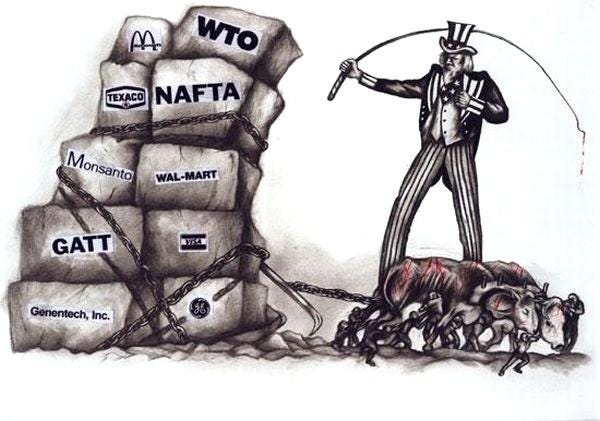
For three-quarters of a century, the global economic order has orbited around a single sun—the United States. Born from the ashes of World War II, this American-centric trade architecture was not simply an accident of history. It emerged from a complex mix of self-interest and genuine idealism: the Marshall Plan, the founding of the United Nations, and the establishment of Bretton Woods institutions all reflected a vision for shared prosperity and global stability, even as they cemented US primacy through dollar hegemony and the gravitational pull of the world’s largest consumer market. Over time, however, a combination of overreach, inconsistencies, and military interventions—alongside real achievements—has complicated the narrative of American leadership and raised questions about its continued moral authority and effectiveness.
Today, while the recent policies of the Trump administration—marked by an "America First" rhetoric and high-profile trade conflicts—have accelerated some trends, it's crucial to understand that the global realignment underway is rooted in deeper structural forces. These include the backlash against globalisation, the rise of automation and digital commerce, shifting demographics, and the growing economic weight of emerging powers. The world economy is fundamentally restructuring itself into a more multipolar constellation, driven not only by a relative decline in US trade dominance but also by the toll of protracted "forever wars," the advancement of sophisticated regional strategies, and, most significantly, the emergence of new forms of economic influence that transcend traditional trade.
While the notion of US decline is widely discussed, it is important to note that this trend is neither linear nor absolute. The United States remains the world’s largest single-nation economy, a global leader in technology, services, and foreign direct investment, and a magnet for human capital and innovation. Recent data from the IMF and World Bank show that the US share of global exports has declined, but that its influence in finance, higher education, and technology remains robust.
What we're observing, then, is not merely the latest chapter in a cyclical rivalry among great powers, but a structural shift toward partial decoupling and parallel systems. Nations and economic blocs are not just hedging for better terms within the existing framework; they are actively designing new economic ecosystems able to function independently of US discretion. Yet, while decoupling is significant in sectors such as advanced technology and supply chains, interdependence in finance, investment, and digital services continues to bind the US to the global economy in complex ways. Multipolarity, in other words, coexists with persistent US strengths—a point sometimes overlooked in more deterministic narratives.
Three years ago, the evidence was ambiguous. Today, the numbers illustrate a clear trend: the US share of global exports has declined steadily for two decades, a pattern that is now accelerating. The moment when the European Union’s trade with China surpassed that with the United States was more than a statistical curiosity—it marked a symbolic Rubicon in global economic relations. Yet, the EU’s deepening commercial ties with China are coupled with significant concerns about Chinese economic practices, security, and values. Much of EU-China trade is in goods of relatively low value-add, and the EU continues to pursue market access, fair competition, and human rights in its China policy.
Across Asia, Africa, and Latin America, intra-regional trade has increased significantly, creating dense networks of economic interdependence that often bypass the traditional US-centered "hub-and-spoke" model. A 2024 UNCTAD report notes that intra-Asian and intra-African trade have grown faster than trade with North America, even as the US remains a major external partner for many economies. Thus, regionalization is strengthening but not fully replacing global integration.
This rewiring is not accidental, but reflects deliberate adaptation. When the United States imposed tariffs on China in 2018, many analysts predicted severe damage to Chinese exports. Instead, China displayed remarkable agility: trade was rerouted through Southeast Asia and Latin America, integration with regional supply chains deepened, and investment in domestic alternatives to US technology accelerated. Empirical studies show that Chinese exports to ASEAN and Latin America grew rapidly in response to US tariffs, while global supply chains reorganized to minimize exposure to US pressure.
While the United States has largely stagnated in its trade diplomacy—hindered by domestic polarisation and a turn inward—the rest of the world has moved rapidly to forge new economic relationships. The EU, for example, has negotiated more substantive trade agreements in the past five years than the US has in the past fifteen. These agreements are not just about tariff reduction; they establish new rules, common standards, and institutional frameworks for future cooperation. Nevertheless, the US continues to negotiate sectoral agreements and remains a top destination for global FDI and innovation, suggesting its continued relevance.
Perhaps the most profound—yet often underappreciated—shift is the rise of regulatory frameworks and standards as a new form of economic power. The European Union, in particular, has discovered that exporting laws can sometimes be more powerful than exporting goods. The General Data Protection Regulation (GDPR) did not just reshape privacy within the EU; it became a global standard, compelling American tech giants to overhaul their business models. The EU's influence in AI governance, ESG standards, and financial regulations is increasingly global, not through military or economic coercion, but because these frameworks offer clarity and predictability in a turbulent world.
The pursuit of economic sovereignty has evolved from a defensive posture to a sophisticated, strategic approach to international engagement. Whether in Europe’s "strategic autonomy," China’s "dual circulation," or India’s "Atmanirbhar Bharat" (self-reliant India), major economies are building internal capacity while maintaining carefully calibrated global ties. Yet, these strategies face internal contradictions and trade-offs: for example, India’s push for import substitution sometimes competes with its export ambitions; China’s efforts to reduce dependence on the US must balance against its reliance on foreign markets and technology.
Ironically, American protectionism—intended to shore up US economic primacy—has often accelerated multipolarity. Each tariff, sanction, or declaration of "America First" serves not as a deterrent but as an impetus for diversification and resilience among US partners and competitors. This shift toward economic nationalism is bipartisan and predates the Trump administration, reflecting deeper anxieties within American society.
Yet, it would be mistaken to overstate the speed or completeness of "de-dollarization" or the erosion of US financial power. Alternatives to the dollar—whether the euro, RMB, or digital currencies—have gained limited traction, constrained by network effects, liquidity, and trust in US institutions. The weaponisation of the dollar through sanctions is real, but so is the persistent global appetite for dollar assets and US market access.
There remains, however, a wildcard that could turn this transition from an orderly rebalancing to catastrophe: the spectre of war. Power transition theory posits that declining hegemons may turn to military force to defend their status, but empirical studies find that actual great-power wars during transitions have been rare in the nuclear era. Nonetheless, the risk cannot be dismissed. The United States maintains over 750 military bases in 80 countries—a global footprint that provides both deterrence and, potentially, temptation for intervention.
The machinery for indirect or proxy conflict is well established, as seen from Syria to Ukraine, the South China Sea to the Sahel. As alternatives to US-dominated payment systems and trade corridors develop, the possibility of "security crises" or instability—whether spontaneous or engineered—cannot be discounted. The Taiwan question looms especially large: a conflict there would not just be regional but would devastate global supply chains and risk catastrophic escalation.
Economic history has turned a corner, but the path forward is perilous. The much-debated "unipolar moment"—if it ever existed in pure form—is over, but what replaces it is not preordained. Multipolarity is emerging, but its exact contours and durability remain open questions. Some scholars argue that US dominance endures in finance, digital infrastructure, and global governance, while others see a more balanced, pluralistic order taking shape.
The challenge facing global leaders is to manage this transition while containing the destructive impulses of a wounded giant. This requires not only economic diversification but also sophisticated deterrence—making the costs of military adventurism prohibitively high while providing face-saving off-ramps for peaceful adjustment. Historical precedents such as the Concert of Europe and the Helsinki Accords, though imperfect, suggest mechanisms for managing great-power transitions without catastrophic war.
For all the talk of decline—and I have emphasised this argument—it is essential to recognize the resilience and adaptability that both the United States and the wider international system have demonstrated in the past. The coming multipolar era is not simply a matter of inexorable decline or triumphant emergence; it is a delicate, high-stakes rebalancing, full of uncertainty and opportunity.
Given the complexity of these transitions, further interdisciplinary research—combining political economy, security studies, and international history—is essential to inform both policymakers and the public. The multipolar future is on the horizon, but whether we reach it through peaceful evolution or destructive conflagration remains unresolved. Those with vision must seek not only to build a more just and stable global order, but to ensure that we survive the transition itself.