
The Mirror Cracks
Donald Trump and the American Psyche

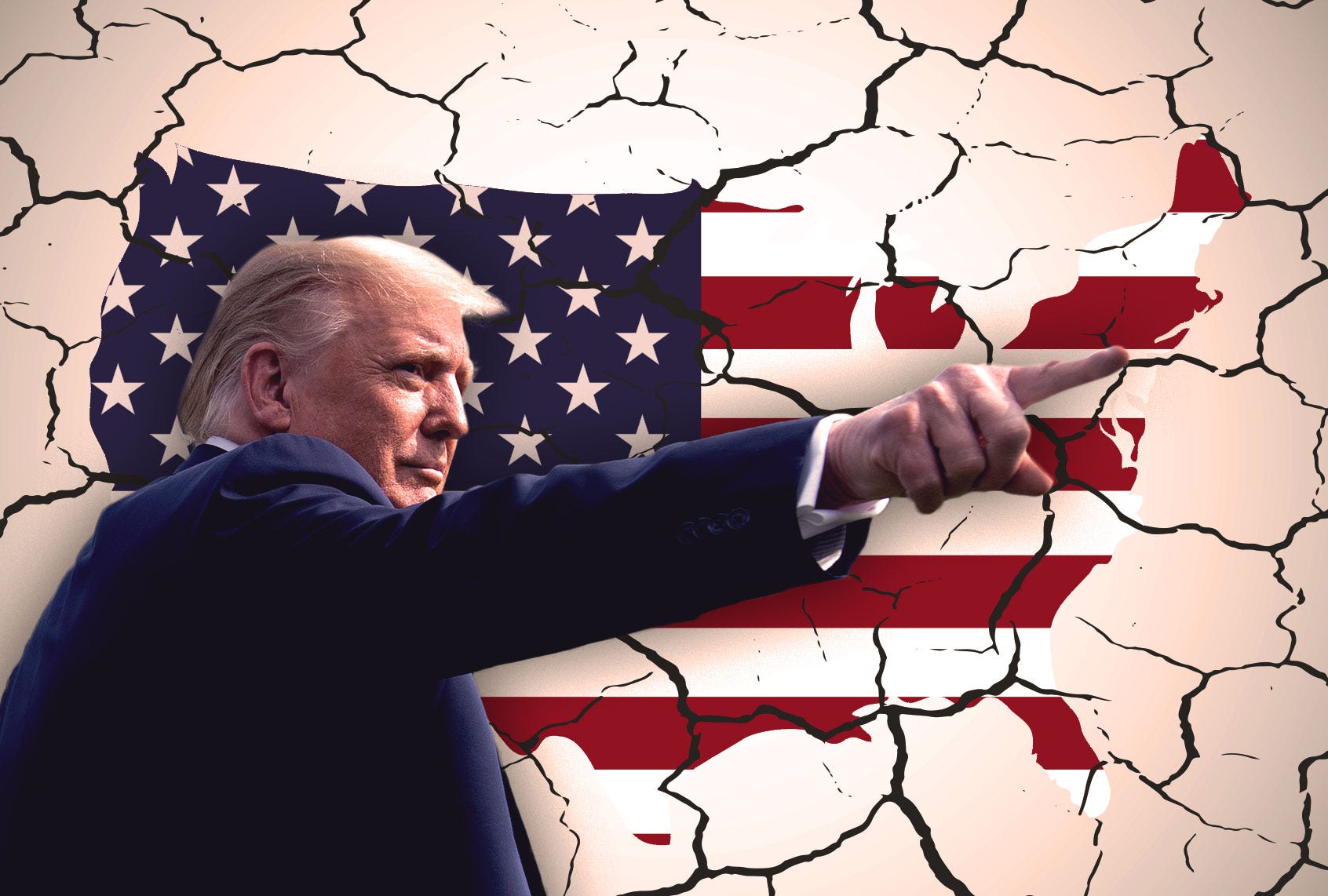
I anticipated Donald Trump’s win in 2016 and again in 2024. It was not that testing. When a society produces a ruler who seems to embody its contradictions with such theatrical precision, we must resist the temptation to treat him as an aberration. Donald Trump didn’t descend from some alien realm to disrupt an otherwise harmonious republic. He emerged from within the American experiment itself, a crystallisation of impulses that have coursed through that nation’s veins since its founding. To understand Trump is to understand something profound about the United States—and by extension, about the predatory nature of industrial economism that has metastasised from American shores to dominate our consciousness.
The man is neither devil nor saviour, though millions have cast him in both roles. He functions instead as a kind of cultural hologram, projecting back to Americans an image of themselves they find simultaneously thrilling yet horrifying. This is why the response to Trump has been so visceral, so immune to any kind of rational discourse. People are not really arguing about tax policy or judicial appointments. They’re arguing about who they are.
Donald Trump is not an interruption of the American story; he is one of its clearest chapters. He condenses habits that long predate him—mythmaking, extraction, spectacle, racial hierarchy, masculine anxiety—into a single, gaudy figure. To look at him carefully is to see the civilisation that made him.
What has changed since 2016 is not the essence of that pattern but the clarity with which it is visible. Trump has now governed twice and lost twice, been impeached twice, indicted repeatedly and convicted once, survived an assassination attempt, and returned yet again as a central gravitational force in American politics. His body is visibly aging; his movement is not. The mirror he holds up to America has more cracks in it, but it still reflects. Trump is a mirror of American industrial civilisation in crisis.
The Carnival Barker as Prophet
The United States was founded on a dazzling contradiction: “all men are created equal,” written by men who owned other humans. Its history since has been a choreography of grand ideals and systematic betrayal. One response to this tension has been hypocrisy—keeping the language of virtue while quietly doing the opposite. Another response, Trump’s response, is to drop the mask.
Trump’s relationship to truth has always been less about error than about theatre. His lies are often so brazen they don’t function as attempts at persuasion in the conventional sense. They are demonstrations of power: an assertion that reality will be whatever his tribe agrees to affirm. In an economy saturated with advertising, public relations, influencer culture, and AI‑generated simulacra, sincerity has already become a sort of genre. Trump sensed this earlier than most politicians. He intuited that people now experience “authenticity” not as factual accuracy but as emotional alignment. He didn’t need to be right; he needed to sound like what his followers felt.
His rallies were never primarily about programmes. They were secular revivals: scripted spontaneity, call-and-response, ritual humiliation of enemies. The “enemies” rotated—immigrants, journalists, globalists, the deep state, universities, public health officials—but the emotional architecture stayed the same. People were not fighting for a tax code; they were trying to hold on to a coherent sense of self in a world that had stopped making sense.
Trump’s real offer was permission—permission to feel outrage, resentment, fear, and to call those feelings patriotism. In a culture of mandatory optimism and self‑help, where every problem is supposed to yield to positive thinking, this permission felt like honesty. It still does.
The Extractive Imperative
To understand why Trump could become a tribune of the left‑behind while living in a penthouse, one must understand the economy that made him possible. American capitalism has always had a frontier logic: move fast, take resources, move on. The late‑20th‑century neoliberal turn transformed that into doctrine. Public assets became private profit centres; unions and social protections were gutted; debt replaced wages as the main way ordinary people accessed a semblance of middle‑class life.
Trump’s business career is a cartoonishly faithful enactment of this logic. He built heavily leveraged projects, squeezed value out of them through branding and debt, and left creditors, workers, and towns to clean up the mess. His casinos sucked money from working‑class gamblers; his own extraction was from the casinos themselves. He turned bankruptcy law into a revenue model, selling his name as a veneer to mask hollow structures.
The country did something very similar. As industry was offshored or automated, communities hollowed out. The wealth generated by technological advances accumulated at the top. The story told to those left behind—retrain, upskill, accept that your entire way of life is obsolete—felt like a demand not just to endure loss, but to be grateful for it.
Trump didn’t challenge the underlying machinery. He accelerated tax cuts for the wealthy, deregulated polluters, and repackaged familiar supply‑side policies in much cruder language. But he did something the technocrats could not or would not do: he named villains and framed suffering as an injustice inflicted by people, not an outcome produced by systems.
This story was often factually wrong and racially charged, but it had emotional coherence. It treated people as wronged, not only as human capital mismatched to current needs. In a country that prefers fairy tales of opportunity to structural analysis, this was enough to bind millions to him.
The Spectacle State
The United States has always blurred the line between politics and entertainment. Celebrity has long been a path to power; while power is often performed as celebrity. This embodiment was possibly most complete under Ronald Reagan. But Trump is the most seamless fusion of these two tendencies so far.
His trajectory—from real estate heir to tabloid curiosity to reality TV star to president—traces the shift from an economy that makes things to one that makes images. “The Apprentice” was less a show about business than a demonstration of humiliation as meritocracy: a fantasy in which a strong man sees through pretense and fires the weak. By the time Trump descended his golden escalator, he had spent decades rehearsing a character: the decisive boss, the wealthy straight‑talker who answers to no one. Networks and later social platforms amplified this persona with almost no restraint because it was good for engagement. Outrage was profitable; they treated it as if it were self‑correcting.
The dynamic has only intensified. Even Trump’s medical diagnoses—chronic venous insufficiency announced in 2025 after photographs of swollen ankles and bruised hands, his physician insisting he remains in “excellent health”—became fodder for the spectacle. His circulatory system turned into content; his aging body into a site of projection. Supporters saw vitality under attack; critics saw decay made visible. The actual medicine was secondary.
The deeper problem is not that one man consumes so much attention but that the political system has reorganised itself around the chase for it. The appearance of strength matters far more than any competence. A functioning bureaucracy is invisible; a viral insult is not. Trump did not create this market; he simply mastered it.
The Fortress Fantasy
Underneath Trump’s wall rhetoric lies a deeper imagination of the world: safety as separation. His promise to build a physical barrier along the southern border always had more psychological than practical content. It conjured an earlier, simpler America—mythically white, orderly, bounded—whose loss could be blamed on specific intruders. It suggested that complexity could be kept at bay by force, that change could be stopped if one just willed it hard enough.
For many white Americans, particularly in smaller towns and city suburbs, demographic change and cultural pluralism don’t register as enrichment but as vertigo. People who had never thought of themselves as white—only as “normal”—are suddenly members of an anxious category. Trump’s language told them their disorientation and fear were not only understandable but noble.
Yet America’s vitality has always rested on porosity: the ability to absorb people, ideas, and conflict, and to metabolise them into something new. The fortress impulse is not just morally troubling; it’s a resolution to prefer stagnation to renewal.
By 2026 the wall has become less masonry than machinery: drones, data systems, expedited deportations, legal innovations like the 2025 executive order trying to end birthright citizenship, blocked by multiple courts. The form has changed; the fantasy persists. It is exported too—into Europe’s Mediterranean policies, Australia’s offshore detention, Britain’s flirtation with shipping asylum seekers to Rwanda. Trumpism globalises as a desire to live in a past that never existed, protected from a present that can’t actually be shut out.
The Masculine Wound
Trump’s gender performance is loudly obvious: the brags about sexual conquest, the contempt for weakness, the obsession with being seen to be strong. It is tempting to treat this as exaggerated farce, but it resonates because it speaks to a specific crisis.
For generations, a certain kind of masculinity—rooted in physical labour, local dominance, and breadwinner status—had a clear place in American life. As factories closed, unions collapsed, and wages stagnated, that role eroded. At the same time, feminism, queer movements, and shifting norms challenged male entitlement in intimate and public life. Many men experienced this as a kind of status whiplash. They were still told they should be powerful but given fewer legitimate ways to be so. Resentment grew, often without clear language to name it.
Trump’s behaviour with women—documented allegations of assault, crude insults, objectification—became, perversely, a credential for some supporters. It proved he was not constrained by politically correct rules. His norm‑breaking functioned as vicarious revenge: he could humiliate in ways they could not get away with. Each violation that carried no consequence signalled that he occupied a different moral universe.
By 2025 his own body had begun to betray the script. The revelation of chronic venous insufficiency—vein valves in his legs failing to return blood effectively, a progressive, irreversible condition of age—made visible what had always been true: no amount of bluster stops decay. The hypermasculine mask sits on a body as mortal and vulnerable as anyone’s. For a movement invested in fantasies of invulnerability, this is poignant.
Women’s responses remain split. Many white women, especially those economically entwined with conservative men, have supported him, prioritising racial or religious identity over gender solidarity, or finding comfort in clear gender hierarchies. Others, especially women of colour and younger women, have organised some of the most sustained opposition, from the Women’s March to reproductive‑rights networks that outlasted the formal fall of Roe.
The masculine wound that Trump expresses is not his alone. It’s a widespread anxiety about worth in a system that no longer knows what to do with physical strength, and often punishes emotional literacy. Trump offers no healing; he offers only swagger as anaesthetic.
The Evangelical Bargain
Trump’s alliance with white evangelical Christianity reveals how thoroughly religion in America has been nationalised. On the surface, the mismatch is obvious: a man famous for adultery and conspicuous greed, ignorant of scripture, embraced as God’s chosen vessel. But if evangelicalism has been re‑coded as a cultural identity rather than a set of demanding teachings, the logic clarifies.
What many white evangelicals want protected is not the Sermon on the Mount; it’s a social order where their moral codes define public life. Trump delivered key pieces of that order: Supreme Court appointments that overturned Roe and narrowed LGBTQ protections; federal rules favouring religious exemptions; rhetorical validation of Christian nationalism. In exchange, he demanded neither personal piety nor humility, only loyalty.
This is not a corruption from without; it is an exposure from within. The fusion of cross and flag long predates Trump. What he did was strip away the apologetics. Christian symbols now appear alongside campaign regalia at rallies where opponents are mocked as enemies of God, and the language of spiritual warfare frames electoral contests.
You can measure the cost in souls as well as laws. Younger people—including young evangelicals—are leaving churches in large numbers, repelled by what they perceive as cruelty cloaked in piety. But for those who stay, the bargain still feels rational: better an ungodly champion who will punish your enemies than a personally decent leader who will not affirm your tribe’s supremacy.
The Racial Reckoning Deferred
Race is the oldest unresolved question in the American project, and Trump has always moved easily in its currents. He rose politically by questioning Barack Obama’s citizenship, signalling that a Black man could not really be of, and for, “real” America. In office and beyond, he has consistently framed non‑white populations—immigrants, city dwellers, protesters—as suspicious, dangerous, alien.
Trump didn’t invent white grievance; but he harvested it. The end of de jure segregation, the expansion of civil rights, and the demographic shift toward a non‑white plurality have threatened a racial order in which whiteness functioned as invisible norm. For many white Americans, especially those not materially privileged, being white remains the most solid status they possess. Trump’s genius lay in making that status explicit. The slogan “Make America Great Again” operated in part as “Make America Feel White Again.” Policies and symbols—defending Confederate statues, restricting migration from non‑European countries, echoing “great replacement” rhetoric—told white voters their fears were understood and their primacy would be guarded.
The multiracial uprisings after George Floyd’s murder in 2020 briefly suggested momentum toward a deeper reckoning. That momentum has been met with backlash: state laws limiting how history and race is taught, renewed emphasis on law and order, demonisation of Black Lives Matter as terrorist. Trumpism thrives in this backlash, even when he is not on the ballot. The reckoning is not cancelled; it’s stuck in a holding pattern, shunted into culture wars rather than structural transformation.
Institutional Fragility
American democracy has always been an uneasy hybrid of popular sovereignty with elite control. It relies heavily on norms—voluntary restraints, unwritten rules—because many of its formal structures are, by design, undemocratic: the Electoral College, the Senate’s bias toward small states, and lifetime judicial appointments. Trump was willing to treat those norms as optional. He refused to release tax returns, installed family members in senior roles, used his office to enrich his businesses, dangled pardons to allies, fired inspectors general, pressured state officials to “find” votes, and incited supporters against his own vice-president when he would not nullify electoral votes.
His second term, beginning in 2025, pushed further. A torrent of executive orders attempted to end birthright citizenship for children of non‑citizens; freeze nearly all federal grant funding, including for health, research, and infrastructure; dismantle the Department of Education and slash student protections; weaken independent regulators like the FEC and FTC by bringing them under direct White House control; punish disfavoured law firms by stripping contracts and security clearances; shut down USAID and gut foreign aid; and roll back ACA patient protections and drug‑price reforms.
Democratic lawmakers and civil society groups challenged many of these orders in court, winning temporary reprieves. Impeachment resolutions were introduced, debated, tabled. Oversight hearings produced viral confrontations but little durable constraint. The effect has been paradoxical: institutions are simultaneously demonstrated to be both fragile and obstinate.
On paper, checks and balances continue to function. In practice, they have been revealed as protracted, inconsistent, and vulnerable to capture. Courts can block some orders; they can’t repair public trust. Elections can remove a president; they can’t make his movement vanish. The law still matters, but its moral authority has been eroded by selective enforcement and open attempts at manipulation.
The deeper lesson is that a constitutional system cannot rest indefinitely on the self‑restraint of elites. Once a sufficiently shameless actor demonstrates that many “rules” are unenforceable preferences, others take note.
The Epistemological Break
Perhaps the most corrosive consequence of the Trump era is not any single policy but the collapse of a shared reality. The United States has always argued with itself, but until recently there was a rough-and-ready accord that facts existed and, in principle, could be checked. Trump showed that for a significant portion of the population, the emotional coherence of a story matters more than its external verification. He declared objective things “fake” when they displeased him: crowd sizes, election results, infection rates, economic data. He floated contradictory conspiracy theories—about COVID‑19, about voting machines, about foreign plots—without concern for consistency because consistency was never the point. The point was to delegitimise any institution that could contradict him.
Social media platforms and, increasingly, generative AI have turned this into a structural condition. Deepfakes and synthetic audio make it easy to produce convincing counter‑realities faster than they can be debunked. Algorithms reward outrage, not accuracy. People retreat into information bubbles where their identities are reinforced and dissonant facts are dismissed as propaganda.
The emergence of “Trump Derangement Syndrome” as a quasi‑official category—Minnesota legislators proposing in 2025 to recognise it as a mental illness marked by “paranoia” and “intense hostility” toward Trump—takes this a step further. It pathologises dissent: if you think the president is dangerous, that is evidence not of perception but of disorder. Trump himself has used the label gleefully, diagnosing opponents, including former allies, as sick.
Authoritarian regimes have long used psychiatry in this way, from Soviet diagnoses of “sluggish schizophrenia” in dissidents to contemporary Russia and China’s forced psychiatric commitments of protesters. The fact that a similar impulse has emerged inside American politics is a warning: once disagreement is medicalised, persuasion easily gives way to containment.
When truth becomes tribal and opposition becomes insanity, the very idea of a common world recedes. Politics becomes a contest of mutually unrecognised realities. In such conditions, the most basic collective tasks, like managing a pandemic, addressing climate change, or administering elections, become sites of existential struggle.
The Imperial Twilight
Trump’s foreign policy has not fundamentally changed the structure of American power; rather it changed its self‑presentation. Previous administrations wrapped interventions and economic coercion in the language of democracy, human rights, and development. Trump often dropped this language, speaking instead in openly transactional terms: allies were protection clients; international agreements were bad deals; aid was leverage; NATO was a shakedown; climate accords were scams.
The substance of empire—military bases, sanctions, covert operations, trade enforcement—continued. But the pretence of benevolence eroded. The chaotic withdrawal from Afghanistan under Biden, and the stark double standards in responses to the conflicts in Ukraine and Gaza, have reinforced the perception, especially in the global South, that American principles are elastic.
From Southeast Asia, where I write, none of this is entirely new. Countries here have long experienced the United States as an ambivalent patron: sometimes helpful, often destabilising, always self‑interested. What is new is the frankness with which this is now visible inside the United States itself.
The empire is not over, but it’s no longer plausible to many that it serves a universal good. Trump clarified what was already true: American power is a particular power, upholding a particular order, for particular beneficiaries. The age of unchallenged moral hegemony has ended; a more multipolar, and potentially more dangerous world is emerging.
The Civilisational Crisis
Beneath all of this—spectacle, fortress, masculinity, race, empire—lies a deeper instability: the exhaustion of the industrial‑capitalist paradigm that shaped the last two centuries. That paradigm promised endless economic growth on a finite planet; freedom through markets that would, allegedly, make everyone richer; progress through technology that would solve the problems it created; and meaning through consumption and individual achievement.
By the mid‑2020s, these promises ring increasingly hollow. The climate system is destabilising; inequality has reached feudal proportions; technological advances amplify surveillance and disinformation as readily as they cure disease; many people experience their lives as precarious, overworked, and lonely.
Trump is not a solution to this crisis; he is its purest political expression thus far. He is extractive in business, extractive in politics, extractive in personal relationships. He takes trust, wealth, institutional capacity, and leaves wreckage. He offers the feeling of reversal—”again”—without any material basis for it. His followers are not wrong that something fundamental is failing. They are wrong in taking his performance of strength as genuine opposition to that failure. But the fact that so many grasp at that performance speaks to the poverty of available alternatives.
The real antagonists in this story are not only the demagogues but the structures that render demagoguery appealing: an economic order that treats humans and ecosystems as expendable, a political order captured by wealth, a cultural order that sells distraction as relief, a technological order that fragments attention and erodes trust.
Beyond the Mirror
Trump functions as a mirror not because he is every American, but because he magnifies tendencies deeply rooted in American and broader industrial culture: truth as performance, strength as domination, difference as threat, nature as resource, history as property. The danger is to think that once he leaves the stage—by ballot, by illness, by time—the problem will have been solved. But mirrors shatter; they don’t heal.
The needs he has exploited are not going away: the hunger for dignity amid economic humiliation; the desire for community in an atomised society; the longing for certainty in a world of cascading crises; the fear of loss—of status, of identity, of familiar landscapes. If those needs are not met in healthier ways, other figures will step forward to weaponise them. Some may be more disciplined, more competent, more embedded in the machinery of the state than he ever was.
The work that matters most is thus not simply electoral, though elections have consequences. It’s the work of building economic arrangements that value people over profit; political arrangements that make participation meaningful rather than purely symbolic; cultural narratives that acknowledge historical violence without collapsing into despair; and ways of life that can endure within ecological limits.
This will not be delivered from above. It will be made, falteringly, by communities experimenting with cooperation over competition, sufficiency over accumulation, regeneration over extraction. Such projects already exist—in worker cooperatives, mutual aid networks, Indigenous land struggles, restorative justice initiatives, experiments in participatory democracy—often at the edges of visibility.
From outside the American bubble, what stands out is less Trump’s uniqueness than Americans’ persistent tendency to treat their crises as singular and their talents as exceptional. Other societies have grappled with declining empires, polarised publics, extractive elites, and environmental limits. There is no ready‑made model to import. But there’s much to learn—from places where communal obligations are foregrounded, where economic life is less individualised, and where politics has been forced to reckon with both defeat and occupation.
Trump is a lesson, not an endpoint. He shows, in grotesque and sometimes comic form, what happens when a civilisation clings to its myths rather than facing its contradictions. Will that lesson be taken as an invitation to double down on fantasy or as a painful opportunity to grow up? The mirror is cracked. It still reflects. What we do with what we see is no longer Trump’s responsibility. It’s ours.
Excellent analysis!
I follow many publications to get a sense about Trump and how he operates. This post is brilliant , articulate, profound, and multi-dimensional in its analysis. It nakedly exposes the fractured soul of America and compels you to do something....anything to move it to healing from the fear hate, and tribal supremacy that has infected and cracked it. Thank you.