
The Unfalsifiable War
On the politics of absolute certainty

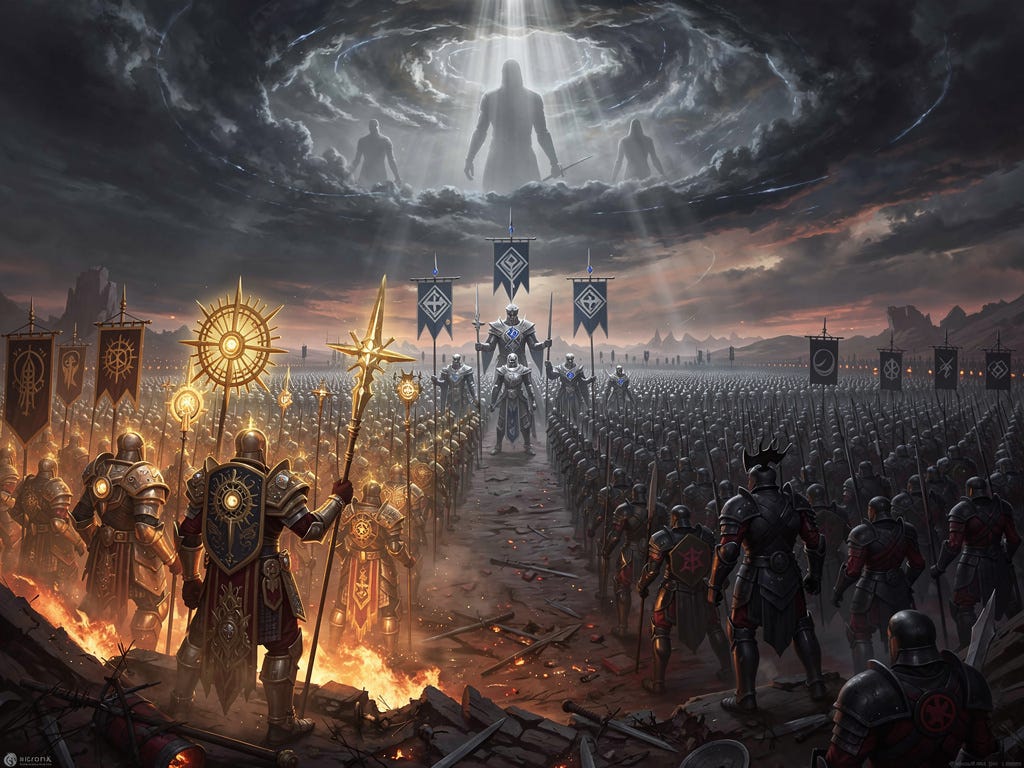
A man in a suit stands before cameras and tells the world that God is protecting the troops. He is not speaking metaphorically. Nor as pastoral consolation offered to grieving families in the small hours of a military base chapel. This is strategic communication, delivered by the United States Secretary of War, on national television, as justification for an ongoing military campaign against Iran. “The providence of our almighty God,” Pete Hegseth announced, “is there protecting those troops.”
Pause there. Not to mock the belief. Belief is its own territory, with its own internal cartography, and mockery is the laziest possible response to it. Pause because something else is happening — something that’s received almost no sustained attention in the torrents of commentary this war has generated. What Hegseth did in that moment was not simply to invoke religion. He committed an epistemological act. He moved the justification for state violence out of the domain of human accountability and into a register where no legislature, no court, no electorate, no inspector general can follow.
Democracy is not simply a voting mechanism or a cluster of institutions. It rests on a specific and fragile epistemic foundation: that claims made to justify public action must be, in principle, falsifiable. A secretary of war who says this campaign serves national interest can be interrogated. The intelligence can be challenged. The strategy can be debated. The casualties can be counted against the stated goals. The whole apparatus of democratic oversight depends on the claim being the kind of claim that evidence can touch.
Providence, however, can’t be subpoenaed. Divine mandate does not appear before the Armed Services Committee. When the justification for war migrates into theology, oversight doesn’t just become tricky. It becomes, by the internal logic of the claim, impertinent.
This would be alarming as an isolated flourish. But it’s not isolated. Complaints filed with the Military Religious Freedom Foundation — now the subject of a congressional investigation — allege that military commanders told combat units the war is “part of God’s divine plan,” and that Trump “has been anointed by Jesus to light the signal fire in Iran to cause Armageddon.” Consider what that does to the structure of military decision-making.
Apocalyptic belief is not simply a theological position. It’s a policy posture — and perhaps the most dangerous one conceivable, because it inverts the entire logic of military restraint. Every framework designed to limit state violence assumes that war is a means toward some calculable end: security, deterrence, and eventual resolution. Remove that assumption and the frameworks dissolve.
If this war is the necessary prelude to the return of Christ, then de-escalation and retreat is not a diplomatic achievement. It’s a theological failure. The normal feedback loops of consequence, proportionality, and accountability have been severed. What remains is certainty, armed to the teeth.
So far, so American. Except that it isn’t. And the first place to look is not Tehran. It is Jerusalem. Israel is a co-belligerent in this war. The opening strikes on Iran were joint US-Israeli operations. And Israel’s own relationship with divine mandate is not a recent political development or an imported American pathology. It’s the founding architecture of the state — older, more layered, and in some respects more consequential than anything Hegseth has said on television.
Israel’s claim to the land rests, in its religious formulation, on covenant — a promise made by God to a people, recorded in scripture, and understood by a significant and growing portion of Israeli political culture as an active, present, non-negotiable title deed. The settlement movement, which has driven much of the policy that produced the current regional configuration, is explicitly theological in its justification. This is not incidental to Israeli nationalism even in its ostensibly secular forms; the religious and the national are so thoroughly braided in Israeli political life that they cannot be cleanly separated without doing violence to both. The current government includes ministers for whom the expansion of Jewish sovereignty over the biblical land is not a policy preference but a messianic obligation — the beginning of the redemption, the unfolding of God’s plan in real time, measurable in dunams and settlements and military operations blessed by rabbinical authority.
That is, structurally, the identical epistemological move. Divine mandate removing territorial and military action from the domain of falsifiable, accountable human decision-making. The address is different. The architecture is the same.
But the connection between American Christian nationalism and Israeli religious Zionism runs deeper than structural resemblance. A substantial portion of the evangelical base that provides Hegseth’s theological framework is Christian Zionist — meaning their eschatology requires a Jewish state in the promised land as a precondition for the second coming of Christ. They support Israel not primarily out of solidarity with Jewish people, and certainly not out of commitment to Israeli security in any conventional strategic sense. They support Israel because Israel is a necessary prop in their apocalyptic narrative. Jewish sovereignty over the land, followed by a final battle at Megiddo, followed by the conversion or destruction of the Jewish people — that is the sequence the theology requires. Which means American Christian nationalists and Israeli religious nationalists are, in a relationship almost nobody discusses directly, using each other. Each provides the other with theological validation and political cover for a narrative in which the other ultimately has no dignified or surviving place. It’s an alliance built on mutual instrumentalisation, consecrated by shared eschatology, and pointing toward an ending that neither party has looked at steadily enough to describe in public.
We’re not watching two apocalyptic frameworks facing each other across this war. We are watching three.
American premillennial dispensationalism: God has anointed Trump to light the signal fire.
Iranian revolutionary Shia eschatology, embodied in velayat-e faqih — the guardianship of the Islamic jurist — in which political and military authority derives directly from God through the supreme leader, and in which conflict with the West carries its own end-times resonance, the resistance of the faithful against the “Great Satan” in the prelude to the return of the Mahdi.
Jewish messianism in its religious Zionist form, for which every military victory is a sacred act, every dunam of land reclaimed a step in the divine unfolding.
Three frameworks. Each internally coherent. Each confirming the others. Each providing the escalatory logic the others require. Iranian strikes confirm American apocalyptic narrative. American strikes confirm Iranian apocalyptic narrative. Israeli expansion confirms both, while drawing sustenance from one and existential threat from the other. They are not just fighting each other. At some level below strategy and politics and stated war aims, they are co-authoring a story. And the story, in all three versions, ends the same way.
Into this walks Pope Leo XIV. The first American pope, born in Chicago, formed by the particular cadences of a country now at war. His response to the providential framework was precise: “Some claim to involve the name of God in these deadly decisions, but God cannot be enlisted by darkness. It is peace that those who invoke him must seek.”
Observe what he did not do. He didn’t offer a competing theology. He didn’t argue that God favours a different side. He made a claim about rationality, accountability, and the limits of violence — a claim that stands on its own legs, independent of whether God exists at all. “The absurd claim,” he called it, “of resolving problems and differences with war.” That is an argument. Falsifiable, debatable, open to evidence. The Pope, in this moment, appears to be doing the work of reason while the Secretary of War does the work of revelation. They seem to have exchanged positions so completely that you would need to check the nameplate to know which is the elected official and which the religious one.
But here is where the ground moves. Leo’s argument, however philosophically sound, does not arrive in the world as a free-floating rational proposition. It arrives wrapped in an institution — the Catholic Church — whose own relationship with divine mandate for violence is, to put it with maximum restraint, extensive. Crusades. Inquisitions. Colonial conquest blessed by papal decree. And then, more recently, more lethally, and more specifically relevant to this theatre: centuries of theological anti-Judaism that provided the deep cultural soil in which the Holocaust became possible, followed by the silence of Pius XII while it happened. The Church of Rome has a long and unresolved account to settle with the Jewish world, with the Muslim world, and with the populations of several continents who received its missionaries alongside their colonisers.
Leo knows this. He is not speaking from a position of innocence. He’s speaking from institutional memory of what it costs when God is enlisted in darkness — because his own institution paid those costs, and imposed them on others, across the centuries. That is a different and harder-won kind of authority than the breezy providential confidence of someone encountering the temptation for the first time. But his audience in Tehran does not receive his words as a neutral rational intervention from above the conflict. Nor does his audience in Jerusalem, or in the diaspora communities still carrying the weight of what his institution either did or permitted. They receive him as a voice from a tradition that has its own long and unresolved account with each of theirs.
There is no view from nowhere. The position that appears to transcend the conflict is itself embedded in all of its histories. The exact concept of a universal rational arbiter — a voice that transcends particular traditions to appeal to shared human reason — is a product of a specific civilisational inheritance, broadly European, broadly Enlightenment-shaped, and that inheritance is not a neutral party to this war. It’s one of the ancestors of the combatants, perhaps of all of them. To invoke it as if it floated free of history is not dishonest, exactly. It is incomplete in a way that the people on the receiving end of that history notice immediately, even when those doing the invoking do not.
What we’re left with is not a story about American pathology, or Christian nationalism, or the particular recklessness of Pete Hegseth. Those things are real and their consequences are being measured in bodies. But they are symptoms of something that runs deeper and wider than any single administration, tradition, or theatre of war.
The recurring, cross-cultural, apparently irresistible temptation to place state violence beyond human accountability by grounding it in divine mandate is not a gremlin in particular political systems. It appears to be a facet of political organisation as such — a structural option that human communities reach for, across vastly different cultures and centuries, when the stakes feel high enough and certainty feels available. The Islamic Republic reached for it in 1979. The crusading papacy reached for it in 1095. Religious Zionism has been reaching for it with increasing confidence since 1967. The American evangelical-nationalist complex is reaching for it now. The specific theologies are utterly different but the structure is indistinguishable. And the consequences, when two or three of these frameworks are simultaneously active and pointing at each other, are not additive. They are, in the precise mathematical sense, exponential.
This is not a comfortable observation because it resists the usual responses. You can’t fix it by electing different people, though different people might help. You can’t fix it by separating church and state, though that separation is worth defending with everything and every breath available to us. You can’t fix it by appealing to international law, though international law is worthy of enforcing. All of these are necessary. None of them touches the underlying question: what would it actually take to build political institutions robust enough to hold power accountable when power has decided it answers only to God?
We don’t have those institutions. We have never had them. We’re now watching three nuclear-adjacent states, each operating from within an unfalsifiable framework of divine mandate, exchanging ordnance over a region that has been absorbing other people’s certainties for several thousand years. The people dying in Iranian hospitals, in Israeli cities, in the militaries of a superpower that has confused its foreign policy with its eschatology — they are the cost of a question we have not yet found the political imagination to ask clearly, let alone answer.
The problem, on all sides, is not the absence of conscience. All sides are abundantly, fervently, catastrophically convinced of their own goodness. That is precisely the problem. It has always been the problem. We keep failing to name it clearly because doing so requires saying something that democratic governments, religious institutions, and the diplomatic frameworks built to manage relations between them are all, in their different ways, structurally unwilling to say.
The most dangerous person in any room is not the one who knows they might be wrong. It’s the one who knows, with absolute and prayerful certainty, that they are right.
This is not, finally, a story about religion. Or rather — it is not only that. The theological frameworks active in Washington, Jerusalem, and Tehran differ in every detail: different texts, different prophets, different eschatologies, different jurisprudential traditions accumulated across different centuries. What they share isn’t content. It is structure. Absolute conviction. Mandate perceived as divine or cosmic or historically inevitable. Violence placed beyond the reach of human accountability.
That structure is not the exclusive property of religion. The twentieth century’s most horrific and catastrophic violence was perpetrated by explicitly secular states — Nazi Germany, Stalinist Russia — operating with quasi-religious certainty about race, history, and the predetermined direction of material forces. They killed more people in fifty years than the crusades managed in two centuries. The problem, then, is not God. It is certainty. Religion is simply the oldest, most refined, most deeply embedded delivery mechanism for it — the one with the longest reach into human psychology and the most thoroughly tested capacity to make educated people not just willing to die but eager to, and to experience the killing of others as a sacred obligation.
Which raises a question that this war — and the last war, and the one before that — has not yet forced us to ask with sufficient solemnity. Whether homo sapiens is, at the level of cognitive architecture, equipped to survive its own capacity for absolute certainty. The anthropological evidence is not reassuring. The disposition toward unfalsifiable belief appears to be hardwired — it emerges universally across cultures, develops in children without instruction, and served genuine adaptive purposes when the species lived in small groups on the African savanna, where shared certainty about invisible forces promoted the cohesion and cooperation that kept the group alive. That was then. The same cognitive architecture, operating at a civilisational scale, with the weapons and the reach that human society has produced, is a different proposition entirely. A tool shaped for the Pleistocene, now running three nuclear-adjacent states simultaneously, each locked into a story about how history ends.
We have built institutions to manage the competition between interests. We have built some, imperfectly, to manage the competition between ideologies. We have built almost nothing capable of remaining accountable when power has decided it answers only to God — or to History, or to Race, or to any of the other names that absolute certainty has worn across the centuries. The gap between the destructive capacity we have developed and the institutional wisdom we have accumulated to govern it has never been wider. And it’s into that gap that the prayers are falling — from Washington, from Jerusalem, from Tehran — each one certain of its address, each one landing in the same silence.
Whether that silence is the silence of an absent God or simply the silence of a universe indifferent to our certainties is, in one sense, the oldest question our species has asked. In another sense, for the first time in our history, it’s also an urgent practical one. We don’t have the luxury of leaving it to theology.