
The War That Cannot End
On the Productive Machinery of Permanent Conflict

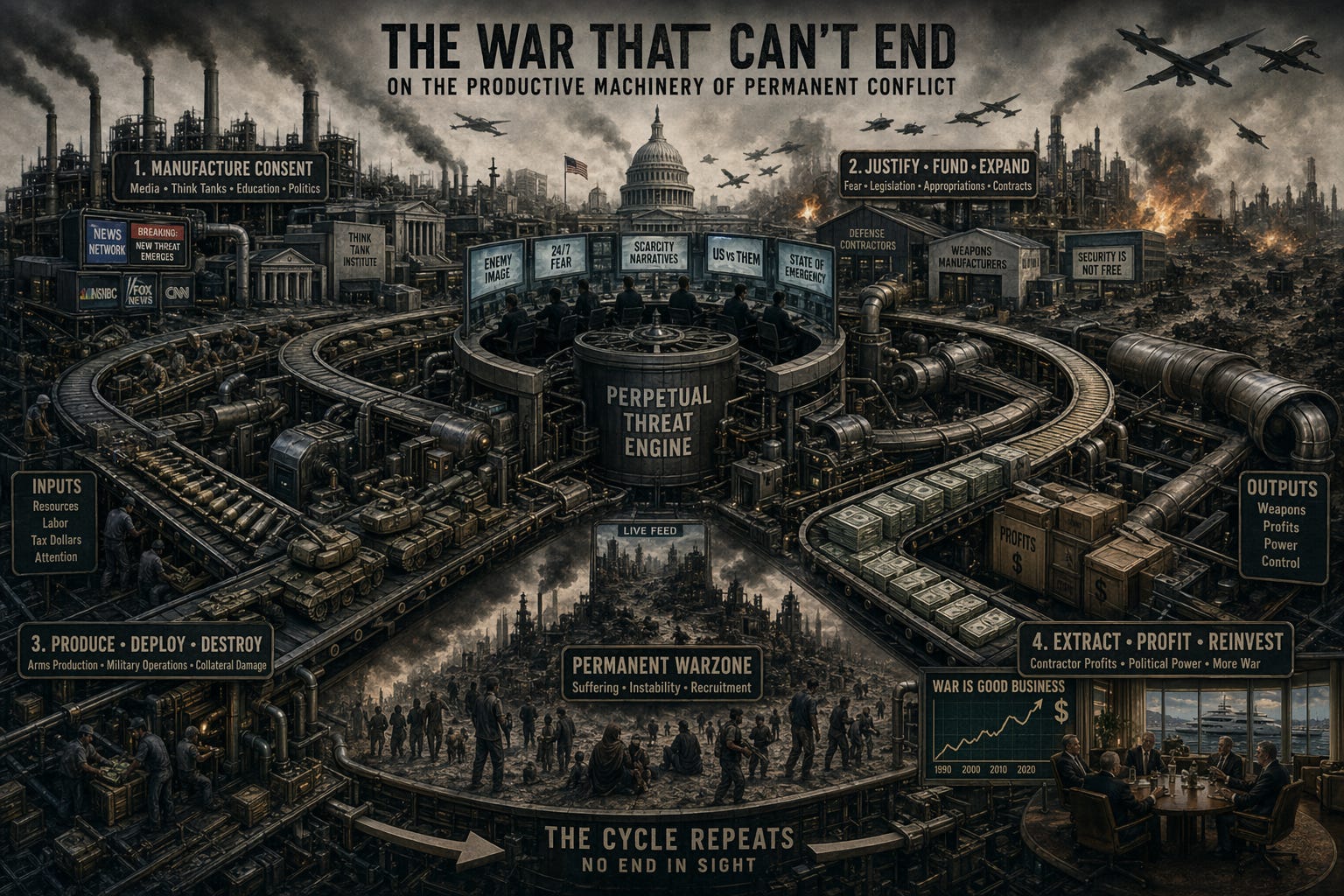
There’s a question that Western analysts have been asking about the war in Ukraine for three years now, and it’s the wrong question. The question is: how do we make this war costly enough that Russia just stops? Behind this question sits an assumption so deeply embedded that it rarely gets aired: namely, that Russia is trying to win, that winning means acquiring territory, and that a state calculating costs and benefits within a shared rational framework will eventually decide the price is too high.
That assumption is wrong. Not partially wrong, not wrong in its details, but wrong at a more fundamental level. And the consequences of getting the framing wrong — of designing strategy around a misdiagnosis — compound with every month that passes.
A more useful question, one that actually leads somewhere, is this: what does this war generate? Not what does it cost Russia. Who benefits from its continuation, and in what form does that benefit arrive? What would have to be true for the war’s productive mechanisms to become less valuable than peace?
These are harder questions. Uncomfortable too. But they’re the questions the situation actually demands.
Start with the domestic economy. Russia’s military spending has more than doubled since 2021, reaching something close to 7.5 per cent of GDP in 2025 — a figure last seen during the height of Soviet rearmament. That number represents not just expenditure but creation: new industries, new supply chains, new classes of employment in regions that had been deindustrialising for decades. Defence industrialists whose order books are now full for years ahead. Regional governors whose employment statistics depend on military production. A growing veteran class whose political expectations — of status, of material support, of recognition — the state has explicitly cultivated and must now permanently honour.
This is not the economy of a state trying to prosecute a war efficiently and return to normal. It’s the economy of a state that has reorganised its productive base around the war’s continuation. The longer it runs, the more deeply the restructuring embeds, and the more actors whose material interests become structurally opposed to any outcome that doesn’t include continued military expenditure. Demobilisation now threatens not just the war effort but the domestic political settlement that has formed around it. You can’t simply turn this off. As in the US, the machine has acquired its own constituency.
Nor is the financial architecture of the war only about Russia’s internal economy. There is a second productive function that receives far less analytical attention: the construction of post-war dependency relationships. Every month of continued destruction in Ukraine is a month in which the eventual reconstruction market — the contracts, the loans, the infrastructure projects, the financial instruments — grows larger and its terms become more favourable to whoever arrives first with capital and leverage. War, in this reading, is not simply a means of pursuing territorial ambitions. It’s a mechanism for pre-building the economic architecture of whatever comes after. The destruction is not a regrettable side effect of the strategic objective. Destruction is the investment.
This is not a novel insight. It has been the operating logic of reconstruction finance since at least the nineteenth century, and it has been demonstrated with particular clarity in the Middle East over the past two decades. The question it raises for Ukraine is uncomfortable but necessary: whose financial interests are being served by the continuation of this war, and are all of them Russian? Not at all. War destroys selectively. The reconstruction economy rewards whoever positioned earliest — and the queue, examined closely, is not exclusively Russian.
The economic argument is the more tractable one, because it involves interests that are in principle negotiable. The ideological argument is harder, because it involves something that resists negotiation almost by definition.
The Kremlin’s civilisational framework — the idea of Russia as a distinct and irreplaceable bearer of authentic values against a decadent West — is routinely described in Western analysis as propaganda: something manufactured by the state apparatus and deployed instrumentally to manage public opinion. This description is not wrong, but it’s dangerously incomplete. The framework has roots that extend back centuries, through the nineteenth-century Slavophile movement, through the concept of the Third Rome, through the Orthodox eschatological tradition that understands Russia as the last guardian of genuine Christian civilisation after the corruption of the West. Putin did not invent this. He activated it, drew on it, and deployed it in the service of a specific and immediate political programme. But the tradition he activated was present long before him and will survive him.
Patriarch Kirill of the Russian Orthodox Church — the institutional head of the tradition that provides the theological architecture for Russian civilisational certainty — has described the war in Ukraine not as a geopolitical conflict between states with competing interests but as a metaphysical struggle: the forces of an international liberal order promoting values incompatible with the authentic Christian civilisation that Russia embodies, and that Ukraine must be prevented from joining. This is not peripheral commentary from a religious figure on a political conflict. It’s the explicit theological justification for state violence, provided by the leader of a church with eighty million members to a government that has mobilised that church’s authority in the service of a war.
What this means, structurally, is that the war has a function within the ideological system that goes beyond the territory it is ostensibly being fought over. The sacred narrative of civilisational restoration — the unfalsifiable conviction that Russia is the bearer of something the world cannot afford to lose — requires ongoing validation. A Russia at peace with Ukraine, having accepted a negotiated outcome short of its stated civilisational objectives, is a Russia that must account for what the sacrifice was for. The war, even an inconclusive one, keeps the teleological narrative active. It provides the martyrological evidence the certainty requires. Peace would demand a reckoning with what the certainty has cost, and that reckoning is one the ideological system is structurally incapable of performing.
This is a meaningfully distinct danger from the one classical deterrence theory is designed to address. Deterrence assumes that the adversary is calculating costs and benefits within a framework where unacceptable costs eventually override strategic objectives. But if the costs are being reframed within the ideological system as the price of sacred obligation — if the suffering is not a deterrent but a proof, not evidence against the enterprise but evidence for it — then the calculus deterrence depends on has shifted in ways that Western strategic thinking has been systematically reluctant to confront.
Much recent Western analysis of the Ukraine war has organised itself around a useful but insufficient framework: the identification of illusions that distort Western strategic intelligence. Democratic transition as the expected outcome. Ceasefire as equivalent to peace. The existing toolkit as adequate to the task. These are real illusions and naming them is valuable.
But there’s a fourth illusion that the analysts fall for themselves, and it may be the most consequential: that somewhere behind the summits, the strategy papers, and the coordinated statements, a coherent Western actor exists with the intention and the institutional capacity to execute what the situation actually requires. The last three years have not revealed such an actor. Indeed they have demonstrated its absence.
This is not only a problem of the current American administration, though the US-Russia rapprochement — the pressure on Ukraine to accept territorial concessions, the easing of sanctions, the resumption of high-level military dialogue that had been suspended since before the invasion — has made it dramatically more visible. The deeper problem is that the institutional foundations for sustained Western strategic coherence were never properly built. The rules-based international order was always, in practice, selectively applied: universal in its rhetoric, interest-driven in its operation, visibly so to every population in the Global South that has been watching its workings over several decades.
The war in Gaza didn’t create this problem. But it has demonstrated it, at scale, with a clarity that has handed the Kremlin’s information apparatus something it could not have manufactured: the spectacle of the same Western governments invoking international law in Ukraine while providing arms, diplomatic cover, and institutional protection for conduct that the International Court of Justice and independent legal scholars have described in the gravest available terms. The Kremlin didn’t produce that contradiction. The West demonstrated it. Repeatedly. In ways that are visible to everyone whose support the West now requires for any durable strategic response to Russia’s aggression.
This matters. Not because of moral equivalence — the situations are not the same and the reflex toward that framing is itself a way of avoiding the point — but because of strategic capacity. The productive machinery of Russian information operations doesn’t need to fabricate stories about Western hypocrisy. It needs only to point them out. And the longer the pointing continues, the more the credibility that any effective counter-strategy requires is eroded at its foundations.
Returning to the question that was set aside at the beginning: not how to make the war costly enough that Russia stops, but what conditions would need to exist for the productive mechanisms of war to become less valuable than peace.
The economic answer is the most tractable. Sanctions have demonstrably weakened — alternative financial corridors have opened, Arctic trade routes are developing, the authoritarian supply network is maturing — and nothing arrests that trajectory. The more urgent question is the one barely asked: who captures the financial architecture of post-war Ukraine? That matters as much as who controls the front line. A strategy that leaves it unanswered is not a strategy. It’s a wish.
The ideological answer is harder but not impossible. The Kremlin tracks its own approval ratings obsessively, monitors public discourse, and invests heavily in narrative control — behaviours that reveal anxiety rather than confidence. Russia’s draft budget for 2026 cuts some military line items while increasing state media funding by more than half. The crackdown on VPN services accelerates. The push to migrate citizens onto government-controlled platforms intensifies. These are not the actions of a system certain of its ideological grip. Quite the opposite: the actions of a system that knows its grip is fragile and is racing to reinforce it before something slips.
The window for engagement in that space is narrowing. But the precondition for exploiting it is one that the West has so far been unwilling to meet: a credible demonstration that its own proclaimed values are not selectively applied, that the rules it invokes when Russian tanks cross Ukrainian borders are the same rules it enforces when its allies commit comparable acts in other jurisdictions. This is not a demand for moral perfection. It’s a demand for minimum credibility. Without it, every information initiative aimed at Russian domestic audiences will be neutralised by the evidence the West itself continues to supply.
The strategic answer — the fourth illusion’s answer — requires the West to do something it has historically found almost impossible: treat its own institutional incoherence as a strategic variable rather than a background condition. The fractures within the alliance, the selective application of principle, the gap between declared values and material behaviour, are not incidental weaknesses in an otherwise sound position. They are the load-bearing vulnerabilities that the machine of permanent conflict is designed to exploit. Addressing them is not a distraction from the strategic problem. It is the strategic problem.
There’s a symmetry here that Western analysis prefers not to examine. The argument that Douglass North’s work on institutional path dependence applies to Russia — that societies under stress reproduce the institutional patterns they already know — is correct, and important. But it applies with equal precision to the West. Both sides are, under pressure, reproducing what they already know: Russia reproducing imperial control and civilisational certainty; the West reproducing the selective, interest-driven multilateralism it always actually practised beneath the universalist rhetoric.
The machine of permanent conflict didn’t emerge out of nowhere. It was built in the space between what the West said it stood for and what it demonstrably did. Every time that space widens, the machine becomes more productive. Every time a Western government invokes principles it is simultaneously violating elsewhere, the ideological architecture of Russian civilisational certainty receives a structural subsidy it didn’t need to earn.
A durable peace — not a pause, not an intermission, but a condition in which Russia is neither willing nor able to sustain permanent confrontation — requires dismantling the machine, not just degrading its current output. That means engaging with who benefits from the war’s continuation and why. It means taking seriously the ideological system’s internal logic and finding the specific points where it is fragile rather than assuming it can be overwhelmed by cost. And it means, with clarity and without deflection, closing the gap between Western principles and Western practices to a degree that withdraws the most valuable resource on which the machine currently runs.
None of this is easy. All of it is necessary. The alternative — continuing to ask the wrong question, designing strategy around a misdiagnosis, watching the productive mechanisms of permanent conflict compound — is a choice, even when it doesn’t feel like one.
The gap between US principles and practices does not appear to be closing anytime soon.