
United in Principle
The Lingering Death of an Empire on Paper

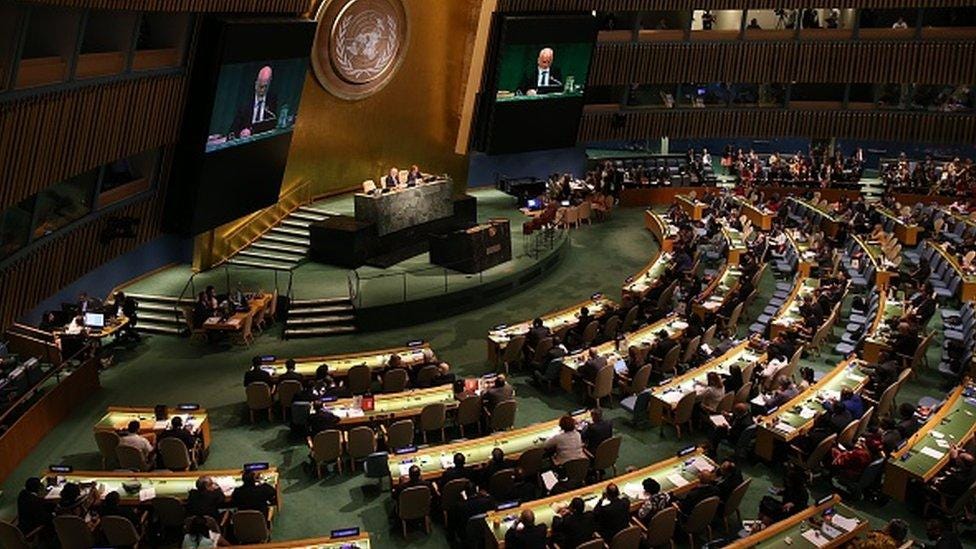
Over the past decade I have been very critical of the United Nations and its obvious inability to fulfil even its basic mandate. From time to time I’m asked whether the UN can be “fixed”, or whether we need some entirely new way of co-ordinating a civilisation on the brink of ecological, social and psychological exhaustion. It’s the wrong question of course, but a useful one nonetheless, because it exposes the habits of thought that keep us tethered to failing institutions and their obsolete methods of operating.
The UN is a relic of industrial modernity – a kind of constitutional prosthesis for the Westphalian nation-state. Conceived in the ruins of war, it encoded a simple bargain: sovereigns would restrain themselves, or at least stage their quarrels under fluorescent lights and microphones, because the memory of mass slaughter was fresh enough to shame them into a semblance of self-control.
That memory has now faded. What remains is a theatre. Five permanent powers clutch their vetoes like nuclear rosaries. One hundred and eighty-odd other states queue up to make plaintive speeches in the General Assembly, knowing full well that nothing fundamentally threatening to the strong will emerge from that chamber. Peacekeeping missions limp along where the stakes for major powers are low. Treaties accumulate faster than compliance. Much of the real action – sanctions, technological embargoes, currency manipulation, information warfare – occurs outside the UN’s legal canopy.
It’s fashionable to announce, with a certain smugness I suppose, that the UN has failed. That’s too generous. The UN didn’t fail so much as it succeeded on its own cramped terms: it helped stabilise an industrial order whose internal contradictions are now tearing it apart. Expecting the UN to coordinate a just, ecologically sane and genuinely pluralist world is like expecting a steam engine to run on sunlight. The machinery is wrong.
The more vital inquiry, then, is not whether we can replace the UN with some improved bureaucracy standing on the same metaphysical ground, but whether we’re willing to evolve the ground itself.
The Ghost in the Chamber
The UN Charter’s most persistent ghost is not the veto; it’s the unquestioned sanctity of the nation-state. Flags, anthems, seats, and votes – all presuppose that the primary actors in world affairs are territorially bounded corporate fictions called “countries”, each with an indivisible “interest” that can be bargained, threatened or appeased.
This picture was already inaccurate in 1945. Today it’s bordering on hallucinatory. Data flows, capital, pathogens, supply chains, carbon emissions, digital propaganda, synthetic biology, rare earths, climate refugees, freshwater theft – none of these respect borders, except as levers to be manipulated. Yet we insist on managing them through an architecture that treats sovereignty as sacrosanct and planetary interdependence as an afterthought.
What passes for global governance is therefore neither global nor particularly governing. It is, far more often, a game of appearances. Heads of government converge on glass boxes in New York, Geneva or Bonn. They issue communiqués and “frameworks” while treating the real levers of power – financial infrastructures, technological standards, military alliances, intelligence networks, cultural narratives – as external to, or at best adjacent to, the UN.
In that sense, the UN has become the official script of a drama whose plot has moved elsewhere. It retains symbolic legitimacy, juridical credence, and some useful machinery – the WHO, the IAEA, the WFP, UNICEF, and dozens of other agencies perform essential, often life-saving functions. But as an integrating intelligence for a planetary civilisation, it is at best rudimentary. At worst it legitimises the status quo by pretending that a “family of nations” still exists in any meaningful way.
The brutal truth is that the only truly global order we have is the market order – industrial economism dressed up as rational inevitability. It speaks the language of efficiency and growth while treating living systems as inventory. It lives beneath and behind the flags, binding them into value chains, credit structures, energy systems and digital enclosures. This order has no General Assembly. Its Security Council meets in boardrooms, hedge funds and defence ministries. Its veto is not a raised hand but a threat to withdraw liquidity or security guarantees. Any serious conversation about an alternative to the UN must therefore address this deeper empire, or it will simply recreate a more colourful version of the same thing.
BRICS, Beijing and the Mirage of a Second UN
The emergence of BRICS – and its recent expansion – is a symptom of that deeper shift. As the long arc of Western hegemony bends towards plurality, new centres of gravity are forming: Beijing, Delhi, Brasília, Moscow, Pretoria, and beyond. In much of the global South there is genuine hunger for a geopolitical vocabulary not written in Washington, London or Paris.
Could China, leveraging BRICS, design a rival multilateral system, then graciously invite the West to join it? The idea is not entirely fanciful. We have already seen fragments of such a project: the New Development Bank, the Asian Infrastructure Investment Bank, the Belt and Road forums, the Shanghai Cooperation Organisation. These are not trivial experiments. They represent tangible and genuine attempts to rebalance financial and infrastructural power.
But the fantasy of a neat “UN 2.0”, simply uprooted from Manhattan and transplanted to Shanghai, stumbles over at least three structural obstacles.
First, any institution visibly constructed as an instrument of one major power, however benevolent its rhetoric, attracts suspicion. In parts of the global South, the colonial memory is still raw enough that trading one patron for another feels like a poor bargain. Even within BRICS there are serious faultlines: China and India stare at each other across disputed borders; Russia seeks strategic depth in Beijing’s embrace while India deepens ties with Washington; Brazil oscillates between regional leadership and domestic turbulence. This is not fertile soil for a unified global architecture.
Second, the West itself – by which I mean not just the US and Europe but the broader Atlantic security-technology-finance complex – has no appetite to enrol as a junior partner in any Beijing-centred order. Where engagement is tactically useful, we see cooperation, as with some aspects of the Asian Infrastructure Investment Bank. Where core strategic advantage is threatened, resistance is immediate – through sanctions, export controls, alliance-building and information warfare.
Third, and most decisively, BRICS does not escape the underlying industrial worldview, nor does it make any attempt to do that. It disputes who should sit in the cockpit, but the aircraft remains the same: growth as salvation, extraction as normality, national prestige as organising myth, techno-military power as guarantor of “development”. Swapping the hegemon without transmuting that operating system merely relocates the control room of the same civilisation, now more crowded and volatile. That’s the crux of our problem.
The more likely trajectory is messier. BRICS and related initiatives will continue to erode the Western monopoly over finance and infrastructure. Parallel systems of payments, credit, logistics, standards and security co-operation will multiply. Some states will mix and match, participating in both Western-led and China-led arrangements. Others will be coerced or enticed into exclusive alignments.
Instead of one new UN, we will have overlapping constellations of partial authority: G20 for macroeconomics, climate clubs for decarbonisation, ad hoc coalitions for pandemics, corridor alliances for trade and technology, and a UN that still stamps treaties with symbolic legitimacy, even as its capacity to direct events declines.
Polycentric? Perhaps. Stable? Not necessarily. Transformative? No. At least only if something else shifts underneath.
Regional Mosaics and Functional Workarounds
Look closely and you can already see fragments of alternative ordering principles scattered across the landscape. The African Union, the European Union, ASEAN, the Organization of American States, the Gulf Cooperation Council, Mercosur, the Pacific Islands Forum – these are all embryonic attempts to transcend the narrowness of unilateral sovereignty without surrendering it entirely. They pool authority in some domains, such as trade, labour mobility, standards, and occasionally security operations, while stopping short of genuine confederation.
Their record is mixed. The African Union has shown a capacity to deploy peace missions and articulate continental priorities even as it wrestles with resource constraints and internal divisions. The EU has evolved an intricate, sometimes suffocating, juridical web that nonetheless anchors human rights and environmental protections more robustly than any other region. ASEAN, despite its doctrine of non-interference, provides a space where Southeast Asian states can at least whisper about common predicaments.
These formations are not miniature UNs; nor should they be. They are political experiments rooted in specific histories, cultures and wounds: colonisation, partition, dictatorship, genocide, the Cold War. Their very incompleteness is instructive. They remind us that global governance will not emerge as a seamless master-plan but as a bricolage of overlapping jurisdictions, values and practices.
A similar pattern appears around particular issues. The Paris climate process sits alongside informal climate clubs, green finance standards, activist networks, indigenous land defenders, corporate net-zero pledges, central bank pronouncements and sub-national policies. Global health is now shaped as much by philanthropic foundations, biotech consortia and regional disease surveillance networks as by the WHO’s formal resolutions. Cyber norms are negotiated through security alliances, private platforms and technical communities long before diplomats catch up.
In each case, the UN provides a stage and a legal frame, yet the real craftsmanship happens elsewhere, in networks that are agile, often exclusive, sometimes unaccountable, but undoubtedly more capable of adaptation than the UN’s General Assembly.
Is this patchwork sufficient to guide a civilisation away from systemic collapse? The evidence, so far, would suggest otherwise. Incrementalism within an obsolete civilisation rarely yields enlightenment. It delivers managed decline, at best.
Radical Blueprints: Attractive, Improbable, Incomplete
Minds accustomed to systemic design will inevitably reach for more radical sketches. Reform the Security Council. Expand permanent membership to include India, Brazil, at least one African state, possibly Japan or Germany. Limit the veto in cases of mass atrocities. Introduce qualified voting thresholds. Create a second chamber weighted by population or contribution to global public goods.
Establish a standing UN rapid reaction force for humanitarian emergencies – tightly constrained, rapidly deployable, backed by assessed contributions or even a modest global tax on financial transactions, aviation fuel or carbon. Entrust more authority to specialised treaties and agencies where expertise and technical consensus already exist. Give the WHO teeth for future pandemics. Rebuild a rules-based trading system that can incorporate ecological boundaries and labour dignity without being held hostage by every bilateral grievance.
All of this has been proposed, debated and, in some cases, carefully drafted. And yet, decade after decade, the reform window slams shut. The states that would have to ratify such changes are precisely those whose unearned privileges would be curtailed. They block; others lose interest; the machine chugs on.
Beyond UN reform, more sweeping ideas circulate: a concert of democracies; a planetary council representing major civilisational regions; binding global referenda on issues of planetary concern; legal recognition of the biosphere, or even the Earth, as a rights-bearing subject. These visions have ethical appeal; they speak to the intuition that fragments cannot manage what is now, unmistakably, a single living system.
The difficulty is not in drafting the blueprints. The difficulty lies in moving from architectural drawings to foundations when the current occupants refuse to vacate the site, and when their entire sense of identity – national, corporate, religious, ideological – is fused with the walls we’re trying to remodel.
So we return, again and again, to the uncomfortable realisation that no institutional redesign, however elegant, will suffice while the deeper cultural addiction to industrial economism remains unchallenged.
The Tyranny of the Operating System
Every institution, whether it calls itself a union, a league, an alliance or an assembly, runs on an invisible software – a set of shared assumptions about what counts as real, valuable, possible and desirable. The prevailing global software is brutally simple. It equates prosperity with material throughput, status with accumulation, security with dominance, and human worth with productivity and purchasing power. It measures nature as “resource” and society as “market”. It treats time itself as a commodity to be optimised.
Under such a programme, the UN, BRICS, the G20, NATO, the AU, the SCO and every other acronym of note are simply different graphical interfaces glimpsing the same code. They can modify the user experience, re-skin the icons, and tweak performance here and there. But they are bounded by the assumption that the purpose of international order is to enable industrial growth, to manage its by-products, and to contain its conflicts.
In that sense, asking whether BRICS can provide an “alternative” to the UN is akin to asking whether a new brand of petrol car can solve the problems created by the internal combustion engine. You might get better mileage. The underlying physics doesn’t change.
If we’re serious about alternatives, then the true contest is not between “institutions” but between operating systems. What kind of civilisation assumes that the Earth is a closed, finite, exquisitely interdependent home, rather than an open quarry? What kind of civilisation treats other species as cohabitants rather than inventory? What kind of civilisation abandons the fantasy of endless “growth” on a finite planet and discovers richness in regeneration, sufficiency, and shared meaning?
Without some embryonic answers to those questions, the design of global governance remains a game of rearranging deck chairs on the same sinking vessel.
Imagining Governance Beyond Empire
Let me risk a thought experiment.
Imagine a world in which the primary arbiters of legitimacy are not nation-states but caretakers of bioregions – river basins, forest zones, coastal shelves, savannahs – each responsible for stewarding the vitality of their patch within agreed planetary limits. These caretakers might be composed of existing states, indigenous nations, local communities, scientific councils, and even representatives for species or ecosystems whose “voice” is normally silenced and therefore unheard.
Their authority would not rest on flags or armies, but on measured capacity to maintain the health of the soils, waters, atmospheres and social fabrics entrusted to them. They would be bound by transparent thresholds: carbon budgets, biodiversity indices, food and water security, indicators of human flourishing that are not reducible to GDP.
Above them, a light but consequential planetary council could convene – not as a global government in the old sense, but as a forum for resolving conflicts between bioregions, sharing and harmonising innovations, negotiating fair resource transfers, and responding to crises that exceed local capacity. Its legitimacy would derive not from past victory in war, nor from inherited diplomatic privilege, but from a demonstrated capacity to speak for living systems as well as for human polities.
Is such an arrangement immediately workable? Of course not. It clashes with every established habit of sovereignty, property, corporate law and security doctrine. Yet versions of it are already visible in the struggles of indigenous groups defending watersheds, in the language of ‘Earth system boundaries’ emerging from climate science, in legal experiments granting rivers or forests a legal personality, and in the embryonic campaigns to recognise ecocide as an international crime.
Courts in very different cultures are starting to treat the atmosphere, not as an inexhaustible dump, but as a common inheritance they have a duty to defend; in a growing number of climate cases, judges have ordered governments to strengthen their policies on the grounds that a destabilised climate breaches basic rights to life and health. A small but significant group of constitutions now speak explicitly of obligations to those not yet born, sometimes backed by commissioners for future generations whose sole brief is to interrogate the long shadow of today’s decisions. Experiments with the “rights of nature” are spreading beyond a few emblematic rivers to forests, wetlands and whole ecosystems, allowing legal actions to be brought in their name, while financial regulators gingerly concede that tearing holes in the fabric of the biosphere is not just unfortunate collateral damage but a systemic risk that must be recognised in prudential rules. Taken together with the embryonic campaigns to recognise ecocide as an international crime, these moves sketch the outline of a jurisprudence in which sovereignty and property are slowly re-contextualised within deeper duties of care to living systems, rather than standing above them as untouchable idols.
If such lineaments were to coalesce, the UN, BRICS, and their kin would need to reinvent themselves in service to a different worldview - a worldview and world-system defined by what I have called ecority, or the guaranteed security of our species through ecological integrity. The UN’s agencies could be rewired to monitor and enforce ecological thresholds rather than serving as relief valves when those thresholds are casually breached. BRICS-type consortia could redirect investment from extractive mega-projects to restorative infrastructures that heal landscapes and communities rather than hollow them out.
But this requires that the industrial worldview loosen its hold on the collective imagination. It requires, in other words, that we cease to treat neoliberal capitalism as an inevitable fact of life and recognise it as one civilisation’s recent, and increasingly lethal, experiment.
For such sketches to mature beyond poetic conjecture they demand more than good intentions; they insist on a different toolkit of paying attention. The habits that built the United Nations, BRICS, NATO and their imitators were forged in a narrow corridor of perception – linear forecasts, zero‑sum strategy, bureaucratic risk management, the ritual theatre of elections and summits. Those reflexes are exquisitely tuned to yesterday.
A civilisation that aspires to steward whole bioregions, honour obligations to future generations, and treat rivers, forests or the atmosphere as juridical subjects cannot lean on the same mental scaffolding. It must cultivate non-binary methods that accommodate complexity rather than working against it: the detection of tiny, precisely‑placed acupunctural interventions that can re‑pattern the whole; foresight as disciplined rehearsal of multiple futures, not as a parlour game of prediction; high‑resolution digital simulations that allow us to test the consequences of our choices before we impose them on living systems; inquiries conducted within an “expanded now”, where past, present and possible futures are held in conversation rather than stacked along a straight line. Without that kind of cognitive infrastructure, even the most radical institutional designs will be quietly domesticated by the industrial worldview. With it, arrangements that currently sound implausible – bioregional guardianship, ecocide law with teeth, guardians for the unborn – begin to look less like utopian sketches and more like an emergent craft.
From Rule-Books to Conversations
Here we brush against another awkward reality. Governance, in any deep sense, is not primarily about rules written on paper. It’s about ongoing conversations among those affected by shared difficulties. Institutions ossify those conversations into procedures because they are anxious about the potential for volatility, dissent and conflict. Yet it’s exactly those elements – conflict, unpredictability, dissent – that often carry the seeds of renewal.
A viable global order in the twenty-first century must therefore rediscover the art of generative dialogue at scale. That sounds dangerously soft in a world trained to venerate hard power. But think of how social media already reorganises perception, allegiance and mobilisation across borders. Think of how diasporas, activist networks, scientific communities, hacker collectives and cultural movements weave transnational solidarities with far more agility than most governments.
These are crude, often chaotic, prototypes of a different fabric of governance – one where legitimacy flows as much from participation and responsiveness as from formal representation, and where institutions must continuously earn their relevance rather than rest on the laurels of charters drafted in a previous century.
In such a world, the UN could become less a static cathedral and more a dynamic marketplace of experiments: a place where regional compacts are tested, refined and shared; where global citizens’ assemblies inform treaties; where new guardianship models for oceans, atmosphere and commons are not just theorised but endowed with teeth. BRICS-like groupings could serve as crucibles in which dominant and emergent powers renegotiate the ethics of power, rather than simply trading places at the head of the table.
For this to happen, however, those who currently benefit from fossilised arrangements – governments, corporations, even the larger NGOs – would need to tolerate levels of transparency, accountability and distributed agency that they currently find intolerable. Governance would be less about controlling populations and more about orchestrating the capacity for sense-making along with distributed intelligence. That’s a profound cultural shift, not just a simple institutional reform.
What Remains of the UN?
Does this mean the UN is obsolete? Not quite. Not yet. For all its limitations it still anchors a crucial idea: that humanity, in all its diversity, can at least imagine itself as a single conversational community. That idea is imperfectly realised, constantly betrayed, frequently hijacked. Nevertheless, it’s not trivial.
A world without any such forum would be even more dangerous than the one we inhabit. We would be left with unmediated rivalry between empires, each armed with weapons capable of ending the human project in an afternoon.
So the sober answer, for now, is that we will live with the UN – patched, criticised, occasionally useful, often infuriating – while constructing a denser, more honest web of arrangements around and beneath it. BRICS and its successors will be part of that web, just as NATO, the African Union, ASEAN, the G20, and a thousand less visible networks will be. None of them, alone or collectively, will solve the mismatch between global interdependence and parochial politics.
Only a shift in the underlying narrative – from extraction to regeneration, from competition to mutual reliance, from unconstrained economic growth to sufficiency – can begin to align our institutions with the realities of a finite, living planet. Whether that shift arises through foresight or through catastrophe remains, at the time of writing, an open question.
In the meantime, we would do well to treat any proposal for a “new UN”, whether issued from New York, Beijing, Brasília or Addis Ababa, with the same inquiry: does this arrangement merely reshuffle power within the industrial paradigm, or does it begin to liberate us from it? If the answer is the former, then we’re tinkering with the script while the theatre burns. If the answer, even tentatively, is the latter, then that is where our attention, our imagination, and our courage are most needed.