

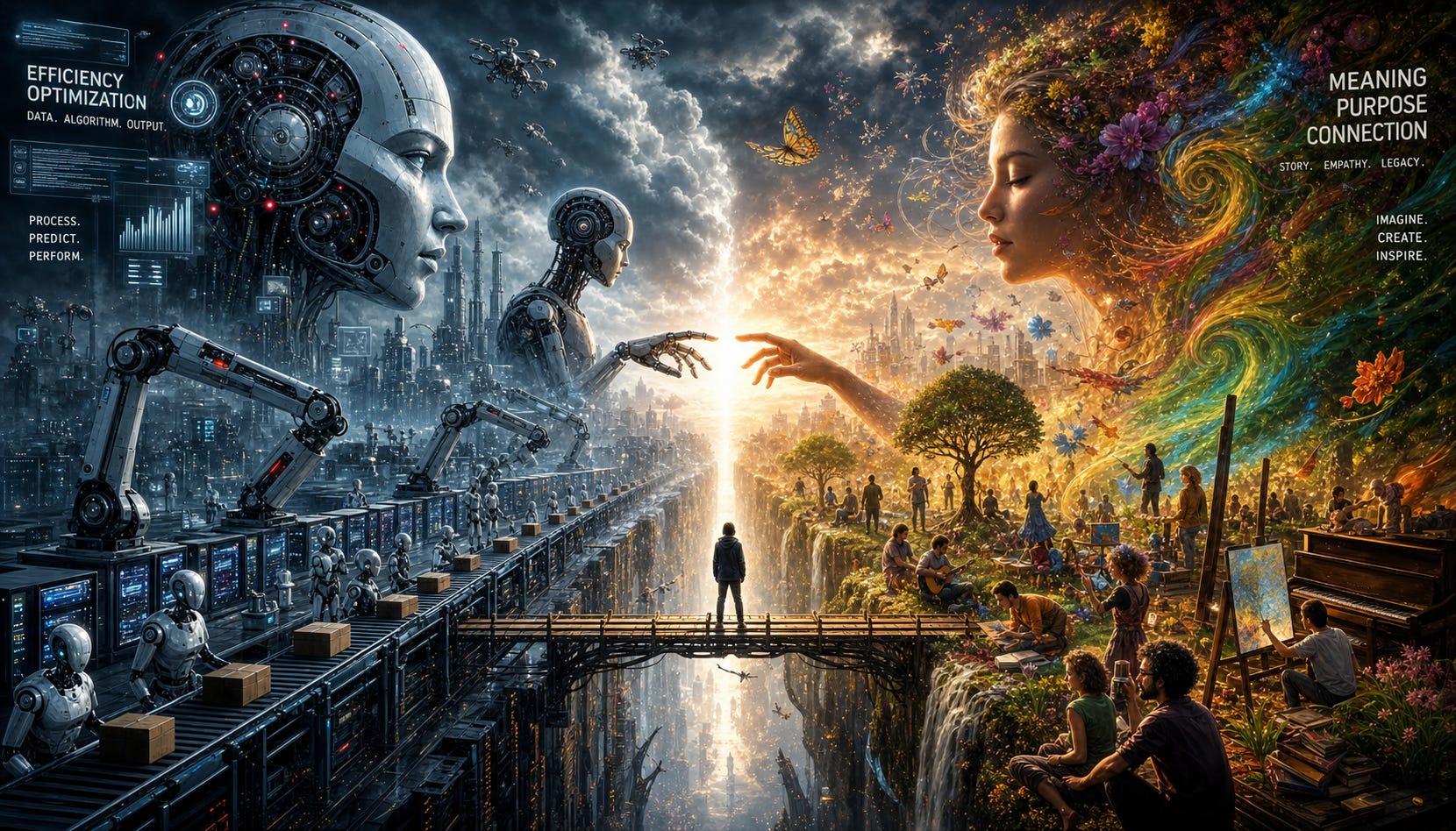
Eventually, every civilisation arrives at a moment when its technologies outrun its wisdom. We’re living in one such moment, and we have decided, with indecent yet almost joyful haste, to treat it as a market opportunity rather than a moral one.
Machines compose, paint, translate, summarise, and argue with a fluency that unsettles even those who built them — and industrial economism, ever alert to a newly discovered efficiency, has already begun pricing the soul out of the curriculum. Departments of literature shrink. Philosophy is asked to justify its existence in units of employability. Music, history, art – disciplines that once encouraged Homo sapiens to be a species that reaches for aesthetic perfection – are filed under discretionary spending. This is not an accident of budgeting. It’s the visible edge of a much older confusion about what a human life is actually for.
The case for the humanities has usually been made defensively, as though beauty and meaning were luxuries to be rationed once the serious business of productive growth and consumption is dutifully accounted for. That framing has always been a submission – to materialism, to utilitarianism, to the technocracy, to the presentist reflex that starves anything whose return is generations away – and it is now a dangerous one. The humanities are not the ornamentation on the surface of our civilisation. They are its core architecture — the load-bearing structure through which a society decides what matters, what is owed, and to whom. Strip that architecture out and the building becomes uninhabitable.
Consider what we’re actually automating. Artificial intelligence is extraordinarily capable at patterning, synthesis, and prediction — the machinery of cognition. But large language models are just “stochastic parrots” – sophisticated pattern-matchers without any genuine kind of understanding. What AI cannot do, and shows no evidence of learning, is grieve. It cannot be ashamed. It cannot fall in love with a haiku or sonnet for reasons it can’t fully explain or sit with an ethical dilemma that has no clean resolution and choose, anyway, to act with care.
Something fundamental has inverted in the last few years, and most institutions have not yet metabolised it. Information, for most of history, was the scarce resource — the fact was hard to find, the source hard to reach, and the analysis hard to produce. All three are now nearly free and nearly infinite, available to anyone with a prompt and a few seconds of patience. What remains scarce, and grows scarcer as information multiplies, is the judgement to know what any of it is for. Meaning has discretely become the bottleneck that information used to be. A curriculum built for an age of scarce information is now training people for a problem that no longer exists, while leaving the actual bottleneck almost entirely untaught.
There is a further irony worth sitting with. The very parrot doing the stochastic mimicking was trained on the accumulated humanist record — on plagiarised novels, essays, paintings catalogued and described, centuries of philosophical argument, and poetry translated and retranslated by people who cared enough about a single word to spend a lifetime on it. The machine didn’t invent its fluency. It inherited ours, compressed and redistributed at a speed no human tradition ever moved at. And now the civilisation that fed it is defunding the discipline that produced the feast, as though the meal could go on being served after the kitchen has been closed.
These are not decorative embellishments appended to intelligence. They are the terrain on which intelligence becomes wisdom. A civilisation that offloads its calculations to machines while starving the disciplines that teach discernment is not becoming smarter. It is becoming faster and shallower at once, and mistaking the first for the second.
The usual response to this acceleration is to redirect education toward technical literacy — more coding, more data science, more of whatever skill the machines have not yet mastered. This upends the logic. If calculation is precisely what is being automated, then calculation is no longer the scarce capacity a curriculum needs to protect. Empathy is. Discernment is. Creative thinking is. The more fluent our machines become at analysis, prediction, and synthesis, the more of a society’s educational effort must go toward the disciplines that teach a person what to do with an answer once it arrives — whether to trust it, determine whom it serves, what it costs someone else, and what it cannot say. This is not a case for holding humanities funding steady while technical education expands around it. It’s a case for redirecting the balance the other way, since the very success of the machinery is what is depleting the human capacity it depends on to be used well.
This is where the trinary becomes indispensable — our obligations to one another, to those not yet born, and to the living systems that hold us all in place. None of these obligations can be computed. They can only be felt, argued, dramatised, mourned, and renewed — which is to say, they can only be carried by the humanities. A tax code can allocate resources across generations. It can’t teach a person why the allocation matters or make them weep at what is being lost on a reef, in a language, in a grandmother’s memory. Poetry can. History can. A well-told story about a war nobody won can do more to prevent the next one than any treaty, because treaties bind states and stories bind hearts, and only hearts refuse to fight.
It is worth mentioning, too, that the people carrying this discipline rarely do so from security. The artist, the adjunct historian, and the poet-teacher piecing together a living from three institutions at once are asked to hold civilisation’s memory and conscience while being paid as though the task were a hobby. A society serious about the argument this essay is making would not only redirect curricula. It would pay, properly and without embarrassment, the people doing the remembering — because a discipline staffed by the exhausted and the underpaid cannot sustain the very depth it is being asked to supply.
There’s also a civic dimension to this, sharper than aesthetics and more immediate than grief. Discernment is not only what tells a person whether to trust their own choices — it is what tells a public whether to trust the story it is being sold. A citizenry untrained in reading argument, tracing rhetoric back to its interests, or recognising the shape of a manufactured consensus does not simply make weaker private judgments. It becomes governable by whoever owns the most persuasive machine. Propaganda has always needed an audience incapable of noticing its own manipulation; the humanities were, for a very long time, the discipline that made such an audience harder to produce. Erode that discipline and self-governance do not fail loudly. It dissolves quietly, one algorithmically optimised feed at a time, until the public no longer notices what has been decided on its behalf.
I think of artists, historians, anthropologists and philosophers now as something like imaginal cells — those unassuming clusters inside the caterpillar that begin, quietly and against the organism’s own immune response, to imagine the shape of a butterfly it cannot yet see. If the paradigm of industrial economism is a caterpillar, then its immune system is capitalism: its job is to identify anything that does not immediately convert to yield as a threat and to attack it. This is why humanities funding is always the first line cut and the last line restored – not because the discipline lacks value, but because its value can’t easily be metabolised by a system built to measure only throughput. The imaginal cells persist anyway. They always have. That’s their nature and, I would argue, their evolutionary function.
There’s a rhythm profile to human meaning that no large language model has yet been asked to learn, because no model has been asked to suffer, to raise a child, to bury a parent, or to stand in a gallery and be rendered speechless by the radiant light of a Rembrandt painting. Syntrophic inquiry – the deliberate feeding of one way of knowing into another – depends on precisely this range: the scientist needs the poet’s precision with ambiguity, the engineer needs the historian’s memory of what happens when power forgets its limits, and the technologist needs the philosopher’s stubborn insistence on asking what a creation is for before asking how fast it can be built. Remove any one strand and the fabric tears in a direction nobody predicted, usually at the worst possible moment.
None of this should excuse the humanities from their own reckoning. Too many departments retreated into a specialised vocabulary that speaks mainly to itself, mistaking difficulty for depth and insularity for rigour, and a public asked to fund what it cannot follow will eventually stop asking why. That failure is real, and it has cost the discipline allies it could not afford to lose. But a professional culture’s failures of translation are an argument for reform, not for abandonment — the coral reef is not less worth grieving because the ecologist explaining its loss used the wrong words. The task now is to rebuild the bridge, not to demolish the far shore because the bridge fell into disrepair.
We are told, often by people who should know better, that this is an engineering problem requiring an engineering solution — that the right algorithm, the right governance framework, and the right set of management guardrails will see us through. But guardrails are built by people who already know what they are protecting, and that knowledge is not technical. It is cultivated, agonisingly slowly, by exposure to Sophocles and Stockhausen; to Rābiʿa al-ʿAdawiyya and Sei Shōnagon; to Bach and the blues; to the felt weight of the gravity of ghosts — all those unresolved obligations to the dead who still shape what the living consider virtuous and beautiful. A society that has stopped reading its own tragedies loses the capacity to recognise one when it is standing inside it.
None of this is an argument against science, or against the astonishing digital tools now arriving at such speed. It’s an argument against sequencing them without a compass. The art of wayfinding was never about needing a map; it was about developing the judgement to move fluently and mindfully without one, guided by stars that don’t change even when the terrain beneath your feet does. The humanities are that judgement, externalised and passed down across centuries in the only durable form available to a species too impatient to remember on its own – story, image, argument, and song.
At this juncture, with intelligence itself being redefined by machines that mimic our fluency without sharing our finitude, we are asked, urgently, to what purpose we intend to remain human. Efficiency will not answer that question, because efficiency was never built to ask it. Only the humanities were built for this — to keep insisting, against every economic pressure to the contrary, that meaning is not a market failure to be optimised away but the entire point of the civilisational exercise. If we cut that discipline loose now, in the mistaken belief that machines have made it redundant, we will not simply lose an academic department. We will lose the last remaining place where a species learns, generation after generation, how to be worthy of its own unique intelligence.
So the curriculum should not simply hold its ground. It should tilt, deliberately and without apology, in proportion to every gain the machines make on our behalf — because each new increment of speed they hand us is also a new increment of judgement we will be asked to supply. This is not a hedge against disruption. It’s the price of it, paid in advance. A civilisation that lets its analytical power grow while leaving its discernment untended is not preparing its young for the future; it’s arming them for a threshold they have never been taught to cross.
It goes without saying that this is not just a matter of curriculum. When information is virtually free, meaning becomes the real scarcity, and a public untrained in supplying it is a public available for the taking — usually by whoever writes the most persuasive prompt. Meeting that threshold honestly will cost something beyond syllabus reform. It will mean paying, properly, the people already doing this work on the discipline’s behalf—the underfunded historian, the adjunct poet, and the artist patching together three jobs to keep making that which a market cannot yet price. No civilisation has ever protected a capacity it refused to fund.
The curriculum that meets this moment honestly will not treat the humanities as a counterweight bolted on for balance. It will treat them as the ballast without which the whole vessel, however fast it now moves, capsizes the first time the water turns turbulent.