
What The Text Does Not Say
In defence of authenticity in authorship

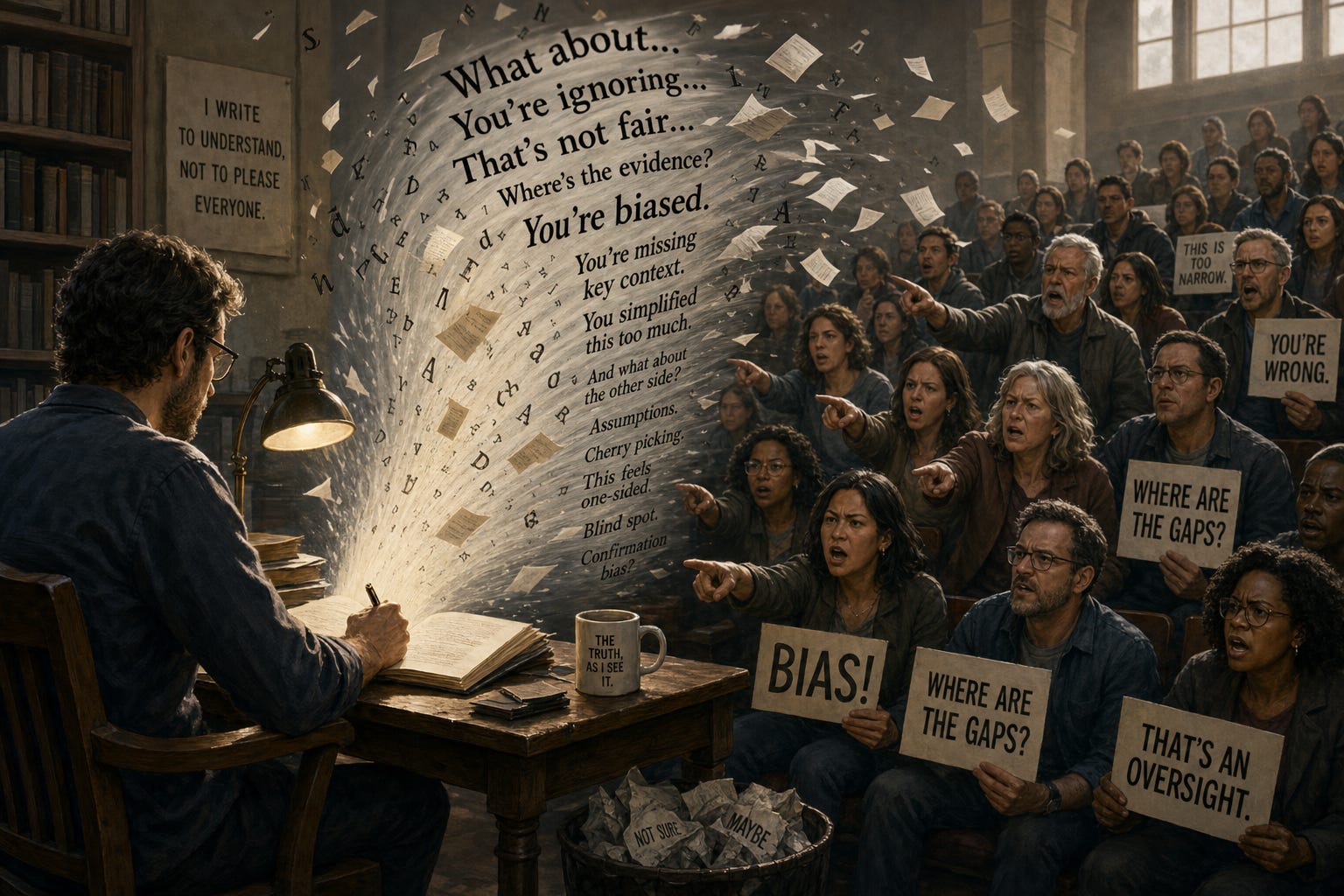
Someone writes to tell me I have missed the point. Not my point — theirs. I failed, apparently, to address a particular case, omitted a detail they consider essential, and neglected an angle that would have complicated my argument. The implication is that the piece is therefore incomplete. Deficient. That I owe them more than I gave.
I have been receiving versions of this letter for forty years.
There’s something I want to say to those readers, not in irritation but in genuine puzzlement, because I think the complaint reveals a misunderstanding so fundamental it’s worth examining openly. It is this: selection is the argument. What a writer leaves out is not an oversight or a failure of nerve. It is, very often, where the real thinking happens — in the long and sometimes painful process of deciding what the work doesn’t need to carry.
When I am deep in a manuscript, the decisions that cost me the most are not about what to include. They are about what to cut. Every omitted case, every withheld example, every tangent I chose not to follow — these represent hours of consideration. The path the work takes is defined as much by what it refuses as by what it pursues. To then be told that the path should have gone somewhere else, visited some other acre of the forest, covered more ground — this is not a critical observation. It’s a plea for an entirely different article or chapter.
I understand where the impulse comes from. We live inside an information model of writing, one that treats a text as a container for facts and arguments, measured by its completeness. A gap in coverage looks like negligence. Every omission becomes an accusation. But this model belongs to encyclopaedias and technical manuals — not to essays, not to philosophical writing, and especially not to anything that’s actually trying to move thought rather than catalogue it.
An essay that tried to address every relevant case would dissolve into mush. It would lose the very quality that makes it worth reading: the sense that a particular mind has been to a particular place and come back with something specific to say. Comprehensiveness, pursued honestly to an endpoint, is paralysis. The footnote that must acknowledge every counter-example eventually swallows the chapter.
There is, I should be fair, a legitimate version of the objection. Sometimes a reader identifies something genuinely structural — a case that, had I engaged with it candidly, would have fractured my argument at the load-bearing point. That’s not a demand for completeness. That is an intellectual wound, and it deserves attention. I have had those letters too, and they are valuable, even when they sting. The difference is usually apparent. The genuine challenge names something specific and explains why it matters to the argument’s architecture. The other kind simply gestures at the unmapped terrain and calls the map inadequate.
What seems to disturb the second kind of reader most, I think, is not the omission itself but the confidence that preceded it. A piece of writing that knows its own shape — that proceeds without apologising for what it has chosen not to be — implies that the writer made a judgement. And judgements can be wrong. The ‘but what about’ is sometimes less a critical response than an attempt to destabilise that confidence, to refuse the authority that comes with having decided what the work is about.
I am not immune to doubt. Every piece I publish carries a residue of uncertainty about whether the choices were right — whether the path I carved was the right one. But I have learned, slowly, to trust that process. The uncertainty is part of the work. What I am not prepared to do is apologise for having a focus or pretend that the absence of something is the same as an argument’s failure to account for it.
There is also, I think, a generosity that readers owe writers — one that the current reading environment makes increasingly difficult to extend. To receive a text on its own terms first. To follow the path before asking why it did not become a different path. To hold the provisional trust that the choices were not arbitrary, that something deliberate is seeking the light. That discipline requires patience. It requires a willingness to be taken somewhere rather than to arrive already knowing where you should have been taken.
I write, at this point in my life, for readers who are willing to do that. Not because I want to be unaccountable—quite the opposite in fact. I want the accountability that comes from being read closely and accurately on the work’s own ground. What I find harder to meet is the reader who arrives already holding a different argument in their head and measures what I have written against its absence.
♦
Then there’s the other note. Not the demand for completeness but the charge of bias — and therefore wrong. Or compromised. Or disqualified from the argument. Or even immoral!
This one arrives more often than the omission complaint, and it carries a sharper edge, because it’s not really about the writing at all. It’s about the writer. The move is to locate a position — a provenance, an allegiance, a history — and use it to contaminate the argument before the argument can be heard. You are Australian. You are Western. You have worked with governments. You have not been there, so how can you know? You have not lived through what I have lived through. Therefore...
The logical name for this is the genetic fallacy: the idea that the origin of an argument determines its validity. It’s a fallacy because it isn’t true. The origin of a thought or argument tells you something worth knowing — context is never irrelevant — but it doesn’t tell you whether that thought or argument is correct. A person with every conceivable bias under the sun can observe something accurately. A person with impeccable credentials and lived experience can be profoundly wrong. The two questions — who is saying this and is it true — are related but distinct, and collapsing them is an intellectual shortcut dressed up as rigour.
I have been called biased from so many directions simultaneously that I have come to regard it as a reasonable sign I am doing something right. When the accusation arrives from the left and the right, from nationalists and internationalists, from those who think I am too harsh on Western institutions and those who think I am not harsh enough, the word starts to lose its traction. Everyone is situated. Everyone carries the sediment of their formation. The question is not whether bias exists — it invariably does — but whether it’s been acknowledged, whether the argument can survive scrutiny on its own terms, whether the reasoning holds when you test it against evidence and logic rather than against the writer’s biography.
What the bias accusation often does, in practice, is relieve the reader of any obligation to engage. It’s remarkably efficient in that regard. Rather than identifying where the reasoning fails, rather than producing counter-evidence or exposing a flawed inference, the reader simply names the source as tainted and steps back. The argument is not refuted. It is quarantined. This feels like critical thinking. It has the surface texture of scepticism. But it’s closer to its opposite — a way of avoiding critical thinking, dressed in the language of epistemological caution.
There is a version of this I take more seriously, and it’s the one that goes further than the accusation. The reader who says, ‘Here is where your position has shaped your reading of the evidence, and here is what a different reading produces’ — that reader is doing genuine intellectual work. They are not using bias as a conversation-stopper. They are tracing it into the argument’s tissue and showing how it operates. That I can work with. That is, in fact, exactly the kind of challenge that sharpens thinking rather than foreclosing it.
But that version is less frequent than it should be. More common is the gesture toward the writer’s location as though the location were itself a verdict.
The consequences of this, in a climate of accelerating political sensitivity, are no longer merely intellectual. They are professional and financial and, in some cases, irreversible. I know this from direct experience. Several months ago I was accused of antisemitism — a charge so remote from anything I have written, so dependent on what was assumed rather than read, that I could not at first take it seriously. I took it seriously soon enough. Three keynote engagements were cancelled. No one who made those decisions had engaged with the actual work. The accusation had done its job without any assistance from evidence.
I am not alone in this, and that is precisely why it’s worth stating here. The mechanism is now routine across intellectual and public life. A writer, a speaker, a thinker is located — placed within a presumed allegiance and assigned a position they may never have held — and the location is treated as sufficient. The text is not read. The argument is not tested. The charge circulates, and institutions, understandably terrified of association, respond before anyone has looked closely at what was actually said. Political correctness, at its worst, is not the protection of the vulnerable it presents itself as. It’s the replacement of reading with assumption, of argument with accusation, of conversation with quarantine.
What makes the antisemitism charge particularly instructive as an example — I use it because it happened to me, not to make myself the subject — is the moral weight it carries. It is precisely because the charge is so grave that institutions act without waiting for evidence. The gravity that should demand the most careful scrutiny instead produces the least. The heavier the accusation, the faster the verdict, and the less anyone feels obliged to open the book.
I am biased. Of course I am. I have lived a long and particular life across cultures and disciplines and political upheavals, and all of that is present in how I see the world. I don’t write from nowhere — nobody does, and anybody who claims otherwise is either deceiving you or themselves. What I try to do is be as transparent as I can about where I am standing, to name my assumptions when I’m aware of them, and to build arguments sturdy enough that they can be examined and challenged on their own terms rather than dismissed because of who built them.
The alternative — writing that pretends to be view-from-nowhere, that performs a false neutrality, that bleaches out the particularities of a situated intelligence in favour of a voice that sounds like it came from no one — is not any less biased. It’s more dangerous, because it has concealed its true position rather than declared it openly.
So yes, I am biased. Read accordingly. Bring your own situated intelligence to bear on what I have written. Find where my position has distorted my vision, if you can. Tell me specifically. That conversation I will gladly have.
What I will never accept is the accusation as a substitute for the conversation.
I suspect that those who react this way are uncomfortable with what you have said, want to critique it, but lack any foundation for doing so. Painting themselves into a corner of critiquing the text without engaging with it, they punt to something outside the text without identifying how it should belong.
I love your work. I think you write beautifully. I don't always agree with the points that you make; in fact, I often disagree. What makes your work special is that your written word engages my brain and stimulates thought. Very often, it stimulates thinking in areas I wouldn't ordinarily spend any mental energy on.
One issue I have with your work, and with other writers, perhaps more so, is that you create essays that are more like a paper that one would turn in for an assignment their professor gave them. You cite too many supporting works, explain your point too thoroughly, cross too many t's, and dot too many i's. You repeat the main point. Very often, you and the other writers have an important observation to share, a fact that people really need to know, a trend that really IS alarming, and your message is lost in all of the supporting verbiage. Your written thoughts are just TLTR. (Too Long To Read).
I have to wonder if your motive for writing is to pass along information or to prove yourself as a worthy author? (Honestly, you're not nearly as bad as other SubStack writers I read.)
Sooo, your piece claims that the really hard work in creating it often lies in what to leave out. I commend the hard work you do and suggest you work even harder. (Please don't take this the wrong way.)