
When Truth Becomes Casualty
The Risks of Moral Certainty in an Age of Misinformation

There’s a particular rhythm to walking in Bangkok. The heat has a weight to it—something you push against rather than move through—and the foot traffic adjusts accordingly. People don’t stroll; they pick their way with the economy of those who know that hesitation can cost more than a moment. It costs space, momentum, and sometimes the entire crossing.
I have been thinking about that economy of movement lately, though not in terms of either heat or crowds. I have been thinking about how we navigate contested ground when the ground itself keeps shifting beneath us. About what it costs to hesitate when the thing at stake is not a crossing but a truth.
What we’re witnessing in the aftermath of October 7 is not only a battle over land, sovereignty, or justice—though it is certainly all of those things. It’s a battle over something more foundational, and therefore more fragile: the essential anatomy of how we know what we know.
A report lands. It’s delivered by Pramila Patten to the United Nations Security Council. It finds “reasonable grounds” to believe that sexual violence—rape, gang rape, and other atrocities—occurred during the attacks of October 7 and may still be occurring against hostages still held. The source is not a partisan actor. It’s not the Israeli government. It’s the United Nations, an institution whose relationship with Israel has been, to put it mildly, complicated.
Here, then, is something that might—in a functioning epistemic order—serve as common ground. Not as the final word, perhaps, but as a point of departure. Evidence. Investigative. Documented.
And yet...
In certain quarters, the response has been not engagement but dismissal. Not interrogation of the evidence but erasure of it. The report is ignored, distorted, or waved away with the casualness of someone brushing a fly from the table.
This is where the real danger begins. Not with disagreement—disagreement is the lifeblood of any healthy democracy—but with the refusal to let credible evidence land. With the decision, before the fact, that some truths are inadmissible because they would disturb the preferred narrative.
The philosopher Hannah Arendt, writing about a different darkness, observed that the greatest danger of totalitarianism was not that it imposed one lie, but that it destroyed the distinction between truth and falsehood. When that distinction collapses, what replaces it isn’t freedom but its shadow: the freedom to believe whatever serves the moment, unmoored from any shared reference point.
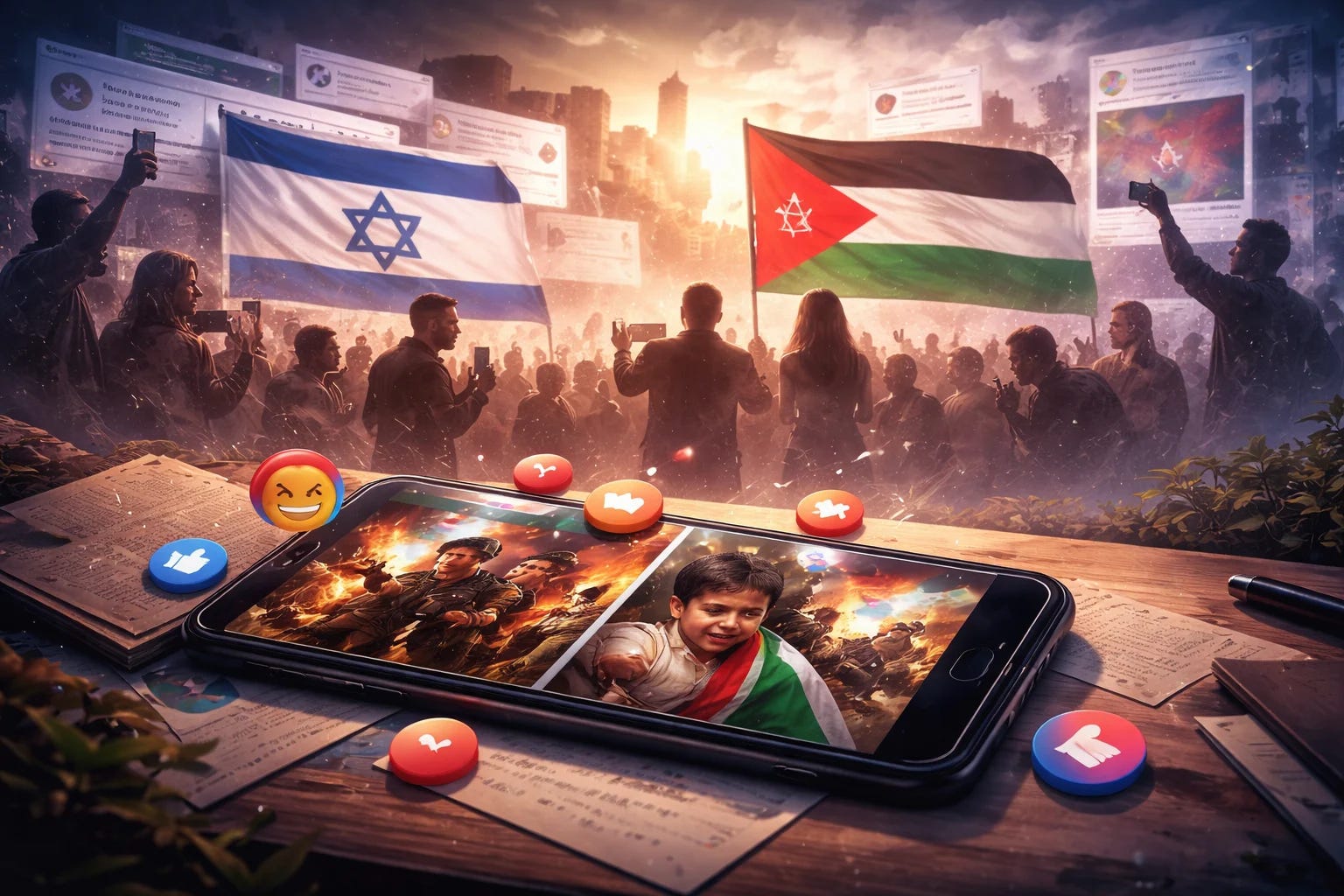
We’re not living in Arendt’s world. But we are living in one where the shards of that logic have scattered across public life. And social media—that vast engine of outrage and amplification—has proved itself a remarkably efficient broker.
The dynamic is familiar by now. A young person with a large following speaks out. The algorithm rewards certainty over complexity. So complexity is edited out; contradiction is flattened. What emerges is posture, pure and simple. And because most followers don’t distinguish between the two, posture acquires the weight of authority it has not earned.
This is no trivial matter. It’s a question of what happens when influence outpaces understanding. When the mechanisms of reach detach entirely from the apparatus of accountability. And when a statement about a multifaceted geopolitical reality is judged not by its fidelity to evidence but by its fit with tribal affiliation.
Let me be precise about what I am not saying.
I am not saying that criticism of Israel—or of any state—should be silenced. Robust, informed critique is essential. It’s the oxygen of democratic life. I am not saying that the United Nations is beyond reproach; its record on Israel is uneven at best. Nor am I saying that the Patten report is the last word on anything or that its findings can’t be contested on evidentiary grounds.
What I am saying is that there’s a difference between contesting evidence and ignoring it. This difference is not technical. It is moral. And it seems to be disappearing.
The consequences are threefold, and they compound one another.
First: the erosion of epistemic integrity. The shared understanding of how we know what we know. Without a baseline respect for evidence—without the agreement that some things are true and some are not, and that the difference matters—public discourse fragments into mutually exclusive realities. Dialogue then becomes impossible. What remains is accusation and counter-accusation, each side inhabiting a world from which the other is excluded.
Second: the moral hazard of asymmetrical empathy. There’s a pattern, visible across contemporary politics, in which the suffering of one group is elevated by the minimisation of another’s. But empathy isn’t a zero-sum game. The refusal to acknowledge credible reports of sexual violence against Israeli women doesn’t automatically elevate the suffering of Palestinian women. It diminishes our collective capacity to recognise atrocity, whoever its victims are.
Third, and most dangerously: the historical echo. The Holocaust didn’t begin with gas chambers. It began with the steady erosion of truth. The normalisation of falsehood. The dehumanisation of a people, accomplished first through innuendo before it was accomplished in policy. History doesn’t repeat in simple cycles. But it offers patterns. And we shouldn’t ignore that fact.
I don’t invoke history lightly. To do so is to risk that which I am warning against: the weaponisation of memory for political ends. But I invoke it because the mechanism is the same. The slow corrosion of any distinction between what’s true and what’s useful. The substitution of tribal loyalty for intellectual integrity. The ranking of human suffering according to political convenience.
These are not Jewish problems. They are not Israeli problems. They are human problems. The operating system of our age—the logic of extraction, of outrage as currency, of the algorithm that rewards certainty and punishes doubt—presses against all of us. It doesn’t ask us to be wrong. It asks us to be certain. To perform conviction rather than to inhabit inquiry.
This is the deeper terrain worth examining. Not left versus right. Not pro- versus anti-. Those are the coordinates of the worldview under interrogation. To argue from within them, even to oppose them, is to remain captured by them.
What is required instead is something older. More difficult. More expensive. Intellectual discipline. Moral consistency. The humility to acknowledge that complexity demands more than impulsive judgement. The courage to hold multiple truths at once, even when they are uncomfortable. The willingness to say: ‘I don’t know, but I will find out.’
Before we speak, we might ask ourselves: Have I read the primary sources, or just what someone else said about them? Do I understand the evidentiary thresholds being used, or am I judging findings by standards I haven’t even examined? Am I willing to hold that more than one thing can be true—that the violence of October 7 was real and the violence in Gaza is real and these truths don’t cancel each other out but rather coexist in the terrible atrocities of this moment? Am I comfortable with not knowing?
That last question is the hardest. Because not knowing can be distressing. But it’s also the only ground from which genuine understanding can grow.
In an age of instantaneous communication and amplified opinions, the responsibility to tell the truth—or at least to seek it sincerely—has never been greater. The alternative isn’t just misunderstanding. It is the slow, collective surrender of reality itself. The substitution of narrative for evidence. The replacement of dialogue with performance. And once that surrender is complete, what remains is just the management of antagonism and hatred.
We have seen this before. Not in this form, perhaps. Not with these technologies, these platforms, these speeds. But the shape is recognisable. The pattern is clear. The question is whether we have the discipline to see it. The courage to name it. The humility to step back from certainty long enough to let evidence land.
We’re all moving through contested ground now. The heat is real. The pressure is real. The temptation to move faster than our understanding can sustain is real. But the ground will not hold if we refuse to see it as it really is.
Truth is not the first casualty of war. It’s the first casualty of the decision, made in advance, that some truths are not acceptable and cannot be admitted. Will we make that decision? Or will we resist it – with discipline, with courage, and with the patience of building a shared world from the fragments we’ve been given?
Resistance offers only the possibility of knowing what’s true, and the dignity of being accountable to it. But that surely should be enough?